
Plus One Business Studies Notes 2026-27 (New Syllabus) | Kerala SCERT Chapter Wise PDF
Last Updated: July 2026 | 📚 Class: Plus One (Class 11) | 📖 Subject: Business Studies | 🏫 Board: SCERT Kerala
Looking for Plus One Business Studies Notes 2026-27 based on the new SCERT Kerala syllabus? This page has complete chapter-wise notes updated for the revised SCERT Plus One Business Studies textbook 2026-27, prepared by expert HSST Commerce teachers from Kerala.
Business Studies is one of the most practically relevant and scoring subjects for Kerala Commerce stream students. It forms the foundation for careers in management, marketing, finance, entrepreneurship, and MBA.
കുറിപ്പ്: Competitor sites-ൽ Business Studies notes incomplete ആണ്. ഈ page-ൽ full 2026-27 new syllabus ഉൾക്കൊള്ളുന്ന complete notes ഉണ്ട്.
Plus One Business Studies Notes 2026-27 New Syllabus Kerala
Download Plus One Business Studies Notes 2026-27 based on new SCERT Kerala syllabus. Chapter-wise PDF notes, key concepts & exam tips for HSS Commerce students.
What is Included in These Plus One Business Studies Notes?
- ✅ All chapters from new SCERT Plus One Business Studies textbook 2026-27
- ✅ Key concepts and definitions in simple language
- ✅ Case study examples for application-based questions
- ✅ Important distinctions and comparisons in table format
- ✅ Kerala business examples for local context
- ✅ PDF format — printable and mobile-friendly
Plus One Business Studies Chapters 2026-27
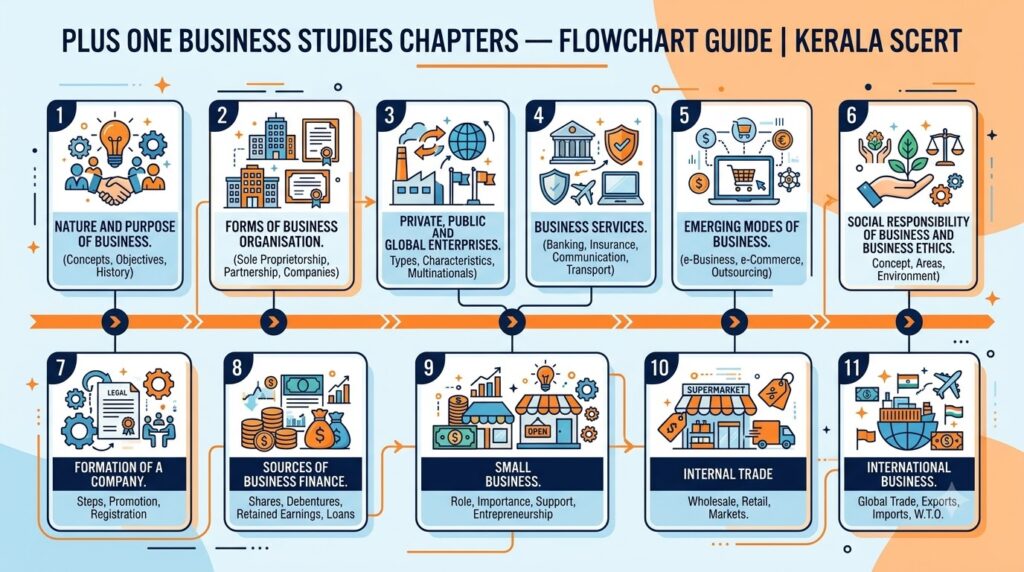
Chapter 1: Nature and Purpose of Business
Meaning and characteristics of business, business vs profession vs employment, objectives of business — economic and social, role of profit. Business risks. 👉 Exam Tip: Characteristics of business and difference between business, profession, and employment are common 3-mark questions. Business risks with examples are asked in 2-mark questions.
Chapter 2: Forms of Business Organisation
Sole proprietorship — features, merits, demerits. Partnership — types, deed, registration. Joint Hindu Family business. Co-operative societies. Joint stock companies — private and public.
👉 Exam Tip: Comparison between sole proprietorship and partnership, and between private and public companies, are frequently asked in 5-mark questions. Features and limitations of each form are important.
Chapter 3: Public, Private and Global Enterprises
Forms of public enterprises — departmental undertakings, statutory corporations, government companies. Changing role of public sector. Private sector enterprises. Global enterprises (MNCs) — features and impact.
👉 Exam Tip: Comparison of three forms of public enterprise in table format is a guaranteed question. Features of MNCs and their advantages/disadvantages for Indian economy are important.
Chapter 4: Business Services
Banking services — types of banks, functions of commercial banks. Insurance — principles, types (life, fire, marine). Warehousing — types and functions. Communication services.
👉 Exam Tip: Principles of insurance (insurable interest, utmost good faith, indemnity, subrogation) are very frequently asked. Types of warehousing with differences are important for 3-5 mark questions.
Chapter 5: Emerging Modes of Business
E-business — meaning, features, advantages, limitations, security concerns. Outsourcing — BPO, KPO, LPO. Smart cards, ATM, EFT. Online banking.
👉 Exam Tip: Advantages and limitations of e-business are very commonly asked. Difference between traditional business and e-business in tabular form is important.
Chapter 6: Social Responsibilities of Business and Business Ethics
Concept of social responsibility, arguments for and against. Responsibility towards stakeholders. Business ethics — elements and significance. Environment protection.
👉 Exam Tip: Arguments for and against social responsibility, and stakeholder-wise responsibilities (owners, employees, customers, government, society) are regularly asked. Business ethics principles are important.
Chapter 7: Formation of a Company
Steps in company formation — promotion, incorporation, capital subscription, commencement of business. Important documents — Memorandum of Association (MOA) and Articles of Association (AOA).
👉 Exam Tip: Stages of company formation in sequence and contents of MOA vs AOA comparison are important. Difference between MOA and AOA is a common 5-mark question.
Chapter 8: Sources of Business Finance
Internal vs external sources. Long, medium, short-term sources. Shares — equity and preference, debentures, public deposits, commercial banks, financial institutions, trade credit, factoring.
👉 Exam Tip: Comparison of equity shares vs preference shares vs debentures is a guaranteed question. Merits and demerits of each source of finance are important for 3-5 mark answers.
Chapter 9: Small Business and Entrepreneurship
Role of small business in India, advantages, limitations, problems. Entrepreneurship — qualities of an entrepreneur, functions, entrepreneurship development in India. MSME sector.
👉 Exam Tip: Problems faced by small businesses and qualities of a successful entrepreneur are commonly asked. Role of small business in Indian economy (employment, export, innovation) is important.
Chapter 10: Internal Trade
Meaning, types — retail and wholesale trade. Fixed shop retailers — types. Itinerant retailers. Departmental stores, chain stores, supermarkets. Wholesale trade — features and services.
👉 Exam Tip: Differences between departmental store and chain store (multiple shops) are frequently asked. Types of itinerant retailers with examples and services of wholesalers are important.
Chapter 11: International Trade
Meaning, advantages and limitations. Export and import procedures — documents (bill of lading, letter of credit, bill of exchange). Import and export promotion in India.
👉 Exam Tip: Documents in export trade (bill of lading, airway bill, letter of credit) with their purposes are regularly asked. Advantages of international trade questions appear in 3-mark section.
Download Plus One Business Studies Notes PDF 2026-27
| Chapter | Topic | Download |
|---|---|---|
| Chapter 1 | Nature and Purpose of Business | Download PDF |
| Chapter 2 | Forms of Business Organisation | Download PDF |
| Chapter 3 | Public, Private and Global Enterprises | Download PDF |
| Chapter 4 | Business Services | Download PDF |
| Chapter 5 | Emerging Modes of Business | Download PDF |
| Chapter 6 | Social Responsibilities and Ethics | Download PDF |
| Chapter 7 | Formation of a Company | Download PDF |
| Chapter 8 | Sources of Business Finance | Download PDF |
| Chapter 9 | Small Business and Entrepreneurship | Download PDF |
| Chapter 10 | Internal Trade | Download PDF |
| Chapter 11 | International Trade | Download PDF |
Tips to Score 90+ in Plus One Business Studies Kerala Board
1. Learn to Compare: Business Studies loves comparison questions — sole proprietorship vs partnership, equity shares vs debentures, MOA vs AOA. Prepare a comparison table for every pair of concepts in the syllabus.
2. Case Studies Are Easy Marks: Section D in Business Studies often has case study-based questions. Read the situation, identify which concept it relates to, and apply the theory. Practice with textbook case studies.
3. Forms of Business Organisation: Chapter 2 carries 10-15 marks in board exams. Master the features, merits, demerits, and suitability of each form — sole proprietorship, partnership, company.
4. Insurance Principles: The 7 principles of insurance (insurable interest, utmost good faith, indemnity, contribution, subrogation, causa proxima, mitigation of loss) are asked as a list or with examples in almost every board exam.
5. Read Business News: Business Studies is a current-affairs-linked subject. Understanding real company examples (Tata, Infosys, Kerala co-operatives) makes answers more relevant and fetch extra marks.
Frequently Asked Questions (FAQ)
Q1: Are these Plus One Business Studies Notes based on new SCERT Kerala 2026-27 syllabus?
Yes. Fully updated for the revised SCERT Plus One Business Studies textbook 2026-27.
Q2: Is Business Studies scoring in Plus One Kerala board?
Yes. Business Studies is considered one of the most scoring subjects in Kerala Plus One Commerce stream. Students who understand the concepts and prepare comparison tables consistently score above 85.
Q3: What is the difference between Business Studies and Commerce as a subject?
In Kerala Higher Secondary, Business Studies is a separate theory subject focusing on business management, organisation, and finance. Commerce as a stream includes Accountancy, Economics, and Business Studies.
Q4: Is Business Studies useful for MBA preparation?
Yes. The foundation concepts — forms of business, finance sources, business ethics, trade — are directly relevant to MBA entrance and studies.
Also Read
- 📊 Plus One Economics Notes 2026-27 New Syllabus Kerala
- 📒 Plus One Accountancy Notes 2026-27 New Syllabus Kerala
- 🎓 Career Options After Plus Two Commerce Kerala 2026
Plus One Business Studies New Syllabus Kerala | SCERT Plus One Business Studies Notes | Kerala Plus One Commerce Notes PDF 2026
Last Updated: July 2026