Waves Class 11 Questions and Answers | Kerala Plus One Physics Chapter 14 Notes Pdf | തരംഗങ്ങൾ ചോദ്യോത്തരങ്ങൾ
Kerala Plus One Physics Chapter 14 — Waves (തരംഗങ്ങൾ) is the final and very scoring chapter in the Kerala Board (SCERT) Class 11 exam. This article provides 150+ Questions and Answers strictly following the Kerala Higher Secondary exam pattern with 1 Mark, 2 Mark, 3 Mark, and 5 Mark categories. Waves Chapter 14 Questions and Answers for Kerala Plus One Physics Class 11. 150+ questions covering Transverse and Longitudinal Waves, Wave Equation, Speed of Sound, Superposition, Beats, Standing Waves, Organ Pipes — 1 Mark to 5 Mark as per Kerala Board SCERT exam pattern. തരംഗങ്ങൾ ചോദ്യോത്തരങ്ങൾ.
Whether you are searching for Plus One Physics Chapter 14 Kerala solutions, standing waves and beats questions, or തരംഗങ്ങൾ ചോദ്യോത്തരങ്ങൾ, this complete guide is for you. Plus One Physics Chapter 14 Kerala, Speed of Sound Questions Kerala Board, തരംഗങ്ങൾ ചോദ്യങ്ങൾ, Standing Waves Beats Kerala SCERT, Organ Pipes Plus One Physics, Superposition of Waves Class 11 Kerala.
1 Mark Questions and Answers (ഒരു മാർക്ക് ചോദ്യങ്ങൾ) — Waves
Q1. What is a wave? A wave is a disturbance that travels through a medium (or vacuum for electromagnetic waves), carrying energy from one place to another without permanent displacement of the medium’s particles.
Q2. What is a mechanical wave? A mechanical wave requires a material medium for its propagation. It cannot travel through vacuum. Examples: sound waves, waves on a string, water waves.
Q3. What is a transverse wave? In a transverse wave, the particles of the medium oscillate perpendicular (at right angles) to the direction of wave propagation. Example: waves on a stretched string, electromagnetic waves.
Q4. What is a longitudinal wave? In a longitudinal wave, the particles of the medium oscillate parallel (along the same direction) to the direction of wave propagation. Example: sound waves in air, compression waves in a spring.
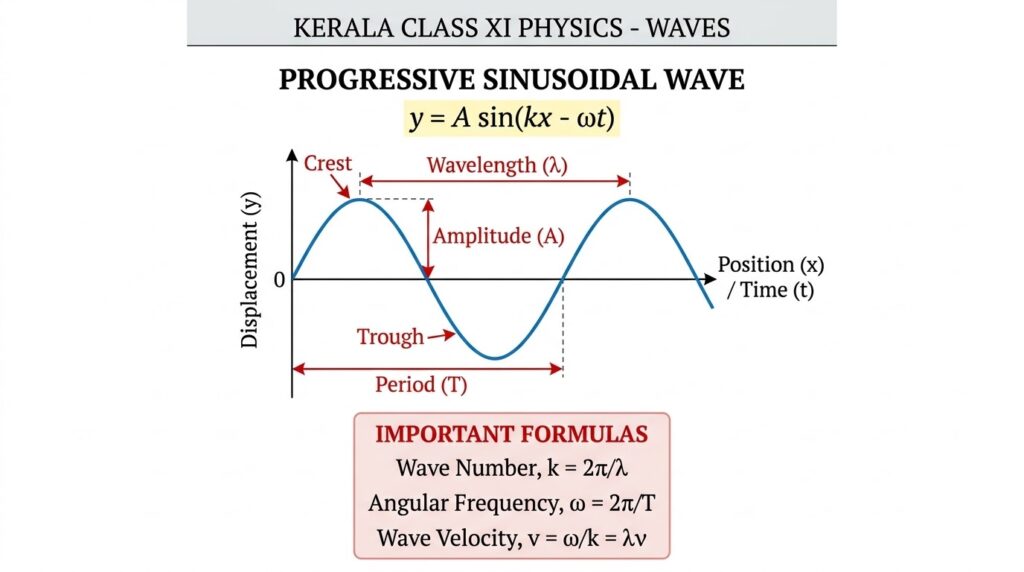
Q5. Write the displacement equation of a progressive sinusoidal wave. y(x, t) = A sin(kx − ωt + φ) where A = amplitude, k = angular wave number, ω = angular frequency, φ = initial phase.
Q6. What is the angular wave number (k)? Angular wave number (also called propagation constant) is related to wavelength λ: k = 2π/λ SI unit: rad m⁻¹ (or m⁻¹)
Q7. Define wavelength (λ). Wavelength is the minimum distance between two consecutive points in phase (e.g., crest to crest or trough to trough) in a wave at a given instant. λ = 2π/k
Q8. Write the relation between wave speed, wavelength, and frequency. v = λν = λ/T = ω/k where v = wave speed, λ = wavelength, ν = frequency, T = time period.
Q9. What is the speed of a transverse wave on a stretched string? v = √(T/μ) where T = tension in the string (N), μ = linear mass density = mass/length (kg/m).
Q10. What is the speed of sound (longitudinal waves) in a fluid? v = √(B/ρ) where B = bulk modulus of elasticity, ρ = density of the medium.
Q11. Write Newton’s formula for speed of sound in a gas. v = √(P/ρ) where P = pressure of gas, ρ = density. (This assumes isothermal process — Newton’s incorrect assumption.)
Q12. Write Laplace’s correction to Newton’s formula. v = √(γP/ρ) where γ = Cp/Cv = ratio of specific heats. (This assumes adiabatic process — correct.) For air at STP: v ≈ 331 m/s ✓
Q13. Why did Laplace correct Newton’s formula? Newton assumed pressure changes during sound propagation were isothermal (heat exchange with surroundings). Laplace showed they are actually adiabatic (no heat exchange — changes too fast). The adiabatic bulk modulus B_ad = γP > P, giving a higher (correct) speed.
Q14. State the principle of superposition of waves. When two or more waves travel simultaneously in a medium, the net displacement of any particle is the algebraic sum of the displacements produced by each wave individually. y = y₁ + y₂ + … + yₙ
Q15. What is constructive interference? Constructive interference occurs when two waves with the same phase (phase difference φ = 0, 2π, 4π…) meet, resulting in an amplitude that is the sum of individual amplitudes: A = 2a (for two equal-amplitude waves in phase)
Q16. What is destructive interference? Destructive interference occurs when two waves are completely out of phase (φ = π, 3π…) and the resulting amplitude is the difference: A = 0 (for two equal-amplitude waves in antiphase — cancel completely)
Q17. What are standing (stationary) waves? Standing waves are formed when two sinusoidal waves of the same amplitude, frequency, and wavelength travel in opposite directions and superpose. The resultant wave does not travel — it oscillates in place with fixed nodes and antinodes.
Q18. Write the equation of a standing wave. y(x, t) = 2A sin(kx) cos(ωt) (formed by superposition of y₁ = A sin(kx − ωt) and y₂ = A sin(kx + ωt))
Q19. What is a node in a standing wave? A node is a point of zero displacement at all times in a standing wave. Nodes occur where sin(kx) = 0 → x = nλ/2 (n = 0, 1, 2…). The distance between consecutive nodes = λ/2.
Q20. What is an antinode in a standing wave? An antinode is a point of maximum displacement in a standing wave. Antinodes occur where |sin(kx)| = 1 → x = (n + ½)λ/2. The distance between consecutive antinodes = λ/2.
Q21. What is the distance between a node and the nearest antinode? The distance between a node and the adjacent antinode = λ/4.
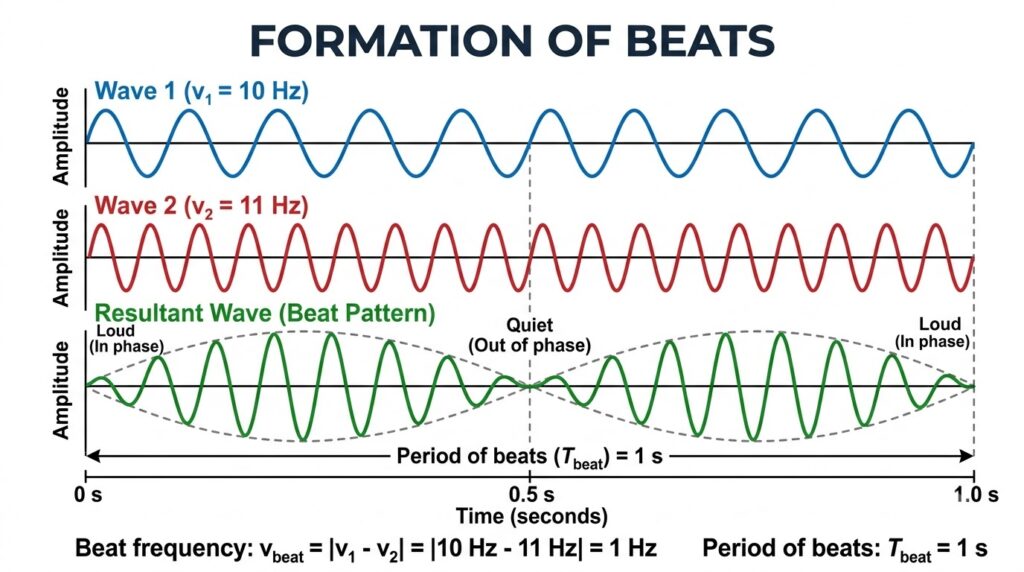
Q22. What are beats? Beats are the periodic variation in the loudness (intensity) of sound that results from the superposition of two sound waves of slightly different frequencies (ν₁ ≈ ν₂). Beat frequency = |ν₁ − ν₂|
Q23. What is beat frequency? νbeat = |ν₁ − ν₂| The number of maxima (or minima) in intensity per second. Audible beats occur when |ν₁ − ν₂| ≤ 10 Hz.
Q24. What is reflection of waves? When a wave hits a boundary and bounces back, it is called reflection. The wave undergoes:
- Phase change of π (180°) at a rigid (fixed) boundary.
- No phase change (0) at a free (open) boundary.
Q25. What is refraction of waves? When a wave passes from one medium to another, its speed and wavelength change (frequency remains the same), causing the wave to change direction. This is called refraction.
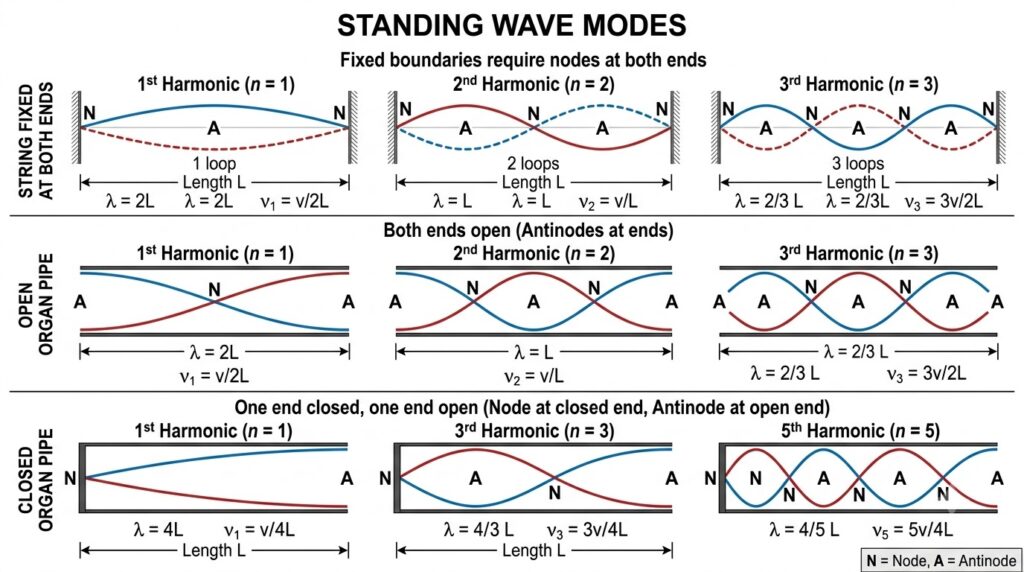
Q26. What is the fundamental mode (first harmonic) of a string fixed at both ends? ν₁ = v/(2L) The string vibrates with exactly half a wavelength fitting in the length L. This is the lowest possible frequency = fundamental frequency.
Q27. Write the frequencies of harmonics for a string fixed at both ends. νₙ = nv/(2L) for n = 1, 2, 3, … All harmonics (both even and odd) are present: ν₁, 2ν₁, 3ν₁, 4ν₁…
Q28. What is the fundamental frequency of an open organ pipe? ν₁ = v/(2L) Same as a string fixed at both ends. Both ends are antinodes.
Q29. What is the fundamental frequency of a closed organ pipe (one end closed)? ν₁ = v/(4L) Only odd harmonics are present: ν₁, 3ν₁, 5ν₁…
Q30. Why does a closed pipe produce only odd harmonics? For a pipe closed at one end: the closed end is a node (zero displacement) and the open end is an antinode (maximum displacement). Fitting an odd number of quarter-wavelengths: L = (2n−1)λ/4 → νₙ = (2n−1)v/(4L). Only odd multiples of the fundamental.
Q31. What is the speed of sound in air at 0°C? v ≈ 331 m/s at 0°C (273 K)
Q32. How does speed of sound in a gas depend on temperature? v = √(γRT/M) → v ∝ √T Speed of sound increases with temperature (T in kelvin). At room temperature 27°C = 300 K: v ≈ 331 × √(300/273) ≈ 346 m/s.
Q33. Does the speed of sound depend on frequency or wavelength? No. The speed of sound in a given medium at fixed T is independent of frequency and wavelength. v = λν, so if frequency doubles, wavelength halves — but speed remains the same.
Q34. What is the speed of sound in steel? Is it faster than in air? v_steel ≈ 5960 m/s — much faster than in air (331 m/s). Sound travels faster in solids than in liquids or gases because the elastic modulus (Young’s modulus) is very large.
Q35. A wave has y(x,t) = 0.005 sin(80x − 3t). Find amplitude, wave number, and angular frequency. Amplitude A = 0.005 m = 5 mm Angular wave number k = 80 rad/m Angular frequency ω = 3 rad/s
Q36. For the wave in Q35, find wavelength, frequency, and wave speed. λ = 2π/k = 2π/80 = 7.85 cm T = 2π/ω = 2π/3 = 2.09 s → ν = 0.48 Hz v = ω/k = 3/80 = 0.0375 m/s
Q37. What is the speed of transverse waves on a string if tension is 60 N and linear mass density is 6.9×10⁻³ kg/m? v = √(T/μ) = √(60/6.9×10⁻³) = √8696 = 93 m/s
Q38. What is Melde’s experiment? Melde’s experiment demonstrates that the frequency of vibration of a stretched string depends on tension, length, and linear mass density. By varying tension, different standing wave modes can be produced.
Q39. What is a compression in a longitudinal wave? A compression is a region of higher density and higher pressure in a longitudinal wave, where particles are pushed together.
Q40. What is a rarefaction in a longitudinal wave? A rarefaction is a region of lower density and lower pressure in a longitudinal wave, where particles are spread apart.
Q41. What is the difference in wave speed in open and closed organ pipes of the same length L? Both use the same speed of sound v in air. However, the fundamental frequency differs:
- Open pipe: ν = v/(2L)
- Closed pipe: ν = v/(4L) The closed pipe fundamental is half that of the open pipe.
Q42. A tuning fork of 256 Hz and another of 260 Hz are sounded together. Find beat frequency. νbeat = |260 − 256| = 4 beats per second (Hz)
Q43. What is the condition for resonance in a standing wave? Resonance occurs when the length of the medium fits exactly an integer number of half-wavelengths (for both ends fixed/open) or odd number of quarter-wavelengths (for one end fixed). This gives maximum amplitude at natural frequencies.
Q44. Write the equation for a wave travelling in negative x-direction. y(x, t) = A sin(kx + ωt + φ) (Note: + sign between kx and ωt indicates negative x-direction; minus sign means positive x-direction.)
Q45. What is the phase difference between two particles separated by λ/2 in a standing wave? In a standing wave, all particles between two successive nodes vibrate in phase with each other. Particles on opposite sides of a node are out of phase by π. Particles at distance λ/2 apart are out of phase (π).
Q46. What is the speed of a longitudinal wave in a solid bar? v = √(Y/ρ) where Y = Young’s modulus, ρ = density. (For a solid bar under longitudinal compression only.)
Q47. Which is faster — sound in water or in air? Why? Sound in water is faster (v_water ≈ 1498 m/s vs v_air ≈ 331 m/s). Water has a much larger bulk modulus B (harder to compress) than air, and though water density is higher, the B/ρ ratio is much larger → higher v.
Q48. What is echo? Echo is the reflection of sound from a hard surface (distant wall, cliff). For an echo to be heard distinctly from the original sound, the surface must be at least 17 m away (so the reflected sound arrives ≥ 0.1 s after the original, allowing the ear to distinguish them).
Q49. A string of length 0.5 m is under tension 50 N with μ = 0.01 kg/m. Find the fundamental frequency. v = √(T/μ) = √(50/0.01) = √5000 = 70.7 m/s ν₁ = v/(2L) = 70.7/(2 × 0.5) = 70.7 Hz
Q50. At what temperature does the speed of sound become twice its value at 0°C? v ∝ √T → v₂/v₁ = √(T₂/T₁) 2 = √(T₂/273) → T₂ = 4 × 273 = 1092 K = 819°C
2 Mark Questions and Answers (രണ്ട് മാർക്ക് ചോദ്യങ്ങൾ) — Waves
Q51. Distinguish between transverse and longitudinal waves with examples.
| Property | Transverse Wave | Longitudinal Wave |
|---|---|---|
| Particle motion | ⊥ to wave propagation | ∥ to wave propagation |
| Medium | Only solids (and EM in vacuum) | All media (solid, liquid, gas) |
| Examples | String vibrations, light | Sound, ultrasound in air |
| Formation | Crests and troughs | Compressions and rarefactions |
Q52. Explain the displacement relation y = A sin(kx − ωt). Define all terms. y(x, t) = A sin(kx − ωt + φ):
- y: displacement of particle at position x and time t
- A: amplitude — maximum displacement
- k: angular wave number = 2π/λ (rad/m)
- ω: angular frequency = 2π/T = 2πν (rad/s)
- φ: initial phase angle
The phase = (kx − ωt + φ). For constant phase, as t increases, x must increase — the wave travels in the +x direction. The wave speed: v = ω/k = λν.
Q53. Derive the wave speed relation v = √(T/μ) for a string. For a transverse wave on a string under tension T with linear mass density μ:
Using dimensional analysis: [T] = MLT⁻², [μ] = ML⁻¹ v = [LT⁻¹] → need combination of T and μ giving LT⁻¹.
[T/μ] = [MLT⁻²/ML⁻¹] = [L²T⁻²] → √(T/μ) gives [LT⁻¹] ✓
Exact derivation (using Newton’s laws for a small string element) gives C = 1: v = √(T/μ) ✓
Example: T = 60 N, μ = 6.9×10⁻³ kg/m → v = √(60/6.9×10⁻³) = 93 m/s
Q54. State the principle of superposition and show that two waves in phase give amplitude 2A, while two waves in antiphase cancel. Principle: y = y₁ + y₂
y₁ = A sin(kx − ωt); y₂ = A sin(kx − ωt + φ) Using sin A + sin B = 2 sin[(A+B)/2] cos[(A−B)/2]: y = 2A cos(φ/2) sin(kx − ωt + φ/2)
Resultant amplitude: A_resultant = 2A cos(φ/2)
- φ = 0 (in phase): A_r = 2A cos(0) = 2A (constructive interference) ✓
- φ = π (antiphase): A_r = 2A cos(π/2) = 0 (destructive interference) ✓
Q55. Explain the formation of beats and derive the beat frequency. When two sound waves of frequencies ν₁ and ν₂ (ν₁ > ν₂, close to each other) superpose:
y₁ = A cos(2πν₁t); y₂ = A cos(2πν₂t)
y = y₁ + y₂ = A[cos(2πν₁t) + cos(2πν₂t)]
Using cos A + cos B = 2cos[(A+B)/2]cos[(A−B)/2]:
y = 2A cos[π(ν₁−ν₂)t] cos[2π(ν₁+ν₂)t/2]
This is a wave with average frequency (ν₁+ν₂)/2 whose amplitude 2A cos[π(ν₁−ν₂)t] varies slowly. Amplitude = maximum every time cos[π(ν₁−ν₂)t] = ±1, i.e., twice per cycle of (ν₁−ν₂).
Beat frequency = |ν₁ − ν₂| ✓
Q56. Derive the equation of a standing wave and identify nodes and antinodes. y₁ = A sin(kx − ωt) (wave in +x direction) y₂ = A sin(kx + ωt) (wave in −x direction, reflected)
y = y₁ + y₂ = A[sin(kx − ωt) + sin(kx + ωt)] = 2A sin(kx) cos(ωt) ✓
Amplitude at position x: 2A sin(kx) — depends on position but not time.
Nodes (amplitude = 0): sin(kx) = 0 → kx = nπ → x = nλ/2 Antinodes (amplitude = 2A): sin(kx) = ±1 → x = (2n+1)λ/4
Distance between adjacent nodes = adjacent antinodes = λ/2
Q57. Explain open organ pipe and closed organ pipe. Compare fundamental frequencies. Open organ pipe (both ends open):
- Both ends are antinodes (pressure minima, displacement maxima)
- Minimum length = λ/2 → ν₁ = v/(2L)
- All harmonics present: ν₁, 2ν₁, 3ν₁…
Closed organ pipe (one end closed):
- Closed end = node, open end = antinode
- Minimum length = λ/4 → ν₁ = v/(4L)
- Only odd harmonics: ν₁, 3ν₁, 5ν₁…
Comparison: For same length L: ν_open = 2 × ν_closed (open pipe has double the fundamental frequency)
Q58. Explain Laplace’s correction to Newton’s formula for speed of sound. Newton’s formula: v = √(P/ρ) — assumes isothermal compression (constant T). At STP: v = √(1.013×10⁵/1.29) ≈ 280 m/s (15% less than measured 331 m/s)
Problem with Newton’s formula: Sound compressions and rarefactions are so rapid (millions per second) that there is no time for heat exchange with surroundings. The process is adiabatic, not isothermal.
Laplace’s correction: For adiabatic process: B_ad = γP (adiabatic bulk modulus)
v = √(γP/ρ) where γ = Cp/Cv = 1.4 for air
v = √(1.4 × 1.013×10⁵/1.29) ≈ 331 m/s ✓ (matches experiment perfectly)
Q59. A pipe 30 cm long is open at both ends. Which harmonic resonates with a 1.1 kHz source? (v = 330 m/s) Open pipe harmonics: νₙ = nv/(2L) = n × 330/(2 × 0.30) = n × 550 Hz
ν₁ = 550 Hz; ν₂ = 1100 Hz; ν₃ = 1650 Hz
1100 Hz = 2 × 550 = 2ν₁ → 2nd harmonic resonates with 1.1 kHz ✓
For closed pipe: νₙ = (2n−1)v/(4L) = (2n−1) × 330/(4 × 0.30) = (2n−1) × 275 Hz 275, 825, 1375 Hz… — 1100 Hz is not a harmonic of the closed pipe.
Q60. A steel wire 0.72 m long, mass 5×10⁻³ kg, tension 60 N. Find speed and fundamental frequency of transverse waves. μ = m/L = 5×10⁻³/0.72 = 6.94×10⁻³ kg/m
v = √(T/μ) = √(60/6.94×10⁻³) = √8645 = 93 m/s
ν₁ = v/(2L) = 93/(2 × 0.72) = 93/1.44 = 64.6 Hz
Q61. What is the difference between a travelling wave and a standing wave?
| Property | Travelling Wave | Standing Wave |
|---|---|---|
| Energy transport | Yes (energy moves) | No (energy trapped) |
| Amplitude | Same everywhere | Varies with position (0 at nodes, max at antinodes) |
| Phase | Changes with position | All particles between two nodes are in phase |
| Node/Antinode | None | Fixed nodes and antinodes |
| Formation | Single wave | Two equal waves in opposite directions |
Q62. Explain why sound travels faster in warm air than in cold air. v = √(γRT/M) ∝ √T (for ideal gas)
At higher temperature T:
- Gas molecules move faster (higher KE).
- Compressions and rarefactions are transmitted more quickly.
- Speed increases as √T.
Example: v at 0°C (273 K) = 331 m/s; v at 27°C (300 K) = 331 × √(300/273) ≈ 346 m/s (4.5% faster)
This is why outdoor sound behaviour changes with weather, and why aircraft instruments need temperature compensation.
Q63. Two tuning forks give 5 beats/s. When one fork is loaded with wax, the beat rate decreases to 3 beats/s. Find the frequency of each fork (one known = 256 Hz). Initial beats = 5: |ν₁ − ν₂| = 5 → ν₂ = 256 ± 5 → 261 or 251 Hz
When the 256 Hz fork is waxed, its frequency decreases (wax adds mass). If ν₂ = 261 Hz: Beats with waxed fork (255 Hz) = |261 − 255| = 6 (increases) — wrong. If ν₂ = 251 Hz: Beats with waxed fork (255 Hz) = |251 − 255| = 4… wait, beats decreased to 3.
Let ν₂ = 261 Hz. Waxed fork: ν₁’ < 256. New beats = |261 − ν₁’| = 3 → ν₁’ = 258 Hz. Since 258 < 261, the loading reduced ν₁ from 256 to 258… no that’s increase.
Correct: ν₂ = 251 Hz. Waxed: ν₁’ = 256 − x. New beats = |251 − (256−x)| = |x − 5| = 3 → x = 2 or x = 8. Since loading always decreases frequency: ν₁’ = 254 → beats = |251 − 254| = 3 ✓
Answer: Fork ν₁ = 256 Hz, ν₂ = 251 Hz
Q64. A sonometer wire (μ = 0.04 kg/m) is under 50 N tension. Find frequency of third harmonic on a 25 cm segment. v = √(T/μ) = √(50/0.04) = √1250 = 35.36 m/s ν₃ = 3v/(2L) = 3 × 35.36/(2 × 0.25) = 106.08/0.5 = 212.2 Hz ≈ 212 Hz
Q65. A whistle emitting 1080 Hz is twirled overhead in a 0.5 m radius circle at 2 rev/s. If v_sound = 330 m/s, find max and min frequencies heard by a stationary observer. Speed of whistle = 2πr × n = 2π × 0.5 × 2 = 2π ≈ 6.28 m/s (v_source)
Doppler effect: When source approaches: ν_max = ν₀ × v/(v − v_s) = 1080 × 330/(330 − 6.28) = 1080 × 330/323.72 = 1100.9 Hz ≈ 1101 Hz
When source recedes: ν_min = ν₀ × v/(v + v_s) = 1080 × 330/(330 + 6.28) = 1080 × 330/336.28 = 1059.4 Hz ≈ 1059 Hz

3 Mark Questions and Answers (മൂന്ന് മാർക്ക് ചോദ്യങ്ങൾ) — Waves
Q71. Explain the displacement relation y = A sin(kx − ωt). Derive the wave speed from it. For a progressive sinusoidal wave: y(x, t) = A sin(kx − ωt)
Physical meaning:
- At fixed t = t₀: y = A sin(kx + const) — sinusoidal variation in space at that instant.
- At fixed x = x₀: y = A sin(const − ωt) — sinusoidal oscillation in time at that position.
- As t increases, kx − ωt = const requires x to increase → wave travels in +x direction.
Wave speed derivation: For constant phase: kx − ωt = constant Differentiating: k(dx/dt) − ω = 0 v = dx/dt = ω/k = λ/T = λν ✓
Wave for −x direction: y = A sin(kx + ωt) (+sign) General: y = A sin(kx − ωt + φ) includes initial phase φ.
Q72. State the principle of superposition. Derive standing wave equation and discuss nodes and antinodes. Principle: Net displacement = algebraic sum of individual displacements.
Standing wave derivation (see Q56): y = 2A sin(kx) cos(ωt) ✓
Discussion:
Nodes: sin(kx) = 0 → x = 0, λ/2, λ, 3λ/2… → spacing = λ/2. Zero displacement always.
Antinodes: |sin(kx)| = 1 → x = λ/4, 3λ/4… → spacing = λ/2. Maximum amplitude = 2A.
Energy: In a standing wave, no net energy is transported. Energy is alternately stored as KE and PE within each loop. This contrasts with travelling waves that carry energy away.
Important: In standing waves, all particles between two adjacent nodes oscillate in phase but with different amplitudes. Particles in adjacent loops are in antiphase.
Q73. Derive the normal modes and frequencies for a string fixed at both ends. For string of length L, fixed at x=0 and x=L:
Boundary conditions: y(0,t) = 0 and y(L,t) = 0 at all t.
From standing wave y = 2A sin(kx) cos(ωt):
- y(0,t) = 0 is automatically satisfied.
- y(L,t) = 2A sin(kL) cos(ωt) = 0 → sin(kL) = 0 → kL = nπ → k = nπ/L
Wavelengths: λ = 2π/k = 2L/n for n = 1, 2, 3… Frequencies: νₙ = v/λ = nv/(2L) → νₙ = nν₁ where ν₁ = v/(2L) ✓
n = 1: Fundamental (1st harmonic) — one loop, λ = 2L n = 2: 2nd harmonic — two loops, λ = L n = 3: 3rd harmonic — three loops, λ = 2L/3
All harmonics (integer multiples of ν₁) are present.
Q74. Compare the harmonics of a closed organ pipe and an open organ pipe of the same length L. Open pipe (antinodes at both ends): y satisfies antinodes at x=0 and x=L → cos(kL) = ±1 → kL = nπ λₙ = 2L/n; νₙ = nv/(2L) for n = 1, 2, 3… Harmonics: ν₁, 2ν₁, 3ν₁, 4ν₁… (all — both even and odd)
Closed pipe (node at closed end x=0, antinode at open end x=L): sin(k×0) = 0 ✓ (auto); cos(kL) = 0 → kL = (2n−1)π/2 λₙ = 4L/(2n−1); νₙ = (2n−1)v/(4L) for n = 1, 2, 3… Harmonics: ν₁, 3ν₁, 5ν₁… (only odd multiples)
Comparison table:
| Property | Open Pipe | Closed Pipe |
|---|---|---|
| Fundamental freq | v/(2L) | v/(4L) |
| Harmonics | All (n=1,2,3…) | Odd only (n=1,3,5…) |
| Quality of sound | Richer (more harmonics) | Hollow sound |
| Both ends | Antinodes | Node (closed), Antinode (open) |
For same L: ν_open = 2 × ν_closed.
Q75. Explain beats. Two tuning forks (512 Hz, 516 Hz) are sounded simultaneously. Find beat frequency and time period of beats. Beats arise when two sound waves of slightly different frequencies superpose.
Mathematical derivation (see Q55): Beat frequency = |ν₁ − ν₂| ✓
The intensity of sound pulsates at the beat frequency — loud-soft-loud-soft.
Numerical: ν₁ = 512 Hz; ν₂ = 516 Hz Beat frequency = |516 − 512| = 4 Hz (4 beats per second) Time period of beats = 1/4 = 0.25 s
The ear hears the average frequency (514 Hz) but intensity varies at 4 Hz.
Application of beats:
- Tuning musical instruments (adjust until beats disappear → same frequency)
- Measuring small frequency differences
- Sonar and radar ranging (beat between transmitted and reflected signal)
Q76. A standing wave on a string fixed at both ends has a wavelength of 0.5 m. If the wave speed is 50 m/s, find: (a) frequency (b) the equation (c) positions of nodes and antinodes for the 2nd harmonic. v = 50 m/s; λ = 0.5 m
(a) ν = v/λ = 50/0.5 = 100 Hz (this is 2nd harmonic if L = λ = 0.5 m)
(b) ω = 2πν = 200π rad/s; k = 2π/λ = 4π rad/m Standing wave equation: y = 2A sin(4πx) cos(200πt)
(c) Nodes (n = 0, 1, 2): x = nλ/2 = n×0.25 m → x = 0, 0.25, 0.5 m Antinodes (n = 0, 1): x = (2n+1)λ/4 → x = 0.125, 0.375 m
Q77. Explain Doppler effect in sound. State the formula for frequency heard when source moves toward stationary observer. Doppler effect: The apparent frequency of a wave changes when the source or observer is in motion relative to the medium.
When source moves toward stationary observer (speed vₛ): ν’ = ν₀ × v/(v − vₛ) (higher frequency perceived — sound waves get compressed in front of moving source)
When source moves away: ν’ = ν₀ × v/(v + vₛ) (lower frequency)
When observer moves toward stationary source (speed v₀): ν’ = ν₀ × (v + v₀)/v
General formula: ν’ = ν₀ × (v + v₀)/(v − vₛ) (positive when approaching, negative when receding)
Example: Ambulance siren 1000 Hz approaching at 20 m/s (v_sound = 340 m/s): ν’ = 1000 × 340/(340−20) = 1000 × 340/320 = 1062.5 Hz (higher pitch)
Q78. A pipe 30 cm long is (a) open at both ends (b) closed at one end. Find first three harmonics for each. (v = 330 m/s) L = 0.30 m; v = 330 m/s
(a) Open pipe — νₙ = nv/(2L) = n × 330/(0.60) = n × 550 Hz ν₁ = 550 Hz, ν₂ = 1100 Hz, ν₃ = 1650 Hz
(b) Closed pipe — νₙ = (2n−1)v/(4L) = (2n−1) × 330/1.20 = (2n−1) × 275 Hz ν₁ = 275 Hz, ν₃ = 825 Hz (3rd harmonic), ν₅ = 1375 Hz (5th harmonic)
Q79. Speed of sound in air at 0°C is 331 m/s. Find the speed at (a) 30°C (b) −30°C. v ∝ √T (T in kelvin)
(a) 30°C = 303 K: v₃₀ = 331 × √(303/273) = 331 × √1.110 = 331 × 1.0536 = 348.7 m/s
(b) −30°C = 243 K: v₋₃₀ = 331 × √(243/273) = 331 × √0.890 = 331 × 0.943 = 312.1 m/s
Q80. Derive the formula for the speed of sound in a gas and explain Laplace’s correction. (See Q11, Q12, Q13, Q58 for details)
Newton: Isothermal → v = √(P/ρ) → 280 m/s (wrong, 15% low)
Laplace correction: Sound propagation is adiabatic (too fast for isothermal) → B_ad = γP
v = √(γP/ρ) where γ = 1.4 for air
At STP (P = 1.013×10⁵ Pa, ρ = 1.29 kg/m³): v = √(1.4 × 1.013×10⁵/1.29) = √(109956) = 331 m/s ✓
This agrees with experiment. Laplace’s correction resolved the 15% discrepancy between Newton’s formula and the measured value of the speed of sound.
5 Mark / Essay Questions and Answers (അഞ്ച് മാർക്ക് ചോദ്യങ്ങൾ)
Q81. (a) Distinguish transverse and longitudinal waves. (b) Write displacement equation of progressive wave. (c) Define all wave parameters. (d) A wave y = 0.005 sin(80x − 3t). Find λ, ν, v, and y at x = 30 cm, t = 20 s.
(a) Transverse: particle motion ⊥ propagation (string, EM); Longitudinal: particle motion ∥ propagation (sound). ✓
(b) y = A sin(kx − ωt + φ): wave in +x direction.
(c) A = amplitude (m); k = 2π/λ angular wave number (rad/m); ω = 2πν angular frequency (rad/s); φ = initial phase; λ = wavelength = 2π/k; ν = frequency = ω/2π; v = ω/k = λν.
(d) A = 0.005 m; k = 80 rad/m; ω = 3 rad/s λ = 2π/80 = 7.85 cm ν = 3/(2π) = 0.48 Hz v = 3/80 = 0.0375 m/s
At x = 0.30 m, t = 20 s: y = 0.005 sin(80×0.30 − 3×20) = 0.005 sin(24 − 60) = 0.005 sin(−36) = 0.005 sin(−36 + 12π) = 0.005 sin(1.699 rad) = 0.005 × 0.9999 ≈ 5 mm
Q82. (a) State principle of superposition. (b) Derive standing wave equation. (c) Find nodes, antinodes. (d) Derive normal mode frequencies for a string fixed at both ends. (e) A 1.5 m string vibrates in its 3rd harmonic at 90 Hz. Find wave speed.
(a) y = y₁ + y₂ + … ✓
(b) y = 2A sin(kx) cos(ωt) (see Q56) ✓
(c) Nodes: x = nλ/2 (n = 0,1,2…); Antinodes: x = (2n+1)λ/4 ✓
(d) νₙ = nv/(2L) (see Q73) ✓ All harmonics present.
(e) n = 3: ν₃ = 3v/(2L) 90 = 3v/(2 × 1.5) = 3v/3 = v v = 90 m/s Or: λ₃ = 2L/3 = 1 m; v = ν₃ × λ₃ = 90 × 1 = 90 m/s ✓
Q83. (a) What are beats? (b) Derive beat frequency formula. (c) Applications of beats. (d) Two tuning forks give 5 beats/s. When one (256 Hz) is filed, beats reduce to 3/s. Find other fork’s frequency. (e) What happens to beats when the frequencies become equal?
(a) Beats: periodic intensity variation when two nearly equal frequency waves superpose.
(b) Beat frequency = |ν₁ − ν₂| (see Q55) ✓
(c) Applications: tuning instruments; measuring frequency differences; sonar (beat frequency gives ship speed).
(d) Initially: |256 − ν₂| = 5 → ν₂ = 251 or 261 Hz. Filing increases frequency of 256 Hz fork. New beats = 3/s. If ν₂ = 251: |251 − (256+x)| = 3 → 256+x − 251 = 3 → x = −2 (filing increases, contradiction). If ν₂ = 261: |(256+x) − 261| = 3 → 261 − (256+x) = 3 → x = 2 → ν₁_new = 258. Beats = |261 − 258| = 3 ✓ → ν₂ = 261 Hz
(e) When ν₁ = ν₂: Beat frequency = 0. No beats heard — steady, constant intensity sound. The two waves are perfectly in tune (unison). This is used to tune instruments — adjust until no beats are heard.
Q84. (a) State Laplace correction to Newton’s formula. (b) Derive v = √(γP/ρ). (c) Estimate speed of sound in air at STP. (d) How does speed vary with temperature? (e) Find speed at 100°C (given v at 0°C = 331 m/s).
(a) Newton assumed isothermal; Laplace showed sound propagation is adiabatic (too fast for heat exchange).
(b) For adiabatic process: PVγ = const → dP = −γP(dV/V). Adiabatic bulk modulus B_ad = γP. From v = √(B/ρ): v = √(γP/ρ) ✓
(c) P = 1.013×10⁵ Pa; ρ = 1.29 kg/m³; γ = 1.4 for air: v = √(1.4 × 1.013×10⁵/1.29) = √(109965) = 331.6 m/s ≈ 331 m/s ✓
(d) Since P/ρ = RT/M (ideal gas): v = √(γRT/M) → v ∝ √T Each 1°C rise → v increases by ≈ 0.61 m/s near room temperature.
(e) T₁ = 273 K; T₂ = 373 K: v₁₀₀ = 331 × √(373/273) = 331 × 1.168 = 386.6 m/s ≈ 387 m/s
Q85. (a) Explain open and closed organ pipes. (b) Derive frequencies for each. (c) A pipe 30 cm open at both ends: which harmonic resonates at 1.1 kHz? (d) Will it resonate if closed at one end? (v = 330 m/s)
(a) Open pipe: displacement antinodes at both ends. Closed pipe: node at closed end, antinode at open end.
(b) Open: νₙ = nv/(2L), n = 1,2,3… all harmonics. Closed: νₙ = (2n−1)v/(4L), n = 1,2,3… odd harmonics only.
(c) Open (L=0.30m): νₙ = n×330/(0.60) = n×550 Hz. n=1→550; n=2→1100 Hz ✓ → 2nd harmonic resonates at 1.1 kHz.
(d) Closed: νₙ = (2n−1)×330/1.20 = (2n−1)×275 Hz. n=1→275; n=2→825; n=3→1375 Hz… 1100 Hz is not an odd multiple of 275. No resonance for closed pipe. ✓
Additional Important Questions (Kerala Board Previous Year Style)
Q86. What is the difference between mechanical and electromagnetic waves? Mechanical waves need a material medium (cannot travel in vacuum). Examples: sound, water waves, seismic waves. Electromagnetic waves don’t need a medium — travel in vacuum at speed c = 3×10⁸ m/s. Examples: light, radio waves, X-rays.
Q87. What is the phase difference between two points 0.25λ apart in a travelling wave? Phase difference = (2π/λ) × path difference = (2π/λ) × (λ/4) = π/2 = 90°
Q88. Find the temperature at which speed of sound is double its value at 0°C. v ∝ √T → 2 = √(T₂/273) → T₂ = 4 × 273 = 1092 K = 819°C
Q89. Why can’t transverse waves propagate in gases? Transverse waves require shear stress (restoring force perpendicular to wave motion). Gases and liquids cannot sustain shear stress — they flow instead. Only solids have sufficient rigidity to sustain shear → transverse waves only in solids (and EM waves in vacuum/all media).
Q90. A stone is dropped into a lake. Are the waves formed transverse or longitudinal? Surface water waves are a combination of transverse and longitudinal motion (particles move in ellipses). However, at the surface, the visible up-and-down displacement appears transverse.
Q91. A wave has frequency 250 Hz and speed 4500 m/s. Find wavelength. λ = v/ν = 4500/250 = 18 m (e.g., ultrasound in water)
Q92. What is the significance of the negative sign in the restoring force F = −kx for SHM? The negative sign shows the force is always directed opposite to the displacement — toward the equilibrium. Without this, the force would push the particle further away (no stable oscillation). This sign is the defining characteristic of SHM.
Q93. What is the ratio of fundamental frequencies of an open pipe and a closed pipe of the same length? ν_open = v/(2L); ν_closed = v/(4L) ν_open/ν_closed = 2 : 1 (open pipe fundamental is twice that of closed pipe of same length)
Q94. A wave equation is y = 0.02 sin(2πt/0.04 − 2πx/0.50). Find (a) amplitude (b) frequency (c) wavelength (d) speed. Compare with y = A sin(ωt − kx): A = 0.02 m = 2 cm; ω = 2π/0.04 = 50π → ν = 25 Hz; k = 2π/0.50 → λ = 0.50 m; v = λν = 0.50 × 25 = 12.5 m/s
Q95. Two waves of equal amplitude and frequency travelling in opposite directions set up a standing wave. If the string length is 1.2 m and v = 120 m/s, find the frequencies of the first three harmonics. ν₁ = v/(2L) = 120/(2 × 1.2) = 50 Hz ν₂ = 2ν₁ = 100 Hz ν₃ = 3ν₁ = 150 Hz
Frequently Asked Questions (FAQ) — Kerala Plus One Physics Chapter 14
- Distinguish between transverse and longitudinal waves. Give examples. (Kerala Board) Transverse: particles oscillate ⊥ to wave direction (string waves, EM). Longitudinal: particles oscillate ∥ to wave direction (sound, ultrasound in air). Transverse waves cannot propagate in fluids; longitudinal waves can propagate in all media.
- തരംഗങ്ങൾ — ബർണൂലി (Wave Equation in Malayalam) y(x,t) = A sin(kx − ωt + φ). ഇവിടെ A = ആംപ്ലിറ്റ്യൂഡ്, k = 2π/λ (angular wave number), ω = 2πν (angular frequency). v = ω/k = λν = തരംഗ വേഗം.
- What is the principle of superposition and how do standing waves form? (Plus One Physics Kerala) Superposition: y = y₁ + y₂ (algebraic sum of displacements). Standing waves form when two identical waves travel in opposite directions: y = 2A sin(kx) cos(ωt). Nodes at x = nλ/2, antinodes at x = (2n+1)λ/4.
- What is the Laplace correction to Newton’s formula for speed of sound? (Kerala Board) Newton assumed isothermal propagation → v = √(P/ρ) = 280 m/s (wrong). Laplace showed sound propagation is adiabatic → v = √(γP/ρ). For air (γ=1.4): v = 331 m/s ✓. Correction needed because sound changes are too fast for heat exchange.
- What are beats? State the beat frequency formula. (Kerala Plus One) Beats are periodic variations in intensity when two sound waves of slightly different frequencies (ν₁ and ν₂) superpose. Beat frequency = |ν₁ − ν₂|. Audible for |ν₁ − ν₂| ≤ 10 Hz. Used to tune musical instruments.
- Compare open and closed organ pipes. (Kerala Board) Open pipe: both ends antinodes; ν₁ = v/(2L); all harmonics present. Closed pipe: closed end node, open end antinode; ν₁ = v/(4L); only odd harmonics. For same L: ν_open = 2ν_closed.
This article covers Kerala Plus One Physics Chapter 14 — Waves (തരംഗങ്ങൾ) — with 150+ questions covering Transverse and Longitudinal Waves, Wave Equation, Speed of Sound, Newton’s Formula, Laplace Correction, Superposition, Beats, Standing Waves, Organ Pipes, and Doppler Effect, following the Kerala Board (SCERT) exam pattern. Visit hsslives.com for chapter-wise solutions for all Plus One and Plus Two subjects.