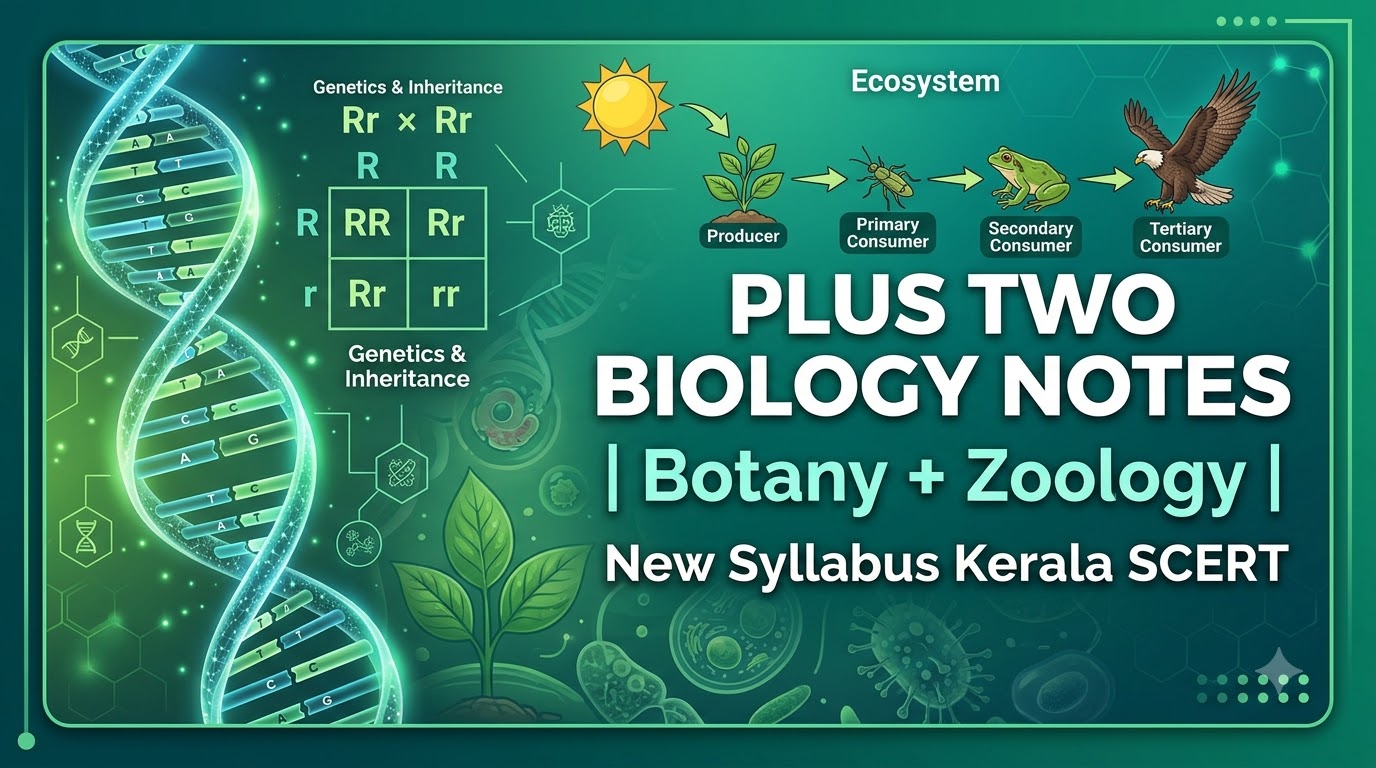

Plus Two Biology Notes 2026-27 (New Syllabus) | Kerala SCERT Botany & Zoology PDF Download
Last Updated: July 2026 | 📚 Class: Plus Two (Class 12) | 📖 Subject: Biology | 🏫 Board: SCERT Kerala
Searching for Plus Two Biology Notes 2026-27 based on the latest SCERT Kerala syllabus? This page has complete chapter-wise Biology notes — both Botany and Zoology — fully updated for the revised SCERT Plus Two Biology textbook 2026-27.
Plus Two Biology is the most critical subject for NEET 2027 aspirants. About 45 of the 90 Biology questions in NEET come from Plus Two topics. Genetics, Reproduction, Ecology, and Biotechnology are the highest-scoring areas.
കുറിപ്പ്: Plus Two Biology-ൽ Genetics & Evolution, Ecology, Biotechnology — ഈ 3 areas ഏറ്റവും important ആണ്. Board exam-ൽ 50% marks ഇതിൽ നിന്ന് വരും. NEET-ൽ ഇതിൽ നിന്ന് 25+ questions ഉണ്ടാകും.
Plus Two Biology Notes 2026-27 New Syllabus Kerala PDF
Download Plus Two Biology Notes 2026-27 based on new SCERT Kerala syllabus. Chapter-wise Botany & Zoology PDF notes with diagrams & NEET 2027 tips.
PART A: BOTANY (Reproduction, Genetics, Evolution)
Chapter 1: Reproduction in Organisms
Modes of reproduction — asexual and sexual. Events in sexual reproduction — pre-fertilization, fertilization, post-fertilization.
👉 Exam Tip: Differences between asexual and sexual reproduction with examples from plants and animals are regularly asked. Types of asexual reproduction (binary fission, budding, fragmentation, spore formation) with examples.
Chapter 2: Sexual Reproduction in Flowering Plants
Flower structure, microsporogenesis, megasporogenesis, pollination — types and agents, fertilization — double fertilization, post-fertilization — endosperm, embryo, fruit and seed development, apomixis, polyembryony.
👉 Exam Tip: Double fertilization diagram is guaranteed in every board exam. Pollination types with examples, and difference between self and cross pollination are regularly asked. T.S. of anther diagram is also important.
Chapter 3: Human Reproduction
Male and female reproductive systems, gametogenesis — spermatogenesis and oogenesis, menstrual cycle, fertilization and implantation, embryonic development, parturition, lactation.
👉 Exam Tip: Diagrams of male and female reproductive systems are guaranteed. Spermatogenesis and oogenesis diagrams with stages are also always asked. Menstrual cycle phases and hormones must be memorized.
Chapter 4: Reproductive Health
Population explosion, contraception methods, MTP, STIs, infertility and assisted reproductive technologies (IVF, ZIFT, GIFT, AI), amniocentesis.
👉 Exam Tip: Types of contraception with examples, full forms of ART procedures (IVF, ZIFT, GIFT, ICSI), and amniocentesis explanation are important. Short-answer questions.
Chapter 5: Principles of Inheritance and Variation
Mendel’s laws, monohybrid and dihybrid cross, test cross, back cross. Incomplete dominance, co-dominance, multiple alleles, ABO blood groups, polygenic inheritance, chromosome theory, linkage, sex determination.
👉 Exam Tip: This is one of the most important chapters. Dihybrid cross (9:3:3:1 ratio), sex-linked inheritance (haemophilia, colour blindness) problems are guaranteed. ABO blood group genetics is a favourite question.
Chapter 6: Molecular Basis of Inheritance
DNA structure, packaging of DNA, replication, transcription, genetic code, translation, regulation of gene expression (Lac operon), Human Genome Project, DNA fingerprinting.
👉 Exam Tip: DNA replication diagram with enzymes, lac operon model, and genetic code properties are very important. DNA fingerprinting applications are asked in 3-mark questions.
Chapter 7: Evolution
Origin of life, chemical evolution, Miller and Urey experiment, Darwinism, natural selection, Hardy-Weinberg principle, evolution of man.
👉 Exam Tip: Hardy-Weinberg principle and its conditions, Darwin’s finches as evidence, and human evolution stages (Australopithecus → Homo sapiens) are regularly asked.
PART B: ZOOLOGY (Ecology, Biotechnology, Human Health)
Chapter 8: Human Health and Disease
Common diseases — typhoid, pneumonia, malaria, amoebiasis, ascariasis, elephantiasis, ringworm. Immunity — innate and acquired, antibodies, vaccines, cancer, drugs and alcohol abuse.
👉 Exam Tip: Life cycle of Plasmodium (malaria parasite) diagram is always asked. Types of immunity (active vs passive, innate vs acquired) comparison is important. Cancer types and carcinogens are also asked.
Chapter 9: Strategies for Enhancement in Food Production
Animal husbandry — dairy, poultry, fisheries, bee-keeping. Plant breeding — steps, hybridisation, HYV, biofortification, SCP. Tissue culture — micro-propagation, somatic hybridisation.
👉 Exam Tip: Steps in plant breeding, HYV (high-yielding variety) examples, and tissue culture technique are important. Mutation breeding and polyploidy are also asked.
Chapter 10: Microbes in Human Welfare
Microbes in household products, industrial products (antibiotics, enzymes, statins), biogas production, sewage treatment, biocontrol agents, biofertilizers. 👉 Exam Tip: Microbes and their products (penicillin → Penicillium, streptokinase → Streptococcus, etc.) are always asked in MCQs. Biogas plant diagram and sewage treatment stages (primary, secondary) are important.
Chapter 11: Biotechnology — Principles and Processes
Restriction enzymes, recombinant DNA technology — tools and steps, PCR, gel electrophoresis, cloning vectors (plasmids, bacteriophages), bioreactors, downstream processing.
👉 Exam Tip: Restriction enzyme action diagram, steps of recombinant DNA technology, and PCR process are very commonly asked. Bioreactor diagram and downstream processing steps are important for 5-mark answers.
Chapter 12: Biotechnology and its Applications
GM organisms — Bt cotton, golden rice, transgenic animals. Applications in medicine — insulin production, gene therapy, molecular diagnostics (ELISA, PCR). Bioethics and biosafety.
👉 Exam Tip: Bt cotton mechanism (Cry proteins against insects), insulin production by rDNA technology, and ELISA principle are very important. Ethical issues in biotechnology are asked in short answers.
Chapter 13: Organisms and Populations
Organism and its environment — habitat, niche. Population attributes — birth rate, death rate, age distribution. Population growth models — logistic and exponential. Population interactions — predation, competition, mutualism, commensalism, parasitism, amensalism.
👉 Exam Tip: Logistic growth curve (S-shaped) and exponential growth curve (J-shaped) diagrams are guaranteed. Population interactions with examples are important for MCQs and short answers.
Chapter 14: Ecosystem
Components of ecosystem, productivity, decomposition, energy flow, food chain, food web, ecological pyramids, nutrient cycling (carbon, phosphorus), ecosystem services.
👉 Exam Tip: Ecological pyramids (pyramid of numbers, biomass, energy) diagrams with examples are always asked. Carbon cycle diagram and energy flow (10% law) are guaranteed questions.
Chapter 15: Biodiversity and Conservation
Patterns of biodiversity, loss of biodiversity, threatened species categories (extinct, endangered, vulnerable), in-situ and ex-situ conservation methods, biodiversity hotspots, India’s biodiversity.
👉 Exam Tip: Difference between in-situ and ex-situ conservation with examples (national parks, biosphere reserves for in-situ; zoos, seed banks for ex-situ) is a guaranteed question. Biodiversity hotspots of India are important.
Chapter 16: Environmental Issues
Air pollution — causes, effects, control. Water pollution — sewage, eutrophication. Ozone depletion, global warming, greenhouse effect, deforestation, solid waste management. Case studies — Chipko movement, Amrita Devi case.
👉 Exam Tip: Greenhouse gases and their sources, ozone depletion mechanism, and Chipko movement details are important. This is an easy scoring chapter — theory-based.
Download Plus Two Biology Notes PDF 2026-27
Part A — Botany
| Chapter | Topic | Download |
|---|---|---|
| Chapter 1 | Reproduction in Organisms | Download PDF |
| Chapter 2 | Sexual Reproduction in Flowering Plants | Download PDF |
| Chapter 3 | Human Reproduction | Download PDF |
| Chapter 4 | Reproductive Health | Download PDF |
| Chapter 5 | Principles of Inheritance and Variation | Download PDF |
| Chapter 6 | Molecular Basis of Inheritance | Download PDF |
| Chapter 7 | Evolution | Download PDF |
Part B — Zoology
| Chapter | Topic | Download |
|---|---|---|
| Chapter 8 | Human Health and Disease | Download PDF |
| Chapter 9 | Strategies for Enhancement in Food Production | Download PDF |
| Chapter 10 | Microbes in Human Welfare | Download PDF |
| Chapter 11 | Biotechnology — Principles and Processes | Download PDF |
| Chapter 12 | Biotechnology and its Applications | Download PDF |
| Chapter 13 | Organisms and Populations | Download PDF |
| Chapter 14 | Ecosystem | Download PDF |
| Chapter 15 | Biodiversity and Conservation | Download PDF |
| Chapter 16 | Environmental Issues | Download PDF |
Top Priority Chapters for Kerala Board + NEET 2027
| 🔴 Must Master | 🟡 High Priority | 🟢 Theory/Easy |
|---|---|---|
| Genetics (Ch.5) | Human Reproduction (Ch.3) | Reproductive Health (Ch.4) |
| Molecular Biology (Ch.6) | Biotechnology Principles (Ch.11) | Evolution (Ch.7) |
| Sexual Reproduction Plants (Ch.2) | Ecosystem (Ch.14) | Microbes (Ch.10) |
| Biotechnology Applications (Ch.12) | Organisms & Populations (Ch.13) | Environmental Issues (Ch.16) |
| Human Health & Disease (Ch.8) | Biodiversity (Ch.15) |
5 Tips to Score 90+ in Plus Two Biology Kerala Board
1. Diagrams Are Half Your Marks: Practice 12 must-draw diagrams — double fertilization, spermatogenesis, oogenesis, Plasmodium life cycle, recombinant DNA, lac operon, ecological pyramids, food chain, DNA replication. Draw and label them daily.
2. Genetics Problems Daily: Monohybrid, dihybrid, sex-linked problems — solve 5 genetics problems every day. Once you can predict crosses automatically, this becomes very high scoring.
3. Biotechnology in Detail: Chapters 11 and 12 together give 15-20 marks. Restriction enzymes, PCR steps, Bt cotton mechanism, insulin production — these are repeated in every board and NEET paper.
4. Ecology Chapters Together: Chapters 13, 14, 15, and 16 form connected ecology content. Study them together — population → ecosystem → biodiversity → environment. Together they give 15-20 marks.
5. Chapter 6 — Don’t Skip DNA: Molecular Basis of Inheritance (Chapter 6) is the foundation for understanding Genetics and Biotechnology. Lac operon, DNA replication enzymes, and genetic code properties are must-prepare.
Frequently Asked Questions (FAQ)
Q1: Are these Plus Two Biology notes based on new SCERT Kerala 2026-27 syllabus?
Yes. Fully updated for the revised SCERT Plus Two Biology textbook 2026-27.
Q2: How many chapters are in Plus Two Biology new syllabus?
There are 16 chapters — 7 in the Botany/Reproduction-Genetics section and 9 in the Zoology/Ecology-Biotechnology section.
Q3: Which Plus Two Biology chapters are most important for NEET 2027?
Genetics and Evolution (Ch.5, 6, 7), Reproduction (Ch.2, 3), Biotechnology (Ch.11, 12), and Ecology (Ch.13-16) have the highest combined NEET weightage from Plus Two Biology.
Q4: Can I complete Plus Two Biology in 3 months for Kerala board exam?
Yes. With a structured study plan — 2 chapters per week with daily diagram practice — 3 months is sufficient to cover all 16 chapters thoroughly.
Q5: Plus Two Biology-ൽ Genetics chapter-ൽ problems solve ചെയ്യാൻ calculators ഉപയോഗിക്കാൻ കഴിയുമോ?
Kerala board exams allow calculators in some subjects but not in Biology. Genetics problems in Biology involve simple ratios and probability fractions that don’t require calculators.
Also Read
- ⚛️ Plus Two Physics Notes 2026-27 New Syllabus Kerala
- 🧪 Plus Two Chemistry Notes 2026-27 New Syllabus Kerala
- 🩺 NEET 2027 Preparation Guide for Kerala Students
Plus Two Biology Notes New Syllabus Kerala | Kerala Plus Two Botany Zoology Notes | SCERT Plus Two Biology Chapter Notes 2026 | Plus Two Biology Notes NEET 2027
Last Updated: July 2026