Oscillations Class 11 Questions and Answers | Kerala Plus One Physics Chapter 13 Notes Pdf | ആന്ദോളനം ചോദ്യോത്തരങ്ങൾ
Kerala Plus One Physics Chapter 13 — Oscillations (ആന്ദോളനം) is a very important chapter in the Kerala Board (SCERT) Class 11 exam covering Simple Harmonic Motion, pendulums, springs, and energy in oscillations. This article provides 150+ Questions and Answers strictly following the Kerala Higher Secondary exam pattern with 1 Mark, 2 Mark, 3 Mark, and 5 Mark categories. Oscillations Chapter 13 Questions and Answers for Kerala Plus One Physics Class 11. 150+ questions covering SHM, Amplitude, Phase, Time Period, Spring-Mass System, Simple Pendulum, Energy in SHM, Damped Oscillations — 1 Mark to 5 Mark as per Kerala Board SCERT exam pattern. ആന്ദോളനം ചോദ്യോത്തരങ്ങൾ.
Whether you are searching for Plus One Physics Chapter 13 Kerala solutions, SHM questions and answers, or ആന്ദോളനം ചോദ്യോത്തരങ്ങൾ, this complete guide is for you. Plus One Physics Chapter 13 Kerala, SHM Questions Kerala Board, ആന്ദോളനം ചോദ്യങ്ങൾ, Simple Pendulum Time Period Kerala SCERT, Spring Mass System Plus One, Simple Harmonic Motion Class 11 Kerala,
1 Mark Questions and Answers (ഒരു മാർക്ക് ചോദ്യങ്ങൾ) — Oscillations
Q1. What is periodic motion? Periodic motion is any motion that repeats itself at regular intervals of time. The time interval for one complete repetition is called the time period T. Examples: revolution of planets, oscillation of a pendulum, vibration of a string.
Q2. What is oscillatory (vibratory) motion? Oscillatory motion is a to-and-fro motion of a body about a fixed equilibrium position. Every oscillatory motion is periodic, but not every periodic motion is oscillatory. Example: motion of a swing, vibration of a guitar string.
Q3. Define simple harmonic motion (SHM). Simple harmonic motion is a special type of periodic motion in which the restoring force is directly proportional to the displacement from the mean position and directed toward it: F = −kx or a = −ω²x
Q4. What is the displacement equation of SHM? x(t) = A cos(ωt + φ) or equivalently x(t) = A sin(ωt + φ) where A = amplitude, ω = angular frequency, φ = initial phase.
Q5. Define amplitude of SHM. Amplitude (A) is the maximum displacement of the oscillating body from its mean (equilibrium) position. It is always positive. SI unit: metre (m)
Q6. Define time period (T) of SHM. Time period T is the time taken for one complete oscillation: T = 2π/ω SI unit: second (s)
Q7. Define frequency (ν or f) of SHM. Frequency is the number of complete oscillations per second: ν = 1/T = ω/(2π) SI unit: hertz (Hz) = s⁻¹
Q8. Define angular frequency (ω) of SHM. Angular frequency is related to frequency and time period by: ω = 2πν = 2π/T SI unit: rad/s
Q9. What is phase in SHM? Phase (ωt + φ) is the quantity that determines the state of motion (position and direction of velocity) of the oscillating particle at any time t. φ = initial phase (at t = 0).
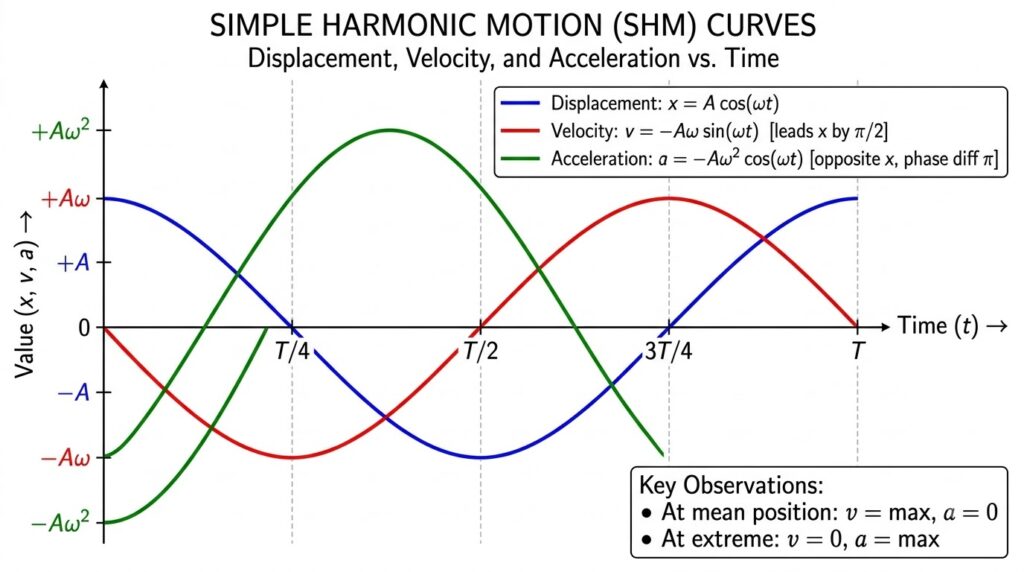
Q10. Write the velocity of a particle in SHM. v = −Aω sin(ωt + φ) or in terms of displacement: v = ±ω√(A² − x²) Maximum velocity: vmax = Aω (at x = 0, mean position)
Q11. Write the acceleration of a particle in SHM. a = −Aω² cos(ωt + φ) = −ω²x Maximum acceleration: amax = Aω² (at x = ±A, extreme positions)
Q12. What is the force law for SHM? F = ma = −mω²x = −kx The restoring force is proportional to displacement and directed toward the mean position. Spring constant k = mω².
Q13. What is the time period of a spring-mass system? T = 2π√(m/k) where m = mass attached to spring, k = spring constant.
Q14. What is the angular frequency of a spring-mass system? ω = √(k/m)
Q15. Write the time period of a simple pendulum. T = 2π√(L/g) where L = length of pendulum, g = acceleration due to gravity.
Q16. What is the angular frequency of a simple pendulum? ω = √(g/L)
Q17. What is the condition for a pendulum to execute SHM? The pendulum executes SHM only for small angular displacements (θ < 15° approximately) where sin θ ≈ θ (in radians).
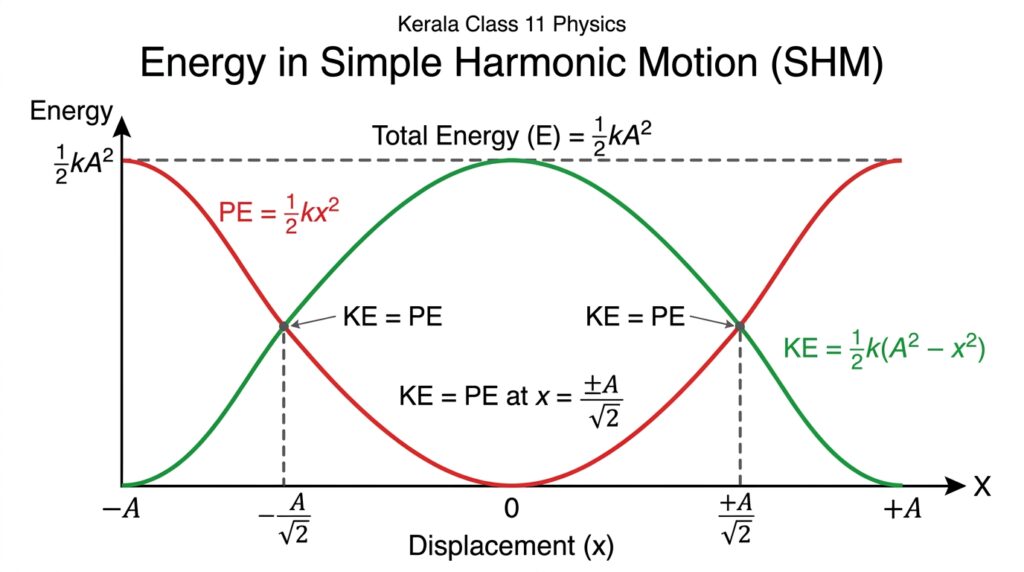
Q18. Write the expression for kinetic energy in SHM. KE = ½mω²(A² − x²) = ½mv² Maximum KE = ½mω²A² at x = 0 (mean position).
Q19. Write the expression for potential energy in SHM. PE = ½mω²x² = ½kx² Maximum PE = ½mω²A² at x = ±A (extreme positions).
Q20. Write the expression for total mechanical energy in SHM. E = KE + PE = ½mω²A² = constant Total energy is constant and proportional to the square of the amplitude.
Q21. At what position is KE maximum in SHM? KE is maximum at the mean (equilibrium) position (x = 0), where velocity is maximum.
Q22. At what position is PE maximum in SHM? PE is maximum at the extreme positions (x = ±A), where velocity is zero and KE = 0.
Q23. At what position are KE and PE equal in SHM? KE = PE when ½mω²(A² − x²) = ½mω²x² → A² − x² = x² → x = ±A/√2
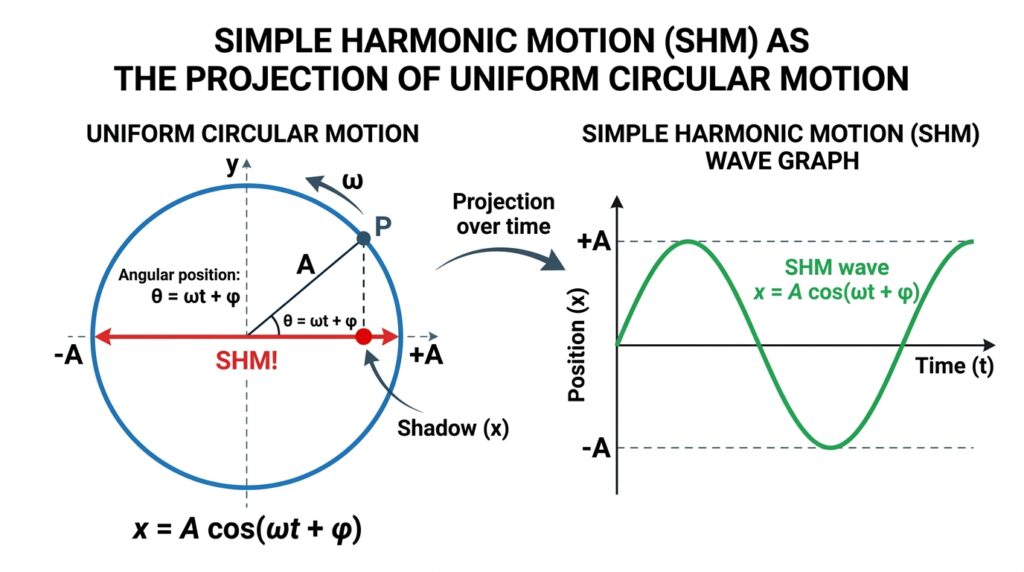
Q24. What is the reference circle (auxiliary circle) in SHM? SHM can be represented as the projection of uniform circular motion on a diameter. The circle of radius A (= amplitude) is the reference circle. The projection of the rotating radius vector on any axis gives the SHM displacement.
Q25. What is free oscillation? Free oscillation occurs when a body vibrates at its natural frequency after being given an initial displacement and released, without any external periodic force — only the restoring force acts.
Q26. What is damped oscillation? Damped oscillation is oscillation in which the amplitude decreases with time due to energy loss (friction, air resistance, viscosity). The system eventually comes to rest.
Q27. What is forced oscillation? Forced oscillation is oscillation produced when a body is subjected to a periodic external force with a frequency different from its natural frequency. The body vibrates at the applied frequency.
Q28. What is resonance? Resonance occurs when the frequency of the external driving force equals the natural frequency of the oscillating body. The amplitude becomes very large (maximum) at resonance.
Q29. What is the natural frequency of a system? The natural frequency is the frequency at which a system oscillates when displaced and released, without any external force or damping. It depends on the physical properties of the system.
Q30. What does the equation a = −ω²x signify? This equation means: acceleration is proportional to displacement and directed opposite to it (negative sign). This is the defining equation of SHM. Any motion described by this equation is simple harmonic.
Q31. Can a motion be periodic but not SHM? Give an example. Yes. Example: rotation of Earth about its axis (periodic but not oscillatory), or a ball bouncing off a floor (periodic but restoring force not proportional to displacement). SHM requires F ∝ −x specifically.
Q32. What is a seconds pendulum? A seconds pendulum has a time period of T = 2 s (takes 1 second for each half-swing). Its length on Earth: L = gT²/(4π²) = 9.8 × 4/(4π²) ≈ 0.993 m ≈ 1 m.
Q33. If the length of a pendulum is quadrupled, how does the time period change? T = 2π√(L/g) ∝ √L. If L → 4L: T → 2T. The time period doubles.
Q34. Does the time period of a simple pendulum depend on mass of the bob? No. T = 2π√(L/g) — it depends only on the length L and g, not on the mass of the bob.
Q35. A spring of spring constant k is cut into two equal halves. What is the spring constant of each half? For a spring of length l and spring constant k, the constant is inversely proportional to length (k ∝ 1/l). Each half has length l/2, so each half has spring constant 2k.
Q36. What is the phase difference between displacement and velocity in SHM? x = A cos(ωt + φ); v = −Aω sin(ωt + φ) = Aω cos(ωt + φ + π/2) The velocity leads the displacement by π/2 (90°).
Q37. What is the phase difference between displacement and acceleration in SHM? a = −Aω² cos(ωt + φ) = Aω² cos(ωt + φ + π) The acceleration is exactly out of phase with displacement (π = 180°) — always opposite.
Q38. Two springs of constants k₁ and k₂ are connected in series. Find the effective spring constant. 1/keff = 1/k₁ + 1/k₂ → keff = k₁k₂/(k₁ + k₂) (< each individual k)
Q39. Two springs of constants k₁ and k₂ are connected in parallel. Find effective spring constant. keff = k₁ + k₂ (> each individual k; both springs pull the mass back together)
Q40. A spring-mass system has T = 0.5 s. If mass is quadrupled, find new period. T ∝ √m. If m → 4m: T → 2T = 1.0 s
Q41. What is the displacement of a particle in SHM at time t = T/4 if x(0) = A (starts from extreme)? x = A cos(ωt) = A cos(2πt/T). At t = T/4: x = A cos(π/2) = 0 (at mean position)
Q42. What is the velocity at the mean position in SHM? v_max = Aω — maximum velocity occurs at x = 0 (mean position) since v = ω√(A² − x²).
Q43. State the equation of motion for SHM. d²x/dt² + ω²x = 0 or equivalently a + ω²x = 0 The general solution is: x = A cos(ωt + φ) or A sin(ωt + φ)
Q44. What is the time period of SHM of the tip of a tuning fork vibrating at 256 Hz? T = 1/ν = 1/256 = 3.9 × 10⁻³ s = 3.9 ms
Q45. What is the maximum displacement from equilibrium for x = 3 sin(2πt + π/4)? The maximum displacement = Amplitude = 3 (in whatever unit x is measured).
Q46. A spring balance reads 50 kg for a full-scale deflection of 20 cm. Find its spring constant. k = F/x = (50 × 9.8)/0.20 = 490/0.20 = 2450 N/m
Q47. What is angular frequency for a spring of k = 1200 N/m with mass m = 3 kg? ω = √(k/m) = √(1200/3) = √400 = 20 rad/s; T = 2π/20 = 0.314 s
Q48. What is the maximum acceleration for a spring-mass system (k=1200 N/m, m=3 kg, A=2 cm)? amax = Aω² = 0.02 × (20)² = 0.02 × 400 = 8 m/s²
Q49. What is the maximum speed for the spring-mass system in Q48? vmax = Aω = 0.02 × 20 = 0.4 m/s
Q50. Time period of a simple pendulum is 2 s on Earth. Find its period on Moon (gM = g/6). T ∝ 1/√g. TM/TE = √(gE/gM) = √6 TM = 2 × √6 = 2 × 2.449 = 4.9 s
2 Mark Questions and Answers (രണ്ട് മാർക്ക് ചോദ്യങ്ങൾ) — Oscillations
Q51. Distinguish between periodic, oscillatory, and simple harmonic motion. Periodic motion: Repeats after fixed time T. Not necessarily to-and-fro. Example: revolution of Earth around Sun.
Oscillatory motion: To-and-fro motion about a fixed equilibrium point. Example: swing of a pendulum. (All oscillatory motions are periodic.)
Simple harmonic motion: Special oscillatory motion where F = −kx (restoring force ∝ displacement). Displacement follows sine/cosine function. Example: spring-mass system, simple pendulum (small angles).
SHM ⊂ Oscillatory motion ⊂ Periodic motion.
Q52. Write the displacement equation of SHM and identify the terms. A particle starts from rest at x = A at t = 0. Write its displacement equation. General displacement: x(t) = A cos(ωt + φ)
- A = amplitude (max displacement)
- ω = angular frequency = 2π/T
- φ = initial phase
If x = A at t = 0 and starts from rest (v = 0 at t = 0): x(0) = A cos φ = A → φ = 0 x(t) = A cos(ωt)
Q53. Derive the expression for velocity of a particle executing SHM. x = A cos(ωt + φ)
v = dx/dt = −Aω sin(ωt + φ)
Since cos²(ωt+φ) + sin²(ωt+φ) = 1: sin(ωt+φ) = √(1 − x²/A²)
v = ±ω√(A² − x²)
At x = 0: vmax = Aω At x = ±A: v = 0 (momentarily at rest at extreme positions)
Q54. Derive the expression for acceleration in SHM and show a ∝ −x. v = −Aω sin(ωt + φ) a = dv/dt = −Aω² cos(ωt + φ) = −ω²x (since x = A cos(ωt + φ))
This shows: a ∝ −x — acceleration is proportional to displacement, directed opposite to it.
At x = 0: a = 0 (no acceleration at mean position) At x = ±A: |amax| = Aω² (maximum acceleration at extreme positions)
Q55. Derive the expression for time period of a spring-mass system. For a mass m on a spring (k), displaced by x: Restoring force: F = −kx By Newton’s second law: ma = −kx → a = −(k/m)x
Comparing with a = −ω²x: ω² = k/m → ω = √(k/m)
T = 2π/ω = 2π√(m/k) ✓
Depends on m and k only — not on g (works in space, on a moving train, etc.).
Q56. Derive the time period of a simple pendulum for small oscillations. For pendulum bob of mass m, string length L, angle θ: Restoring torque: τ = −mgL sin θ ≈ −mgLθ (for small θ) Equation: Iα = −mgLθ → (mL²)α = −mgLθ → α = −(g/L)θ
Comparing: ω² = g/L → T = 2π√(L/g) ✓
Depends on L and g only — not on mass of bob or amplitude (for small angles).
Q57. Derive the expression for total energy in SHM. Show it is constant. KE = ½mv² = ½m × ω²(A² − x²) = ½mω²(A² − x²)
PE = ½kx² = ½mω²x² (since k = mω²)
Total E = KE + PE = ½mω²(A² − x²) + ½mω²x² = ½mω²A² − ½mω²x² + ½mω²x² = ½mω²A² = constant ✓
Total energy depends only on amplitude A, mass m, and ω — independent of position x.
Q58. A spring-mass system (k = 50 N/m, m = 1 kg) oscillates with amplitude 10 cm. Find (a) ω (b) T (c) vmax (d) amax (e) total energy. (a) ω = √(k/m) = √(50/1) = √50 = 7.07 rad/s (b) T = 2π/ω = 2π/7.07 = 0.889 s ≈ 0.89 s (c) vmax = Aω = 0.10 × 7.07 = 0.707 m/s (d) amax = Aω² = 0.10 × 50 = 5 m/s² (e) E = ½kA² = ½ × 50 × (0.10)² = ½ × 50 × 0.01 = 0.25 J ✓
Q59. Find KE and PE at x = 5 cm for the system in Q58. Verify E = KE + PE. KE = ½mω²(A² − x²) = ½ × 1 × 50 × (0.01 − 0.0025) = 25 × 0.0075 = 0.1875 J PE = ½kx² = ½ × 50 × (0.05)² = 25 × 0.0025 = 0.0625 J E = 0.1875 + 0.0625 = 0.25 J ✓ (matches total energy)
Q60. A simple pendulum has T = 3.5 s on Earth. Find T on Moon (gM = 1.7 m/s², gE = 9.8 m/s²). T ∝ 1/√g (for same length L): T_moon/T_earth = √(g_earth/g_moon) = √(9.8/1.7) = √5.76 = 2.4 T_moon = 3.5 × 2.4 = 8.4 s
Q61. What is the SHM equation for x = A sin(ωt)? Find its velocity and acceleration. Displacement: x = A sin(ωt) Velocity: v = Aω cos(ωt) = ω√(A² − x²) Acceleration: a = −Aω² sin(ωt) = −ω²x
At t = 0: x = 0 (starts at mean position), v = Aω (max velocity), a = 0.
Q62. Two springs (k₁ = 200 N/m, k₂ = 300 N/m) connected in series to a 5 kg mass. Find T. 1/keff = 1/200 + 1/300 = 3/600 + 2/600 = 5/600 keff = 120 N/m
T = 2π√(m/keff) = 2π√(5/120) = 2π√(1/24) = 2π × 0.204 = 1.28 s
Q63. Explain damped oscillations. Write the equation of damped SHM. In damped oscillations, a resistive force (friction, air resistance) opposes the motion. The amplitude decreases exponentially with time.
Equation: m(d²x/dt²) + b(dx/dt) + kx = 0 or: d²x/dt² + (b/m)(dx/dt) + ω₀²x = 0
Solution: x(t) = A₀e^(−bt/2m) cos(ω’t + φ)
where ω’ = √(ω₀² − b²/4m²) (damped angular frequency, slightly less than ω₀) Amplitude: A(t) = A₀e^(−bt/2m) — exponential decay
Energy: E(t) = E₀e^(−bt/m) — also decays exponentially
Q64. Explain resonance with examples. When does it occur? Resonance occurs when the driving frequency equals the natural frequency (ω_d = ω₀).
At resonance:
- Amplitude is maximum (theoretically infinite for no damping; finite for damped systems)
- Energy transfer is most efficient
Examples:
- Soldiers break step while crossing a bridge — to avoid resonance between stepping frequency and bridge’s natural frequency (Tacoma Narrows Bridge disaster, 1940).
- MRI machines — resonance of atomic nuclei in magnetic fields.
- Radio/TV tuning — adjusting LC circuit to resonate with broadcast frequency.
- Wine glass shattering — singer’s voice at natural frequency of glass.
- Child on a swing — pushing at natural frequency gives large amplitude.
Q65. What is the effective length of a pendulum? How does it affect the time period? The effective length L of a pendulum is the distance from the point of suspension to the centre of gravity of the bob (not the end of the string).
T = 2π√(L/g) — time period increases with L.
Practical applications:
- Grandfather clocks: Length adjusted so T = 2 s exactly.
- Clocks at altitude: g decreases → T increases → clock runs slow.
- Clocks at depth: g also decreases → T increases → clock runs slow.
- Temperature effect: L increases with temperature (thermal expansion) → T increases → clock runs slow in summer.

3 Mark Questions and Answers (മൂന്ന് മാർക്ക് ചോദ്യങ്ങൾ) — Oscillations
Q71. What is SHM? Derive the differential equation of SHM and its solution. SHM: Periodic motion in which restoring force is proportional to displacement and opposite in direction: F = −kx.
Differential equation: Newton’s second law: F = ma → ma = −kx d²x/dt² = −(k/m)x = −ω²x where ω = √(k/m) d²x/dt² + ω²x = 0 ← equation of SHM
Solution: The general solution is: x(t) = A cos(ωt + φ)
Verification: dx/dt = −Aω sin(ωt + φ); d²x/dt² = −Aω² cos(ωt + φ) = −ω²x ✓
Physical meaning: A = amplitude (from initial conditions), φ = initial phase (from boundary conditions), ω = √(k/m) — determined by the restoring force.
Q72. Derive the time period of a spring-mass system. Show it is independent of amplitude and g. (see Q55 above — detailed derivation) T = 2π√(m/k)
Independence of amplitude: T = 2π√(m/k) — no A in this formula. Larger amplitude → faster max speed, but same period.
Independence of g: k is a property of the spring (elastic force), not gravity. Hence T is the same in space, on Moon, or on Earth — unlike a pendulum.
Q73. Derive the total energy in SHM. Show it equals ½kA². Draw KE-PE variation graphs. (see Q57 above — detailed derivation) E = ½mω²A² = ½kA² = constant ✓
Graphs:
- KE vs x: Parabola opening downward, max at x=0, zero at x=±A: KE = ½k(A²−x²)
- PE vs x: Parabola opening upward, zero at x=0, max at x=±A: PE = ½kx²
- KE vs t: PE = ½kA² sin²(ωt+φ) — always between 0 and ½kA²
- Total E = ½kA²: horizontal straight line
- KE and PE oscillate at 2ω (twice the SHM frequency)
Q74. A spring-mass system (k=1200 N/m, m=3 kg) is pulled 2 cm and released. Find: (a) ω (b) frequency (c) vmax (d) amax (e) energy. (a) ω = √(k/m) = √(1200/3) = √400 = 20 rad/s
(b) ν = ω/(2π) = 20/(2π) = 3.18 Hz
(c) vmax = Aω = 0.02 × 20 = 0.4 m/s
(d) amax = Aω² = 0.02 × 400 = 8 m/s²
(e) E = ½kA² = ½ × 1200 × (0.02)² = ½ × 1200 × 4×10⁻⁴ = 0.24 J
Q75. Derive the time period of a simple pendulum. What are its limitations? (see Q56 above — detailed derivation with torque approach) T = 2π√(L/g) ✓
Limitations:
- Valid only for small angles (θ < 15°) where sin θ ≈ θ.
- Assumes massless, inextensible string.
- Assumes bob is a point mass.
- Assumes no air resistance or friction.
- For large amplitudes, T depends on amplitude (T increases with amplitude for large swings).
Q76. Show that SHM is the projection of uniform circular motion on a diameter. Consider a particle P moving in a circle of radius A with uniform angular speed ω. At time t, angle from x-axis = ωt + φ.
x-projection of P: x = A cos(ωt + φ) y-projection of P: y = A sin(ωt + φ)
Each projection independently satisfies: d²x/dt² = −Aω² cos(ωt+φ) = −ω²x ← SHM equation ✓
This shows SHM = projection of uniform circular motion.
Reference circle: Circle of radius = amplitude, rotating at angular speed ω. SHM: Shadow of the rotating point on any diameter.
This connection explains:
- Why SHM is described by sinusoidal functions
- The meaning of phase φ (initial angle in the circle)
- Why ω for SHM is same as angular speed of the reference circle
Q77. Compare the oscillations of a spring-mass system in horizontal and vertical configurations. Horizontal spring-mass: Restoring force = spring force = −kx T = 2π√(m/k) — independent of g
Vertical spring-mass: At equilibrium: spring is extended by x₀ = mg/k (static stretch) For displacement x from new equilibrium: Net force = −k(x₀ + x) + mg = −kx (the mg and kx₀ cancel!) Same equation: T = 2π√(m/k) — same as horizontal! ✓
Conclusion: Gravity doesn’t affect the time period of a spring-mass system — it only shifts the equilibrium position. The time period is the same horizontal or vertical.
Q78. Describe forced oscillations and resonance. Give the Tacoma Narrows Bridge example. Forced oscillations: A driving periodic force F_ext = F₀ cos(ω_dt) is applied to a damped oscillating system. System vibrates at ω_d (not at ω₀).
Amplitude: A(ω_d) = F₀/m / √[(ω₀² − ω_d²)² + (b/m)²ω_d²]
At resonance (ω_d = ω₀): denominator minimized → A maximized.
Tacoma Narrows Bridge (1940):
- Suspension bridge in Washington, USA.
- Wind blowing at a frequency matching the bridge’s natural frequency.
- Resonance caused the bridge to oscillate with increasing amplitude.
- Bridge collapsed dramatically in just a few hours.
- Led to redesign of all suspension bridges to avoid resonance.
Lesson: Resonance is not always desirable. Engineers must ensure that operating frequencies of machines, vehicles, and structures avoid their natural frequencies.
Q79. What is damped SHM? Explain underdamping, overdamping, and critical damping. Damped SHM: Oscillation with resistive force F_damp = −bv (b = damping coefficient). Equation: m(d²x/dt²) + b(dx/dt) + kx = 0 x(t) = A₀e^(−bt/2m) cos(ω’t + φ)
Three cases based on value of b:
Underdamping (b < 2√(mk)): System oscillates with decreasing amplitude. ω’ < ω₀. Example: LCR circuit with small resistance; car shock absorbers (designed for this).
Critical damping (b = 2√(mk)): System returns to equilibrium in the shortest time without oscillating. ω’ = 0. Example: car door suspensions; galvanometer damping.
Overdamping (b > 2√(mk)): System returns to equilibrium very slowly without oscillating — sluggish response. Example: heavy overdamped shock absorbers.
Q80. Find the position where KE = PE in SHM. Also find the velocity when displacement is half the amplitude. Where KE = PE: ½mω²(A² − x²) = ½mω²x² A� − x² = x² → 2x² = A² → x = ±A/√2
At x = A/√2: KE = PE = ½ × ½kA² = ¼kA² (each = half total energy)
Velocity at x = A/2: v = ω√(A² − x²) = ω√(A² − A²/4) = ω√(3A²/4) = (√3/2)Aω = (√3/2)vmax
5 Mark / Essay Questions and Answers (അഞ്ച് മാർക്ക് ചോദ്യങ്ങൾ)
Q81. (a) Define SHM. (b) Derive its differential equation. (c) Write the general solution and explain terms. (d) A 1 kg mass on a spring (k=50 N/m) oscillates with A=10 cm. Find ω, T, vmax, amax, energy. (e) Find KE and PE at x=5 cm.
(a) SHM: F = −kx; a = −ω²x. (b) d²x/dt² + ω²x = 0 (see Q71). (c) x(t) = A cos(ωt + φ): A = amplitude, ω = angular frequency, φ = phase constant. (d) (see Q58): ω = 7.07 rad/s, T = 0.89 s, vmax = 0.707 m/s, amax = 5 m/s², E = 0.25 J. (e) (see Q59): KE = 0.1875 J, PE = 0.0625 J, total = 0.25 J ✓.
Q82. (a) Derive T = 2π√(L/g) for simple pendulum. (b) State its conditions. (c) A pendulum T = 3.5 s on Earth. Find T on Moon (gM = 1.7 m/s²). (d) Find length on Earth (gE = 9.8 m/s²). (e) How to use pendulum as a clock?
(a) Derivation using torque (see Q56): T = 2π√(L/g) ✓ (b) Conditions: small angle (θ<15°), massless string, point bob, no friction. (c) T_moon = T_earth × √(gE/gM) = 3.5 × √(9.8/1.7) = 3.5 × 2.4 = 8.4 s (d) L = gT²/(4π²) = 9.8 × 12.25/(4π²) = 120.05/39.48 = 3.04 m (e) As a clock: A seconds pendulum (T=2s, L≈1m) keeps time by each half-swing taking 1s. Any deviation of g or L causes clock to gain/lose time: Δt/t = ½ΔL/L or −½Δg/g.
Q83. (a) Derive energy expressions in SHM. (b) Show total energy is constant. (c) Sketch KE, PE, and total E vs displacement x. (d) A spring-mass (k=1200 N/m, m=3 kg, A=2 cm): Find total E. At what displacement does KE = 2PE?
(a) KE = ½mω²(A²−x²); PE = ½mω²x²; E = ½mω²A² (see Q57) ✓ (b) E = KE + PE = constant (derived in Q57) ✓ (c) Graphs: PE parabola (upward, zero at x=0, max at x=±A); KE parabola (downward, max at x=0); E = horizontal line. (d) E = ½kA² = ½ × 1200 × 4×10⁻⁴ = 0.24 J
For KE = 2PE: ½mω²(A²−x²) = 2 × ½mω²x² A� − x² = 2x² → x² = A²/3 → x = A/√3 = 2/√3 ≈ 1.15 cm
Q84. (a) Explain free, damped, and forced oscillations. (b) What is resonance? (c) State two applications and two harmful effects of resonance. (d) Explain critical damping with an example.
(a) Free: natural frequency, no external force. Damped: amplitude decreases due to friction. Forced: driven by external periodic force at driving frequency.
(b) Resonance: driving frequency = natural frequency → maximum amplitude.
(c) Applications: Radio tuning; microwave cooking (water molecules resonate); MRI scanning; music (resonance in guitar body amplifies sound).
Harmful effects: Tacoma Narrows Bridge collapse; Barham Suspension Bridge near Manchester oscillations; machinery vibration causing fatigue; earthquake resonance with buildings.
(d) Critical damping: Exactly b = 2√(mk). System returns to equilibrium as fast as possible without oscillating. Used in door dampers, galvanometers, shock absorbers for best performance. Also in suspension bridges (dampers prevent resonance).
Q85. (a) Show SHM is projection of uniform circular motion. (b) Two identical springs (each k=200 N/m) and a 4 kg mass: Find T for (i) series (ii) parallel. (c) Compare their time periods with a pendulum of L=1m.
(a) (see Q76) x = A cos(ωt + φ) is projection of circular motion ✓
(b) (i) Series: keff = 200×200/(200+200) = 100 N/m T_series = 2π√(4/100) = 2π × 0.2 = 1.257 s
(ii) Parallel: keff = 200+200 = 400 N/m T_parallel = 2π√(4/400) = 2π × 0.1 = 0.628 s
(c) Pendulum (L=1m, g=9.8 m/s²): T_pendulum = 2π√(1/9.8) = 2π × 0.319 = 2.006 s
Comparison: T_series = 1.257 s < T_pendulum = 2.006 s < T_parallel × 3.2… wait: T_parallel = 0.628 s < T_series = 1.257 s < T_pendulum = 2.006 s.
Parallel springs → stiffest system → shortest period. Series springs → softest → longer period. Pendulum depends only on L and g.
Additional Important Questions (Kerala Board Previous Year Style)
Q86. Which of the following represent SHM: (a) x = A sin²ωt (b) x = A cos(ωt + π/3) (c) x = A sin ωt + B cos ωt? (a) x = A sin²ωt = A(1−cos2ωt)/2 → NOT SHM (constant + cosine; non-zero mean) (b) x = A cos(ωt + π/3) → SHM (pure cosine with constant amplitude) (c) x = A sin ωt + B cos ωt = C cos(ωt + φ) where C = √(A²+B²) → SHM ✓
Q87. At what displacement in SHM is the speed of the particle half the maximum speed? v = ω√(A²−x²) = vmax/2 = Aω/2 A�−x² = A²/4 → x² = 3A²/4 → x = ±(√3/2)A
Q88. Two pendulums have lengths 1 m and 0.25 m. What is the ratio of their time periods? T ∝ √L → T₁/T₂ = √(L₁/L₂) = √(1/0.25) = √4 = 2 : 1
Q89. A spring is stretched 5 cm by a 100 g mass. Find spring constant and time period of oscillation. k = F/x = (0.1 × 9.8)/0.05 = 19.6 N/m T = 2π√(m/k) = 2π√(0.1/19.6) = 2π√0.0051 = 2π × 0.0714 = 0.449 s ≈ 0.45 s
Q90. A 100 g mass is attached to a spring and makes 10 oscillations in 20 s. Find k. T = 20/10 = 2 s; ω = 2π/T = π rad/s k = mω² = 0.1 × π² = 0.987 N/m ≈ 1 N/m
Q91. The displacement of a particle is x = 10 sin(3πt + π/4) cm. Find A, ω, T, phase at t=0. Amplitude A = 10 cm; ω = 3π rad/s; T = 2π/(3π) = 2/3 s; φ₀ = π/4 rad = 45°
Q92. Can a simple pendulum be used as a clock on a satellite? Explain. No. Inside a satellite in orbit, the effective value of g = 0 (weightlessness/free fall). T = 2π√(L/g) → T → ∞ when g = 0. The pendulum will not oscillate at all — it will just float. A spring-mass system clock would work in space since it does not depend on g.
Q93. What is the effect on the time period of a pendulum if (a) temperature increases (b) it is taken to a mine? (a) Temperature increase: Length L increases due to thermal expansion → T increases → pendulum clock runs slow.
(b) Mine (below Earth’s surface): g decreases below surface (g(d) = g(1−d/R)). T = 2π√(L/g) → T increases → clock runs slow.
Q94. Write the equation of SHM for a particle starting from rest at x = −A at t = 0. x(0) = −A → A cos φ = −A → cos φ = −1 → φ = π x(t) = A cos(ωt + π) = −A cos(ωt)
At t = 0: x = −A ✓; v = dx/dt = Aω sin(ωt)|₀ = 0 ✓
Q95. A 58 g mass on a spring (k = 5.8 N/m) oscillates. Find the total energy and the velocity when x = A/2. ω² = k/m = 5.8/0.058 = 100 → ω = 10 rad/s
If A = 5 cm = 0.05 m: E = ½kA² = ½ × 5.8 × (0.05)² = ½ × 5.8 × 0.0025 = 7.25 × 10⁻³ J
v at x = A/2: v = ω√(A² − A²/4) = 10 × √(3/4) × 0.05 = 10 × 0.866 × 0.05 = 0.433 m/s
Frequently Asked Questions (FAQ) — Kerala Plus One Physics Chapter 13
- What is simple harmonic motion? State its defining equation. (Kerala Board) SHM is periodic motion where restoring force ∝ displacement and directed opposite: F = −kx, a = −ω²x. Displacement: x = A cos(ωt + φ). Defining feature: acceleration is proportional to and opposite to displacement.
- ആന്ദോളനം — ലളിത ഹാർമോണിക് ചലനം (SHM in Malayalam) ലളിത ഹാർമോണിക് ചലനം (SHM) — ഒരു കണം അതിൻ്റെ സന്തുലനം (equilibrium) ആൻ്റെ ഇരുവശങ്ങളിലും ഒരേ ആവർത്തനത്തോടെ ചലിക്കുന്ന ആനുകാലിക ചലനം. F = -kx. T = 2π/ω.
- What is the time period of a simple pendulum? What does it depend on? (Plus One Kerala) T = 2π√(L/g). Depends on: (1) length L (T ∝ √L) and (2) acceleration due to gravity g (T ∝ 1/√g). Does NOT depend on mass of bob or amplitude (for small oscillations).
- Derive the energy expressions in SHM. (Kerala Board) KE = ½mω²(A²−x²); PE = ½kx² = ½mω²x²; Total E = ½mω²A² = ½kA² = constant. At mean position: KE max, PE=0. At extreme: KE=0, PE max. KE = PE at x = ±A/√2.
- What is resonance? Give two examples. (Kerala Board) Resonance occurs when driving frequency = natural frequency → maximum amplitude. Examples: Tacoma Narrows Bridge collapse; radio tuning; MRI machines; pendulum clock beating; swing pushed at natural frequency.
- What is the time period of a spring-mass system? How does it differ from a pendulum? T = 2π√(m/k). Depends on mass and spring constant only — NOT on g or amplitude. Works in space. Pendulum: T = 2π√(L/g) — depends on g, works only in gravitational field.
This article covers Kerala Plus One Physics Chapter 13 — Oscillations (ആന്ദോളനം) — with 150+ questions covering SHM, Spring-Mass System, Simple Pendulum, Energy in SHM, Damped Oscillations, Forced Oscillations, and Resonance, following the Kerala Board (SCERT) exam pattern. Visit hsslives.com for chapter-wise solutions for all Plus One and Plus Two subjects.