
Thermodynamics Class 11 Questions and Answers | Kerala Plus One Physics Chapter 11 (താപഗതിശാസ്ത്രം ചോദ്യോത്തരങ്ങൾ)
Kerala Plus One Physics Chapter 11 — Thermodynamics (താപഗതിശാസ്ത്രം) is one of the most conceptually important chapters in the Kerala Board (SCERT) Class 11 exam. This article provides 150+ Questions and Answers strictly following the Kerala Higher Secondary exam pattern with 1 Mark, 2 Mark, 3 Mark, and 5 Mark categories. Thermodynamics Chapter 11 Questions and Answers for Kerala Plus One Physics Class 11. 150+ questions covering Zeroth Law, First Law, Second Law, Carnot Engine, Thermodynamic Processes, Cp-Cv=R — 1 Mark to 5 Mark as per Kerala Board SCERT exam pattern. താപഗതിശാസ്ത്രം ചോദ്യോത്തരങ്ങൾ.
Whether you are searching for Plus One Physics Chapter 11 Kerala solutions, Carnot engine questions and answers, or താപഗതിശാസ്ത്രം ചോദ്യോത്തരങ്ങൾ, this complete guide is for you. Plus One Physics Chapter 11 Kerala, Carnot Engine Questions Kerala Board, താപഗതിശാസ്ത്രം ചോദ്യങ്ങൾ, First Law Thermodynamics Kerala SCERT, Isothermal Adiabatic Process Plus One, Second Law Thermodynamics Class 11 Kerala.
1 Mark Questions and Answers (ഒരു മാർക്ക് ചോദ്യങ്ങൾ) — Thermodynamics
Q1. What is thermodynamics? Thermodynamics is the branch of physics that deals with the concepts of heat, temperature, and the inter-conversion of heat and other forms of energy. It is a macroscopic science dealing with bulk systems.
Q2. What is thermal equilibrium? Two systems are in thermal equilibrium when they are in contact and their macroscopic variables (especially temperature) do not change with time. Heat stops flowing between them.
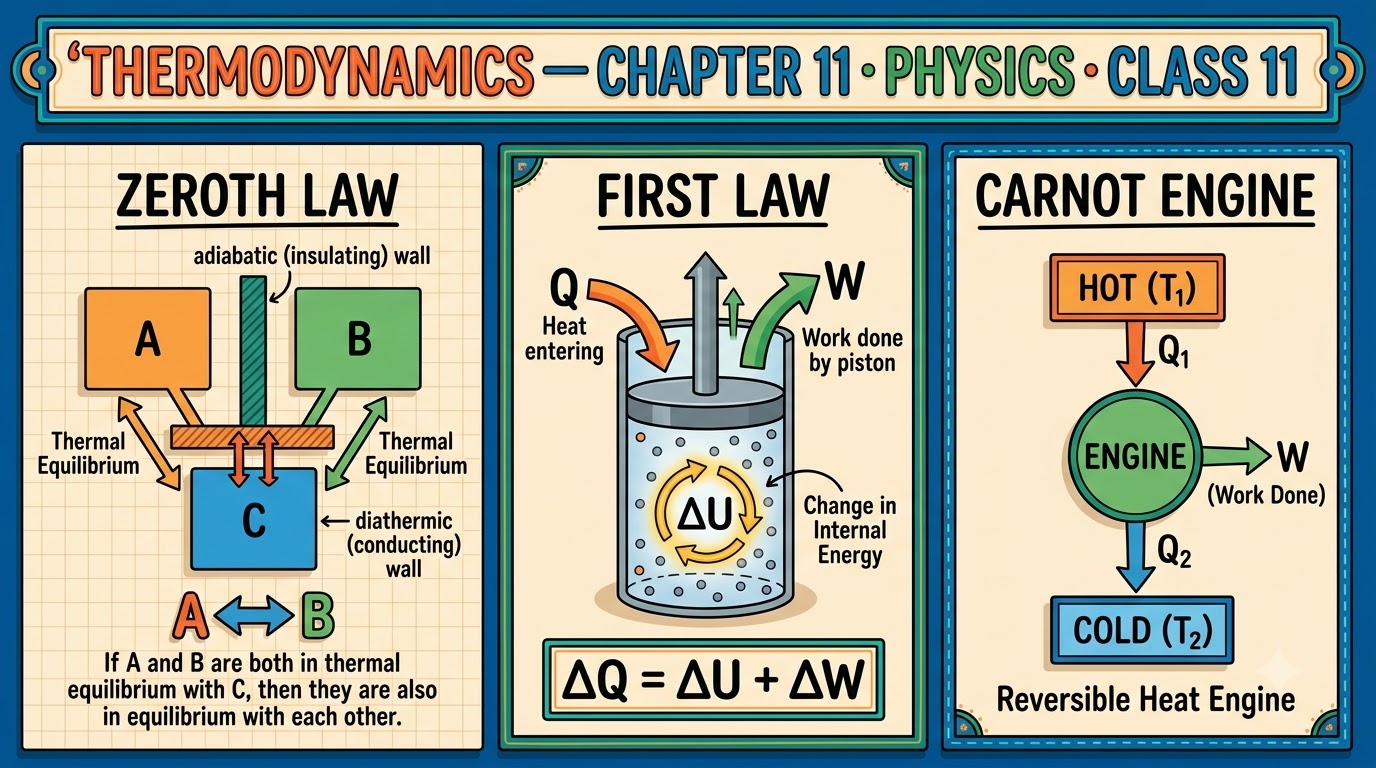
Q3. State the Zeroth Law of Thermodynamics. If two systems A and B are separately in thermal equilibrium with a third system C, then A and B are also in thermal equilibrium with each other.
Q4. What concept does the Zeroth Law define? The Zeroth Law of Thermodynamics provides the basis for the concept of temperature. Temperature is the common property shared by all systems in thermal equilibrium with each other.
Q5. What is internal energy? Internal energy (U) is the sum of the kinetic energies and potential energies of all the molecular constituents of a system. It is a state variable — it depends only on the current state of the system, not on how that state was reached.
Q6. State the First Law of Thermodynamics. The First Law of Thermodynamics is the law of conservation of energy applied to thermal systems: ΔQ = ΔU + ΔW where ΔQ = heat supplied to system, ΔU = change in internal energy, ΔW = work done by system.
Q7. What is a state variable? Give examples. A state variable is a physical quantity whose value depends only on the current state of the system, not on the path taken to reach that state. Examples: pressure (P), volume (V), temperature (T), internal energy (U). Heat (Q) and work (W) are NOT state variables.
Q8. What is an equation of state? An equation of state is a relation connecting the different state variables of a thermodynamic system. For an ideal gas: PV = μRT
Q9. What is a quasi-static process? A quasi-static process is an infinitely slow, idealised process in which the system remains in thermal and mechanical equilibrium with its surroundings at every stage. The system passes through a continuous sequence of equilibrium states.
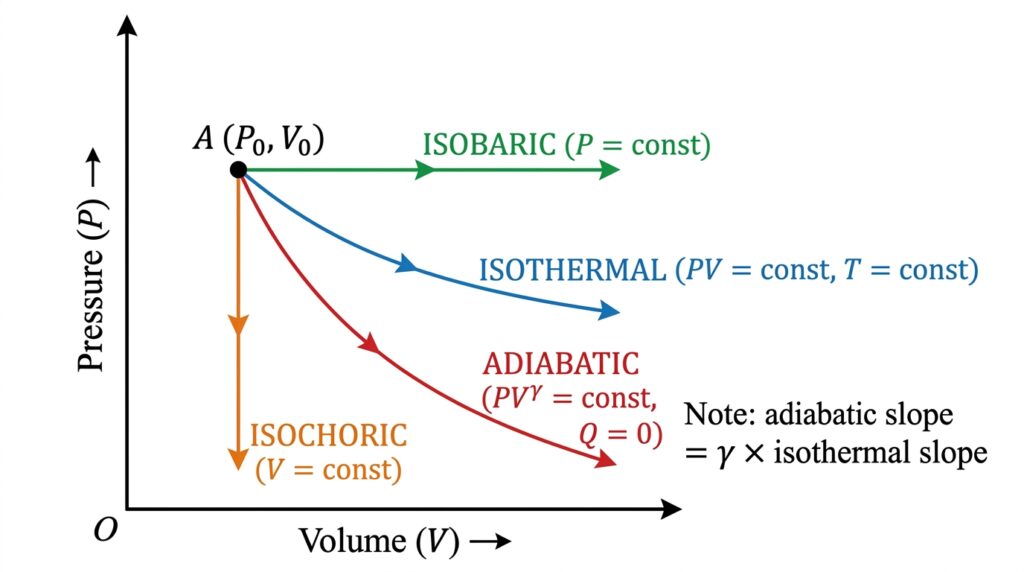
Q10. What is an isothermal process? An isothermal process is a thermodynamic process in which the temperature remains constant throughout (ΔT = 0 → ΔU = 0 for ideal gas). For ideal gas: PV = constant (Boyle’s Law)
Q11. What is an adiabatic process? An adiabatic process is one in which no heat is exchanged between the system and surroundings (ΔQ = 0). For an ideal gas: PVγ = constant where γ = Cp/Cv
Q12. What is an isochoric process? An isochoric (isovolumetric) process is one in which the volume remains constant (ΔV = 0). Therefore, no work is done: ΔW = PΔV = 0. All heat goes into changing internal energy: ΔQ = ΔU.
Q13. What is an isobaric process? An isobaric process is one in which the pressure remains constant throughout (ΔP = 0). Work done: ΔW = PΔV = μR(T₂ − T₁). Heat goes partly to ΔU and partly to work.
Q14. What is a cyclic process? In a cyclic process, the system returns to its initial state after a series of processes. Since internal energy is a state variable, ΔU = 0 for a complete cycle. Therefore: ΔQ = ΔW (total heat absorbed = total work done).
Q15. Define the ratio γ = Cp/Cv. γ is the ratio of molar specific heat at constant pressure to molar specific heat at constant volume: γ = Cp/Cv For monatomic ideal gas: γ = 5/3 ≈ 1.67 For diatomic ideal gas: γ = 7/5 = 1.4
Q16. State the relation Cp − Cv = R. For an ideal gas, the molar specific heats at constant pressure and constant volume are related by: Cp − Cv = R where R = 8.314 J mol⁻¹ K⁻¹ is the universal gas constant.
Q17. What is the work done in an isothermal process? W = μRT ln(V₂/V₁) Since ΔU = 0 for isothermal process of ideal gas: Q = W = μRT ln(V₂/V₁)
Q18. What is the work done in an adiabatic process? W = μR(T₁ − T₂)/(γ − 1) Since ΔQ = 0: ΔW = −ΔU → all work comes from decrease in internal energy.
Q19. State the Second Law of Thermodynamics (Kelvin-Planck statement). No process is possible whose sole result is the complete conversion of heat absorbed from a reservoir into work. (A perfect heat engine is impossible.)
Q20. State the Second Law (Clausius statement). No process is possible whose sole result is the transfer of heat from a colder object to a hotter object without any work input. (A perfect refrigerator is impossible.)
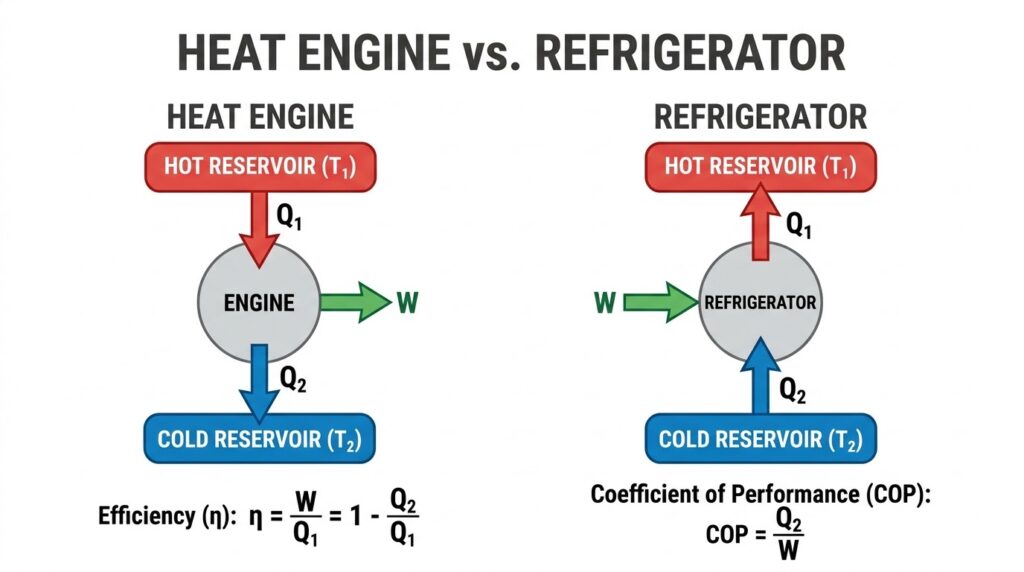
Q21. What is a heat engine? A heat engine is a device that converts heat energy into mechanical work by operating in a cycle. It takes heat Q₁ from a hot source, converts part of it to work W, and releases the remaining heat Q₂ to a cold sink.
Q22. What is the efficiency of a heat engine? Efficiency η = Work done / Heat absorbed from source: η = W/Q₁ = 1 − Q₂/Q₁ For any real engine: η < 1 (100% efficiency is impossible by Second Law).
Q23. What is a Carnot engine? A Carnot engine is an ideal reversible heat engine operating between two temperatures T₁ (hot source) and T₂ (cold sink). It achieves the maximum possible efficiency for any heat engine operating between those two temperatures.
Q24. What is the efficiency of a Carnot engine? η_Carnot = 1 − T₂/T₁ = (T₁ − T₂)/T₁ where T₁ = temperature of hot source (K) and T₂ = temperature of cold sink (K).
Q25. What are the four steps of the Carnot cycle?
- Isothermal expansion at T₁ (absorbs Q₁)
- Adiabatic expansion (temperature drops from T₁ to T₂)
- Isothermal compression at T₂ (releases Q₂)
- Adiabatic compression (temperature rises from T₂ to T₁)
Q26. What is Carnot’s theorem? Carnot’s theorem states:
- No heat engine operating between two temperatures can be more efficient than a Carnot engine operating between the same temperatures.
- The efficiency of a Carnot engine is independent of the nature of the working substance — it depends only on T₁ and T₂.
Q27. What is a refrigerator? A refrigerator is a device that transfers heat from a cold reservoir to a hot reservoir by receiving work input. It is a heat engine operating in reverse.
Q28. What is the coefficient of performance (COP) of a refrigerator? COP = Heat removed from cold reservoir / Work done: COP = Q₂/W = Q₂/(Q₁ − Q₂) = T₂/(T₁ − T₂) (for Carnot refrigerator) A higher COP means more efficient refrigerator.
Q29. What is an intensive variable? Give examples. An intensive variable does not depend on the size of the system — it has the same value for each half if the system is divided. Examples: pressure (P), temperature (T), density (ρ).
Q30. What is an extensive variable? Give examples. An extensive variable is proportional to the size (amount) of the system — it gets halved if the system is divided. Examples: internal energy (U), volume (V), total mass (M).
Q31. For an isothermal process of an ideal gas, what is ΔU? ΔU = 0 — For an ideal gas, internal energy depends only on temperature. Since temperature is constant in an isothermal process, there is no change in internal energy.
Q32. For an adiabatic process, what is ΔQ? ΔQ = 0 — No heat exchange occurs in an adiabatic process (system is thermally insulated).
Q33. In an isochoric process, what is the work done? ΔW = PΔV = 0 (volume is constant, so no work done against/by surroundings). All heat supplied goes to increase internal energy: ΔQ = ΔU.
Q34. A Carnot engine operates between 500 K and 300 K. Find efficiency. η = 1 − T₂/T₁ = 1 − 300/500 = 1 − 0.6 = 0.4 = 40%
Q35. What is the relation between Q₁/Q₂ and T₁/T₂ in a Carnot cycle? Q₁/Q₂ = T₁/T₂ Heat absorbed and released are proportional to the corresponding absolute temperatures.
Q36. Why is the Carnot engine not 100% efficient? By the Second Law, the entire heat absorbed from the hot source cannot be converted to work — some must be rejected to the cold sink. Therefore η = 1 − T₂/T₁ < 1, as long as T₂ > 0 K. For η = 1, we need T₂ = 0 K (absolute zero) which is unattainable.
Q37. What is a reversible process? A reversible process is one that can be reversed exactly — both the system and surroundings return to their original states with no net change anywhere in the universe. It requires: (1) quasi-static process + (2) no dissipative effects (no friction, viscosity, etc.).
Q38. What is an irreversible process? Give examples. An irreversible process cannot be reversed to restore both system and surroundings exactly. Examples: spontaneous heat flow from hot to cold, free expansion of gas, mixing of gases, combustion, diffusion.
Q39. Why are all natural processes irreversible? Natural processes involve: (1) dissipative effects (friction, viscosity) that convert mechanical energy to heat which cannot be fully recovered; (2) the system passes through non-equilibrium states (e.g., free expansion). The Second Law forbids exact reversal of these processes.
Q40. What is the work done by an ideal gas in an isobaric process? W = P(V₂ − V₁) = μR(T₂ − T₁) since PV = μRT → PΔV = μRΔT for constant pressure.
Q41. What is a diathermic wall? A diathermic wall is a thermally conducting wall that allows heat flow between two systems. Systems in contact through a diathermic wall eventually reach thermal equilibrium.
Q42. What is an adiabatic wall? An adiabatic wall is a perfectly insulating wall that does not allow any heat flow between the two systems on either side of it.
Q43. For 1 mole of monatomic ideal gas, what are Cv and Cp? Cv = (3/2)R ≈ 12.5 J mol⁻¹ K⁻¹ (3 translational degrees of freedom) Cp = Cv + R = (5/2)R ≈ 20.8 J mol⁻¹ K⁻¹ γ = Cp/Cv = 5/3 ≈ 1.67
Q44. For 1 mole of diatomic ideal gas, what are Cv and Cp? Cv = (5/2)R ≈ 20.8 J mol⁻¹ K⁻¹ (3 translational + 2 rotational degrees of freedom) Cp = (7/2)R ≈ 29.1 J mol⁻¹ K⁻¹ γ = Cp/Cv = 7/5 = 1.4
Q45. What is molar heat capacity at constant volume (Cv)? Cv = (1/μ)(ΔQ/ΔT)_v = (ΔU/ΔT) (since ΔW = 0 at constant volume) SI unit: J mol⁻¹ K⁻¹
Q46. What is molar heat capacity at constant pressure (Cp)? Cp = (1/μ)(ΔQ/ΔT)_p (heat needed to raise temperature of 1 mole by 1 K at constant pressure) Cp > Cv because at constant pressure, extra heat is needed to do work against the atmosphere (PΔV work).
Q47. Why is Cp > Cv? At constant pressure, when temperature rises, the gas expands and does work PΔV on the surroundings. This extra energy (= R per mole per K) must also be supplied from the heat input. At constant volume, no work is done — all heat goes into ΔU. Hence Cp = Cv + R > Cv.
Q48. A Carnot engine has efficiency 40% with cold sink at 300 K. Find the temperature of hot source. η = 1 − T₂/T₁ → 0.4 = 1 − 300/T₁ 300/T₁ = 0.6 → T₁ = 500 K
Q49. Is heat a state variable? Justify. No. Heat is NOT a state variable. The amount of heat exchange (ΔQ) depends on the path taken between two states, not just the initial and final states. Only state variables (like U, P, V, T) are path-independent.
Q50. What is the physical significance of the First Law? The First Law establishes that heat and work are both forms of energy and that energy is conserved in all thermodynamic processes. It rules out perpetual motion machines of the first kind (machines that produce energy from nothing) but does not specify the direction of processes.

2 Mark Questions and Answers (രണ്ട് മാർക്ക് ചോദ്യങ്ങൾ) — Thermodynamics
Q51. State and explain the Zeroth Law of Thermodynamics. Why was it formulated after the First and Second Laws? Statement: If systems A and B are separately in thermal equilibrium with a third system C, then A and B are in thermal equilibrium with each other.
Significance: This law establishes the concept of temperature as a measurable, common property. If A and B are both at the same temperature as C, they must be at the same temperature as each other.
Why “Zeroth”: This fundamental concept (temperature) logically precedes the First and Second Laws, but was explicitly formulated only in 1931 by R.H. Fowler — after the First and Second Laws had already been named. Rather than renaming, it was called the “Zeroth” Law to indicate it is more fundamental.
Q52. State and explain the First Law of Thermodynamics. Express it mathematically. Statement: The total energy of an isolated system is conserved. When heat is supplied to a system, part of it increases the internal energy and the rest is used in doing work.
Mathematical form: ΔQ = ΔU + ΔW
- ΔQ = heat supplied to system (positive when heat enters)
- ΔU = increase in internal energy
- ΔW = work done by system on surroundings
Significance: The First Law rules out perpetual motion machines of the first kind. ΔU is a state function (path-independent), but ΔQ and ΔW individually depend on the path. Their combination (ΔQ − ΔW) is always path-independent.
Q53. Distinguish between internal energy, heat, and work. Internal energy (U): Sum of kinetic and potential energies of all molecules. It is a STATE variable — depends only on the state of the system.
Heat (Q): Energy in transit due to temperature difference between system and surroundings. NOT a state variable — depends on the path.
Work (W): Energy transfer by means other than temperature difference (e.g., moving a piston). NOT a state variable — depends on the path.
Key distinction: A system has internal energy; it does not “have” heat or work — these are only meaningful during a process (energy transfer). “Heat content of a system” is meaningless; “internal energy of a system” is meaningful.
Q54. Derive the work done by an ideal gas in an isothermal process. For an ideal gas at temperature T expanding from V₁ to V₂:
W = ∫V₁V₂ P dV = ∫V₁V₂ (μRT/V) dV (since PV = μRT, P = μRT/V at constant T)
= μRT ∫V₁V₂ dV/V = μRT [ln V]V₁V₂
W = μRT ln(V₂/V₁)
Since ΔU = 0 (isothermal ideal gas): Q = W = μRT ln(V₂/V₁)
For expansion (V₂ > V₁): W > 0 (gas does positive work, absorbs heat). For compression (V₂ < V₁): W < 0 (work done on gas, heat released).
Q55. Derive Cp − Cv = R for an ideal gas. Start with First Law for 1 mole: ΔQ = ΔU + PΔV
At constant volume (ΔV = 0): Cv = (ΔQ/ΔT)v = (ΔU/ΔT) …(1)
At constant pressure: Cp = (ΔQ/ΔT)p = (ΔU/ΔT)p + P(ΔV/ΔT)p …(2)
For ideal gas PV = RT (1 mole): P(ΔV/ΔT)p = R …(3)
From (1), (2), (3): Cp = Cv + R ∴ Cp − Cv = R ✓
Q56. Compare isothermal and adiabatic processes for an ideal gas.
| Property | Isothermal | Adiabatic |
|---|---|---|
| Temperature | Constant (ΔT = 0) | Changes |
| Heat exchange | Q = W (heat absorbed) | Q = 0 (no heat exchange) |
| ΔU | ΔU = 0 | ΔU = −W (work from internal energy) |
| PV equation | PV = constant | PVγ = constant |
| Slope of P-V curve | −P/V | −γP/V (steeper) |
| Example | Slow compression in metallic cylinder | Rapid compression in insulated cylinder |
Q57. What is the efficiency of a Carnot engine? A Carnot engine absorbs 1000 J at 500 K and rejects heat to 300 K. Find (a) efficiency (b) work done (c) heat rejected. η = 1 − T₂/T₁ = 1 − 300/500 = 1 − 0.6 = 0.4 = 40%
(a) Efficiency = 40%
(b) Work done = η × Q₁ = 0.4 × 1000 = 400 J
(c) Heat rejected = Q₂ = Q₁ − W = 1000 − 400 = 600 J Verification: Q₂/Q₁ = 600/1000 = 0.6 = T₂/T₁ = 300/500 ✓
Q58. Explain the Second Law of Thermodynamics. What does it mean for heat engines? The Second Law has two equivalent statements:
Kelvin-Planck: No engine can convert all the heat absorbed from a hot source into work. Some heat must always be rejected to a cold sink. Perfect heat engine (η = 100%) is impossible.
Clausius: Heat cannot spontaneously flow from cold to hot. A refrigerator requires external work. Perfect refrigerator (COP = ∞) is impossible.
Implication for engines: Every real engine has η < 1. The maximum possible efficiency is the Carnot efficiency η = 1 − T₂/T₁. This tells engineers that the best way to improve efficiency is to maximize (T₁ − T₂) — i.e., use a higher source temperature or lower sink temperature.
Q59. Describe the four steps of the Carnot cycle. The Carnot cycle consists of:
Step 1 — Isothermal expansion at T₁: Gas expands at constant temperature T₁, absorbs heat Q₁. W₁₂ = Q₁ = μRT₁ ln(V₂/V₁)
Step 2 — Adiabatic expansion: No heat exchange; temperature drops from T₁ to T₂. W₂₃ = μR(T₁ − T₂)/(γ − 1)
Step 3 — Isothermal compression at T₂: Gas compressed at constant temperature T₂, releases heat Q₂. W₃₄ = Q₂ = μRT₂ ln(V₃/V₄)
Step 4 — Adiabatic compression: No heat exchange; temperature rises from T₂ back to T₁. W₄₁ = μR(T₁ − T₂)/(γ − 1)
Net work = Q₁ − Q₂
Q60. Show that the efficiency of a Carnot engine is η = 1 − T₂/T₁. From step 1: Q₁ = μRT₁ ln(V₂/V₁) From step 3: Q₂ = μRT₂ ln(V₃/V₄)
Using the adiabatic conditions for steps 2 and 4: T₁V₂^(γ-1) = T₂V₃^(γ-1) …(step 2) T₁V₁^(γ-1) = T₂V₄^(γ-1) …(step 4)
Dividing: V₂/V₁ = V₃/V₄
Therefore: Q₂/Q₁ = (T₂/T₁) × [ln(V₃/V₄)/ln(V₂/V₁)] = T₂/T₁
η = 1 − Q₂/Q₁ = 1 − T₂/T₁ ✓
Q61. What is the coefficient of performance of a refrigerator? Find COP for a Carnot refrigerator between 300 K and 250 K. COP = Heat removed from cold reservoir / Work done = Q₂/W = Q₂/(Q₁ − Q₂)
For Carnot refrigerator: Q₂/Q₁ = T₂/T₁ COP = T₂/(T₁ − T₂) = 250/(300 − 250) = 250/50 = 5
This means for every 1 J of work done, 5 J of heat is removed from the cold reservoir.
Q62. What is the work done in a cyclic process? Explain with a P-V diagram. In a cyclic process, the system returns to its initial state: ΔU = 0 (state function, net change = 0) ∴ ΔQ = ΔU + ΔW = ΔW
Total work done = net heat absorbed
On a P-V diagram, the work done in one complete cycle = area enclosed by the cycle. For a clockwise cycle: W > 0 (net work done by gas — engine). For anticlockwise cycle: W < 0 (net work done on gas — refrigerator).
Q63. Distinguish between reversible and irreversible processes.
| Property | Reversible | Irreversible |
|---|---|---|
| Nature | Idealised | Real |
| Equilibrium | Quasi-static throughout | Non-equilibrium states exist |
| Dissipation | No friction, viscosity | Friction, turbulence present |
| Spontaneous? | Never observed naturally | All natural processes |
| Entropy | No change in universe | Entropy increases |
| Example | Quasi-static isothermal expansion of ideal gas in frictionless piston | Free expansion, combustion, mixing of gases |
Q64. In a process, 500 J of heat is supplied to a gas and it does 200 J of work. Find the change in internal energy. Using First Law: ΔQ = ΔU + ΔW 500 = ΔU + 200 ΔU = 300 J (internal energy increases by 300 J)
Q65. What happens to a gas in (a) free expansion into vacuum (b) slow expansion against external pressure? (a) Free expansion into vacuum (Joule’s experiment):
- No external pressure: ΔW = PΔV = P × 0 = 0 (no opposing force)
- No heat exchange (adiabatic if isolated): ΔQ = 0
- By First Law: ΔU = 0 → temperature doesn’t change for ideal gas
- This is a highly irreversible process (non-equilibrium states)
(b) Slow expansion against external pressure (quasi-static):
- Work done on surroundings: ΔW > 0
- If isothermal: ΔU = 0, so ΔQ = ΔW (heat absorbed = work done)
- This is reversible (quasi-static, no dissipation)
Q66. Explain why the adiabatic curve is steeper than the isothermal curve on a P-V diagram. On a P-V diagram, the slope of the curve is dP/dV:
Isothermal (PV = constant): dP/dV = −P/V Adiabatic (PVγ = constant): dP/dV = −γP/V
Since γ > 1, the adiabatic slope = γ × isothermal slope. The adiabatic curve is steeper.
Physical reason: In an adiabatic expansion, the gas cools (no heat input to maintain temperature), so pressure drops more steeply than in isothermal expansion (where heat enters to maintain constant temperature).
Q67. 1 g of water at 100°C converts to steam at 100°C. Latent heat = 2256 J/g. Calculate (a) ΔQ (b) ΔW (c) ΔU. (1 g water → 1671 cm³ steam at 1 atm) (a) ΔQ = 2256 J (latent heat of vaporisation)
(b) ΔW = PΔV = 1.013×10⁵ × (1671 − 1) × 10⁻⁶ = 1.013×10⁵ × 1670×10⁻⁶ = 169.2 J
(c) ΔU = ΔQ − ΔW = 2256 − 169.2 = 2086.8 J
Most heat goes into increasing internal energy (breaking hydrogen bonds in water) rather than doing PΔV work. Steam at 100°C has much more internal energy than water at 100°C.
Q68. Two Carnot engines A and B work in series. A absorbs at 500 K, rejects to B. B rejects at 300 K. Find: (a) temperature T between them if both have equal efficiencies (b) efficiency of each. Both engines have equal efficiency: η_A = η_B → 1 − T/500 = 1 − 300/T
T/500 = 300/T → T² = 500 × 300 = 150000 T = √150000 ≈ 387 K
η_A = 1 − 387/500 = 1 − 0.774 = 0.226 ≈ 22.6% η_B = 1 − 300/387 = 1 − 0.775 = 0.225 ≈ 22.5% ✓ (approximately equal)
Q69. A gas expands adiabatically from (P₁ = 10⁵ Pa, V₁ = 1 L, T₁ = 300 K) to (T₂ = 200 K). Find work done. (1 mole, Cv = 12.5 J mol⁻¹ K⁻¹, γ = 5/3) W = μR(T₁ − T₂)/(γ − 1) = 1 × 8.314 × (300 − 200)/(5/3 − 1) = 8.314 × 100/(2/3) = 8.314 × 150 = 1247 J ≈ 1250 J
Also: ΔU = −W = −1250 J (internal energy decreases, as gas cools).
Q70. What is the maximum efficiency a heat engine can achieve while absorbing heat at 1000 K and releasing at 300 K? How can we improve it? Maximum efficiency (Carnot): η_max = 1 − T₂/T₁ = 1 − 300/1000 = 0.7 = 70%
No real engine can exceed this. To improve efficiency:
- Increase T₁ (higher source temperature) — use superheated steam, higher combustion temperature.
- Decrease T₂ (lower sink temperature) — use a better cooling system, colder condenser water.
- Minimise irreversibilities — reduce friction, heat losses, improve component design.
Even the Carnot engine can’t reach 70% in practice since T₂ = 0 K is unattainable.
3 Mark Questions and Answers (മൂന്ന് മാർക്ക് ചോദ്യങ്ങൾ) — Thermodynamics
Q71. State and prove Cp − Cv = R for an ideal gas. Find Cp and Cv for monatomic and diatomic gases. Proof: (see Q55 above) — using First Law at constant V and constant P: Cv = ΔU/ΔT; Cp = Cv + R → Cp − Cv = R ✓
Monatomic ideal gas (e.g., He, Ar): 3 translational degrees of freedom → U = (3/2)μRT Cv = (3/2)R = 12.5 J mol⁻¹K⁻¹ Cp = Cv + R = (5/2)R = 20.8 J mol⁻¹K⁻¹ γ = 5/3 ≈ 1.67
Diatomic ideal gas (e.g., N₂, O₂): 5 degrees (3 translational + 2 rotational) → U = (5/2)μRT Cv = (5/2)R = 20.8 J mol⁻¹K⁻¹ Cp = (7/2)R = 29.1 J mol⁻¹K⁻¹ γ = 7/5 = 1.4
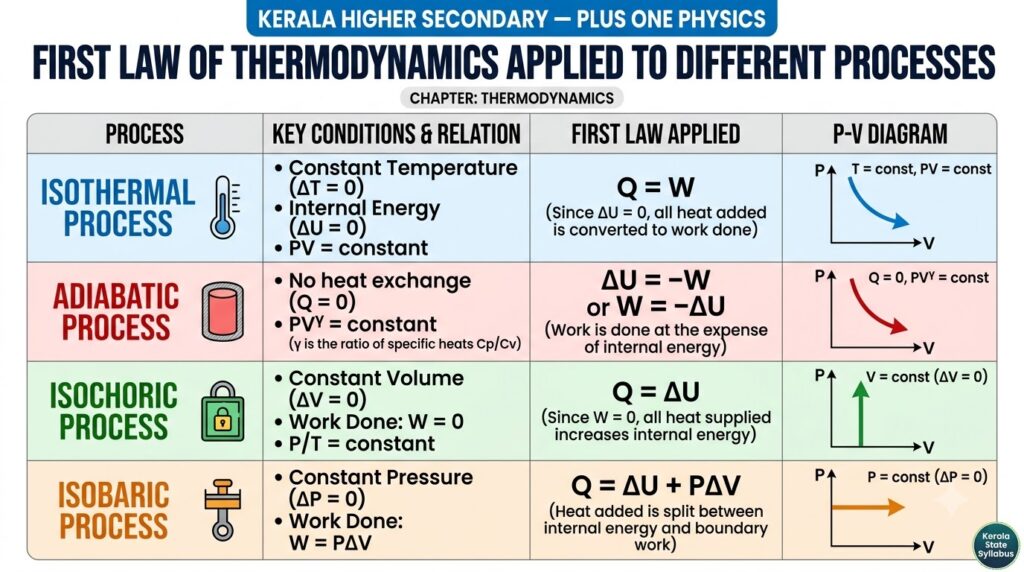
Q72. Explain all four thermodynamic processes using the First Law. Tabulate the results. Starting from ΔQ = ΔU + ΔW:
Isothermal (ΔT = 0, ideal gas → ΔU = 0): ΔW = ΔQ = μRT ln(V₂/V₁)
Adiabatic (ΔQ = 0): 0 = ΔU + ΔW → ΔW = −ΔU = μCv(T₁ − T₂) = μR(T₁ − T₂)/(γ−1)
Isochoric (ΔV = 0, ΔW = 0): ΔQ = ΔU = μCvΔT
Isobaric (ΔP = 0): ΔW = PΔV = μRΔT ΔQ = ΔU + ΔW = μCvΔT + μRΔT = μCpΔT
| Process | ΔQ | ΔU | ΔW | Condition |
|---|---|---|---|---|
| Isothermal | μRT ln(V₂/V₁) | 0 | μRT ln(V₂/V₁) | T = const |
| Adiabatic | 0 | −μR(T₁−T₂)/(γ−1) | μR(T₁−T₂)/(γ−1) | Q = 0 |
| Isochoric | μCvΔT | μCvΔT | 0 | V = const |
| Isobaric | μCpΔT | μCvΔT | μRΔT | P = const |
| Cyclic | ΔW (net) | 0 | ΔQ | Returns to initial state |
Q73. Describe the Carnot engine cycle and derive the expression for its efficiency. Carnot cycle (see Q59 above for steps):
Efficiency derivation (see Q60 above):
Key result: η = 1 − T₂/T₁
Carnot’s theorem: This is the maximum efficiency possible for any heat engine between T₁ and T₂. Proven by showing that a more efficient engine coupled with a reversed Carnot engine would violate the Second Law.
Practical implication: To improve efficiency, maximize temperature difference. Steam engines: T₁ ≈ 550 K, T₂ ≈ 300 K → η ≤ 1 − 300/550 ≈ 45%. Actual steam engines: η ≈ 35–40%.
Q74. State the Second Law of Thermodynamics. Show that the two statements are equivalent. Kelvin-Planck (KP): No process can convert heat entirely into work without any other effect.
Clausius (CL): No process can transfer heat from cold to hot without work input.
Equivalence proof:
If KP is violated → CL is violated: Suppose we have a machine (violating KP) that converts Q from hot source entirely into work W = Q. Use this work to run a refrigerator that takes Q₂ from the cold reservoir and delivers Q₂ + W = Q₂ + Q to the hot reservoir. The net effect: heat Q₂ transferred from cold to hot without any external work — violating CL.
If CL is violated → KP is violated: Suppose heat Q₂ flows spontaneously from cold to hot. Run a heat engine between hot and cold: engine absorbs Q₁ = Q + Q₂ from hot, delivers work W = Q, rejects Q₂ to cold. The net effect of both: hot reservoir loses Q₁ but gains Q₂ — net loss = Q₁ − Q₂ = Q. Work W = Q comes from this net heat Q — violating KP.
∴ KP violation ↔ CL violation → they are equivalent. ✓
Q75. What is the Carnot engine? Describe it. Prove that no engine can be more efficient than a Carnot engine (Carnot’s theorem). Carnot Engine: A reversible heat engine operating between two heat reservoirs (T₁ and T₂) via a 4-step cycle: isothermal expansion → adiabatic expansion → isothermal compression → adiabatic compression. Its efficiency η = 1 − T₂/T₁.
Carnot’s Theorem Proof: Consider irreversible engine I with efficiency η_I and Carnot engine R (reversible) with efficiency η_R. Assume η_I > η_R.
Couple them: I acts as heat engine; R acts as refrigerator (reversed).
- I absorbs Q₁ from hot, gives work W_I = η_I × Q₁, rejects Q₁ − W_I to cold.
- R (as refrigerator) takes work W_R from I, absorbs Q₂’ from cold, delivers Q₁ to hot.
Arrange so that R delivers exactly Q₁ back to hot reservoir. Then R needs work W_R = (1 − η_R)Q₁ < W_I = η_I Q₁ (since η_I > η_R).
Net work output = W_I − W_R > 0.
The combined system takes heat (Q₁ − W_R) − (Q₁ − W_I) = W_I − W_R > 0 from the cold reservoir and converts it entirely to net work — violating the Kelvin-Planck statement.
Therefore, our assumption η_I > η_R must be wrong. No engine can have efficiency greater than a Carnot engine. ✓
Q76. A heat engine absorbs 1000 J at 600 K and rejects heat at 300 K. Find (a) maximum possible efficiency (b) max work (c) minimum heat rejected (d) actual COP if it does 300 J of work. (a) Maximum efficiency = Carnot efficiency: η_max = 1 − 300/600 = 50%
(b) Maximum work (at Carnot efficiency): W_max = η_max × Q₁ = 0.5 × 1000 = 500 J
(c) Minimum heat rejected (corresponding to maximum work): Q₂_min = Q₁ − W_max = 1000 − 500 = 500 J
(d) If actual work done = 300 J: Actual η = 300/1000 = 30% (< 50%, as expected for real engine) Q₂_actual = 1000 − 300 = 700 J (more heat rejected to cold sink)
Q77. Explain internal energy. Why is it a state function? Give two ways to change internal energy. Internal energy (U): The total energy of all molecules in the system — sum of their random kinetic energies (translational, rotational, vibrational) and potential energies of interaction.
Why state function: The internal energy depends only on the macroscopic state (P, V, T), not on the history of how the system arrived at that state. Experimentally verified by Joule: the internal energy of an ideal gas depends only on temperature.
Two ways to change U:
- Heat transfer: Supply or remove heat ΔQ. Temperature difference drives heat flow.
- Work: Compress or expand the gas (do work on it or let it do work). Example: adiabatic compression of gas raises T and U without any heat transfer.
First Law: ΔU = ΔQ − ΔW (heat in minus work out = change in internal energy).
Q78. A gas goes from state A(P₁,V₁) to state B(P₂,V₂) along two different paths. Path 1: isochoric then isobaric. Path 2: isobaric then isochoric. (a) Show ΔU is the same. (b) Are ΔW and ΔQ the same? (a) ΔU is the same for both paths: U is a state variable — it depends only on the initial and final states (A and B), not the path. For an ideal gas, U = μCvT, and since the final state B is the same (same T₂), ΔU = μCv(T₂ − T₁) for both paths. ✓
(b) ΔW and ΔQ differ between paths:
Path 1 (isochoric A→C, then isobaric C→B): ΔW₁ = 0 + P₂(V₂ − V₁) = P₂(V₂ − V₁) ΔQ₁ = ΔU + ΔW₁
Path 2 (isobaric A→D, then isochoric D→B): ΔW₂ = P₁(V₂ − V₁) + 0 = P₁(V₂ − V₁) ΔQ₂ = ΔU + ΔW₂
Since P₁ ≠ P₂, ΔW₁ ≠ ΔW₂, and ΔQ₁ ≠ ΔQ₂. This demonstrates that heat and work are path-dependent — not state variables.
Q79. What is a reversible process? State the conditions. Why is the Carnot engine the most efficient possible? Reversible process: A process that can be exactly reversed to restore both system and surroundings to their original states, with no net change anywhere.
Conditions for reversibility:
- Quasi-static: System always in equilibrium with surroundings (process infinitely slow).
- No dissipation: No friction, viscosity, turbulence, or any irreversible process.
Why Carnot engine is most efficient: The Carnot engine is the ONLY reversible engine between two given temperatures. Since reversibility implies maximum efficiency (Carnot’s theorem), no other engine can exceed the Carnot efficiency. Real engines have friction and other irreversibilities → lower efficiency. The Carnot efficiency sets the theoretical upper bound.
Q80. Explain the concept of state variables. Classify P, V, T, U, Q, W as state or non-state variables. What is an equation of state? State variables: Variables that completely describe the equilibrium state of a system. Their values at any instant depend only on the current state, not on the path taken.
Classification:
- P (pressure): State variable ✓
- V (volume): State variable ✓
- T (temperature): State variable ✓
- U (internal energy): State variable ✓ (depends only on T for ideal gas)
- Q (heat): NOT a state variable ✗ (path-dependent)
- W (work): NOT a state variable ✗ (path-dependent)
However, ΔQ − ΔW = ΔU is path-independent (since U is a state variable).
Equation of state: A mathematical relation between state variables describing all possible equilibrium states. For ideal gas: PV = μRT. For real gas (van der Waals): (P + a/V²)(V − b) = RT.
5 Mark / Essay Questions and Answers (അഞ്ച് മാർക്ക് ചോദ്യങ്ങൾ)
Q81. (a) State all three laws of thermodynamics (including Zeroth). (b) Derive Cp − Cv = R. (c) For 2 moles of monatomic ideal gas (T₁ = 300 K to T₂ = 500 K): find Q, W, ΔU for (i) constant volume (ii) constant pressure. (R = 8.314 J mol⁻¹ K⁻¹)
(a) Laws:
- Zeroth: Systems in equilibrium with same system are in equilibrium with each other → defines temperature.
- First: ΔQ = ΔU + ΔW → conservation of energy.
- Second: No perfect heat engine or refrigerator → entropy increases in irreversible processes.
(b) Cp − Cv = R: (see Q55 above) ✓
(c) μ = 2, monatomic: Cv = (3/2)R = 12.5 J/mol·K; Cp = (5/2)R = 20.8 J/mol·K; ΔT = 200 K
(i) Constant volume (ΔW = 0): ΔQ = ΔU = μCvΔT = 2 × 12.5 × 200 = 5000 J ΔW = 0 ΔU = 5000 J
(ii) Constant pressure: ΔQ = μCpΔT = 2 × 20.8 × 200 = 8320 J ΔW = μRΔT = 2 × 8.314 × 200 = 3326 J ΔU = ΔQ − ΔW = 8320 − 3326 = 4994 J ≈ 5000 J ✓ (same as constant volume — ΔU depends only on T)
Q82. (a) Describe the Carnot cycle with a P-V diagram. (b) Derive η = 1 − T₂/T₁. (c) State Carnot’s theorem. (d) A Carnot engine between 800 K and 300 K works on 3 kg steam per hour at 2000 kJ/kg latent heat. Find (i) efficiency (ii) power output (iii) heat rejected per hour.
(a) 4 steps: isothermal expansion (T₁) → adiabatic expansion → isothermal compression (T₂) → adiabatic compression. P-V diagram: curves connecting the four state points.
(b) Derivation: (see Q60 above) η = 1 − T₂/T₁ ✓
(c) Carnot’s theorem: No heat engine between T₁ and T₂ can have efficiency greater than a Carnot engine. All reversible engines between same temperatures have the same efficiency, independent of the working substance.
(d) Numerical: Q₁ per hour = 3 × 2000 = 6000 kJ = 6 × 10⁶ J
(i) η = 1 − 300/800 = 1 − 0.375 = 0.625 = 62.5%
(ii) Work per hour = η × Q₁ = 0.625 × 6 × 10⁶ = 3.75 × 10⁶ J Power = 3.75 × 10⁶/3600 = 1041.7 W ≈ 1.04 kW
(iii) Heat rejected per hour = Q₁ − W = 6 × 10⁶ − 3.75 × 10⁶ = 2.25 × 10⁶ J = 2250 kJ
Q83. (a) State First Law of Thermodynamics. (b) Apply it to all four thermodynamic processes. (c) 1 g of water at 100°C boils to steam (latent heat = 2256 J/g, 1 atm). Find ΔQ, ΔW, ΔU. (d) Explain why the First Law doesn’t tell the direction of a process.
(a) ΔQ = ΔU + ΔW — conservation of energy applied to thermodynamic processes.
(b) Table (see Q72 above) ✓
(c) Water boiling (see Q67 above): ΔQ = 2256 J; ΔW = 169.2 J; ΔU = 2086.8 J ✓
(d) First Law limitation: It only tells us that energy is conserved. It doesn’t tell us whether a process will occur spontaneously. For example:
- A cold body spontaneously absorbing heat from a hot body: ΔQ positive, ΔU increases, ΔW = 0. The First Law is satisfied.
- But the reverse (heat flowing from cold to hot spontaneously) also satisfies the First Law but violates the Second Law.
- The Second Law provides the directionality — it rules out the reverse process. “First Law: you can’t get something for nothing (energy conservation). Second Law: you can’t even break even (entropy always increases).”
Q84. (a) State the two statements of Second Law. (b) Prove they are equivalent. (c) What are reversible and irreversible processes? (d) Give three examples of irreversible processes with reasons.
(a) KP and Clausius statements (see Q19, Q20 above) ✓
(b) Equivalence proof: (see Q74 above) ✓
(c) Reversible: quasi-static + no dissipation → can be exactly reversed. Irreversible: all real processes — spontaneous, with friction/turbulence.
(d) Irreversible examples:
- Free expansion of gas: Gas expands into vacuum without doing work; cannot spontaneously re-compress itself.
- Heat conduction: Heat flows from hot to cold spontaneously; never reverses without external work (violates Clausius).
- Combustion of fuel: Chemical energy → heat + products; reverse (smoke re-forming fuel) never occurs spontaneously.
Q85. (a) What is internal energy? (b) How is it different from heat and work? (c) For an isothermal process, derive the work done. (d) 1 mole ideal gas (300 K) expands isothermally from 1 L to 10 L. Find Q, W, ΔU. (e) Same gas then cools at constant volume to 200 K. Find Q, W, ΔU. (R = 8.314, Cv = 12.5 J mol⁻¹ K⁻¹)
(a) U = sum of kinetic and potential energies of all molecules. State variable — depends only on current state.
(b) U is a state property; Q and W are process quantities (path-dependent, energy in transit).
(c) Isothermal work derivation: (see Q54 above) W = μRT ln(V₂/V₁) ✓
(d) Isothermal expansion (μ=1, T=300 K, V₁=1L, V₂=10L): W = μRT ln(V₂/V₁) = 1 × 8.314 × 300 × ln(10) = 2494.2 × 2.303 = 5744 J ΔU = 0 (isothermal ideal gas) Q = W = 5744 J
(e) Isochoric cooling (V=const, T: 300→200 K): ΔW = 0 (constant volume) ΔU = μCvΔT = 1 × 12.5 × (200 − 300) = 12.5 × (−100) = −1250 J Q = ΔU = −1250 J (heat is released)
Additional Important Questions (Kerala Board Previous Year Style)
Q86. A gas absorbs 200 J at constant pressure. Its volume increases from 1 L to 3 L at 10⁵ Pa. Find ΔU. ΔW = PΔV = 10⁵ × (3−1) × 10⁻³ = 200 J ΔU = ΔQ − ΔW = 200 − 200 = 0 J
Q87. For an ideal gas, show that in an isothermal process, the work done equals the heat absorbed. ΔU = 0 (isothermal, ideal gas — U depends only on T). First Law: ΔQ = ΔU + ΔW = 0 + ΔW → ΔQ = ΔW ✓
Q88. If a Carnot engine has source at 1000 K and efficiency 70%, find the sink temperature. η = 1 − T₂/T₁ → 0.7 = 1 − T₂/1000 T₂/1000 = 0.3 → T₂ = 300 K
Q89. Can a process be adiabatic as well as isothermal? Only for an ideal gas in free expansion into vacuum (Joule expansion): ΔQ = 0 (adiabatic) and ΔU = 0 → ΔT = 0 (isothermal). For real gases, this doesn’t hold. In general, no — an adiabatic process changes temperature (via ΔU = −ΔW), so it cannot be isothermal.
Q90. A refrigerator has COP = 5 and removes 1000 J from cold reservoir. Find: (a) work done (b) heat rejected to hot reservoir. COP = Q₂/W → 5 = 1000/W → W = 200 J Q₁ = Q₂ + W = 1000 + 200 = 1200 J
Q91. State Carnot’s theorem. A real engine has efficiency 35% between 800 K and 300 K. Is this possible? Carnot efficiency = 1 − 300/800 = 0.625 = 62.5% Since 35% < 62.5%, this is possible (real engines always have η < Carnot efficiency).
Q92. What is the sign of ΔQ and ΔW for: (a) gas compressed adiabatically (b) gas expands isothermally? (a) Adiabatic compression: ΔQ = 0; ΔW < 0 (work done ON gas, so gas does negative work); ΔU = −ΔW > 0 (temperature rises).
(b) Isothermal expansion: ΔW > 0 (gas does positive work); ΔU = 0; ΔQ = ΔW > 0 (heat absorbed from surroundings).
Q93. How many degrees of freedom do monatomic, diatomic, and triatomic linear molecules have? Monatomic (e.g., He): 3 (translational only) Diatomic (e.g., N₂, at room temperature): 5 (3 translational + 2 rotational) Triatomic linear (e.g., CO₂): 7 (3 translational + 2 rotational + 2 vibrational) — though vibrational modes are usually frozen at room temperature.
Q94. A gas in a cylinder does 150 J of work in adiabatic expansion. What is the change in its internal energy? Does it heat up or cool down? Adiabatic: ΔQ = 0 First Law: 0 = ΔU + ΔW → ΔU = −ΔW = −150 J
Internal energy decreases by 150 J → the gas cools down (temperature decreases). This is how adiabatic expansion in diesel engines and refrigerators works.
Q95. What is the first law of thermodynamics for: (a) isobaric, (b) isochoric, (c) adiabatic, and (d) cyclic processes? (a) Isobaric: ΔQ = ΔU + PΔV = μCpΔT (b) Isochoric: ΔQ = ΔU = μCvΔT (ΔW = 0) (c) Adiabatic: 0 = ΔU + ΔW → ΔU = −ΔW (d) Cyclic: ΔU = 0 → ΔQ = ΔW (net heat = net work in full cycle)
Frequently Asked Questions (FAQ) — Kerala Plus One Physics Chapter 11
- State the First Law of Thermodynamics. (Kerala Board) ΔQ = ΔU + ΔW. Heat supplied to a system = increase in internal energy + work done by the system. It is the law of conservation of energy for thermal systems.
- താപഗതിശാസ്ത്രത്തിൻ്റെ ഒന്നാം നിയമം (First Law in Malayalam) ΔQ = ΔU + ΔW. ഒരു സിസ്റ്റത്തിൽ നൽകപ്പെടുന്ന ഉഷ്മാവ്, ആ സിസ്റ്റത്തിൻ്റെ ആന്തരിക ഊർജ്ജ വർദ്ധനവ്, ഒപ്പം ബാഹ്യ ലോകത്തിൽ ചെയ്ത ജോലിക്ക് സമം ആണ്. ഇത് ഊർജ്ജ സംരക്ഷണ നിയമത്തിൻ്റെ ഒരു രൂപം ആണ്.
- What is the efficiency of a Carnot engine? (Plus One Physics Kerala) η = 1 − T₂/T₁, where T₁ = hot source temperature (K) and T₂ = cold sink temperature (K). This is the maximum efficiency possible for any heat engine between those two temperatures.
- What is the difference between isothermal and adiabatic processes? Isothermal: T = constant, Q = W, ΔU = 0, PV = const. Adiabatic: Q = 0, ΔU = −W (temperature changes), PVγ = const. Adiabatic curve is steeper than isothermal on P-V diagram.
- Why is Cp greater than Cv? (Kerala Board) At constant pressure, gas expands when heated, doing extra work PΔV on surroundings. This extra energy must also be supplied as heat. So Cp = Cv + R > Cv. The extra term R accounts for the expansion work at constant pressure.
- State the Second Law of Thermodynamics. What are its implications? KP Statement: No process can convert heat entirely into work. Clausius: Heat cannot flow spontaneously from cold to hot. Implications: perfect heat engine (η = 100%) and perfect refrigerator (COP = ∞) are impossible. All natural processes are irreversible. Entropy of universe always increases.
This article covers Kerala Plus One Physics Chapter 11 — Thermodynamics (താപഗതിശാസ്ത്രം) — with 150+ questions covering Zeroth Law, First Law, Second Law, Thermodynamic Processes (Isothermal, Adiabatic, Isochoric, Isobaric), Carnot Engine, Cp−Cv=R, Reversible and Irreversible Processes, following the Kerala Board (SCERT) exam pattern. Visit hsslives.com for chapter-wise solutions for all Plus One and Plus Two subjects.