
Laws of Motion Class 11 Questions and Answers | Kerala Plus One Physics Chapter 4 (ചലന നിയമങ്ങൾ ചോദ്യോത്തരങ്ങൾ)
Kerala Plus One Physics Chapter 4 — Laws of Motion (ചലന നിയമങ്ങൾ) is one of the most fundamental and high-scoring chapters in the Kerala Board (SCERT) Class 11 exam. This article provides 150+ Questions and Answers strictly following the Kerala Higher Secondary exam pattern with 1 Mark, 2 Mark, 3 Mark, and 5 Mark categories. Plus One Physics Chapter 4 Kerala, Newton’s Laws Questions Kerala Board, ചലന നിയമങ്ങൾ ചോദ്യങ്ങൾ, Friction Questions Plus One, Conservation of Momentum Kerala SCERT, Newton’s Third Law Questions Class 11
If you are searching for Plus One Physics Chapter 4 Kerala solutions, Newton’s Laws questions and answers, or ചലന നിയമങ്ങൾ ചോദ്യോത്തരങ്ങൾ, this complete guide is for you. Laws of Motion Chapter 4 Questions and Answers for Kerala Plus One Physics Class 11. 150+ questions covering Newton’s Laws, Momentum, Friction, Inertia — 1 Mark, 2 Mark, 3 Mark, 5 Mark as per Kerala Board SCERT exam pattern. ചലന നിയമങ്ങൾ ചോദ്യോത്തരങ്ങൾ. FOCUS KEYWORD: Laws of Motion Class 11 Kerala

1 Mark Questions and Answers (ഒരു മാർക്ക് ചോദ്യങ്ങൾ) — Laws of Motion | Laws of Motion Class 11 Questions and Answers | Kerala Plus One Physics Chapter 4
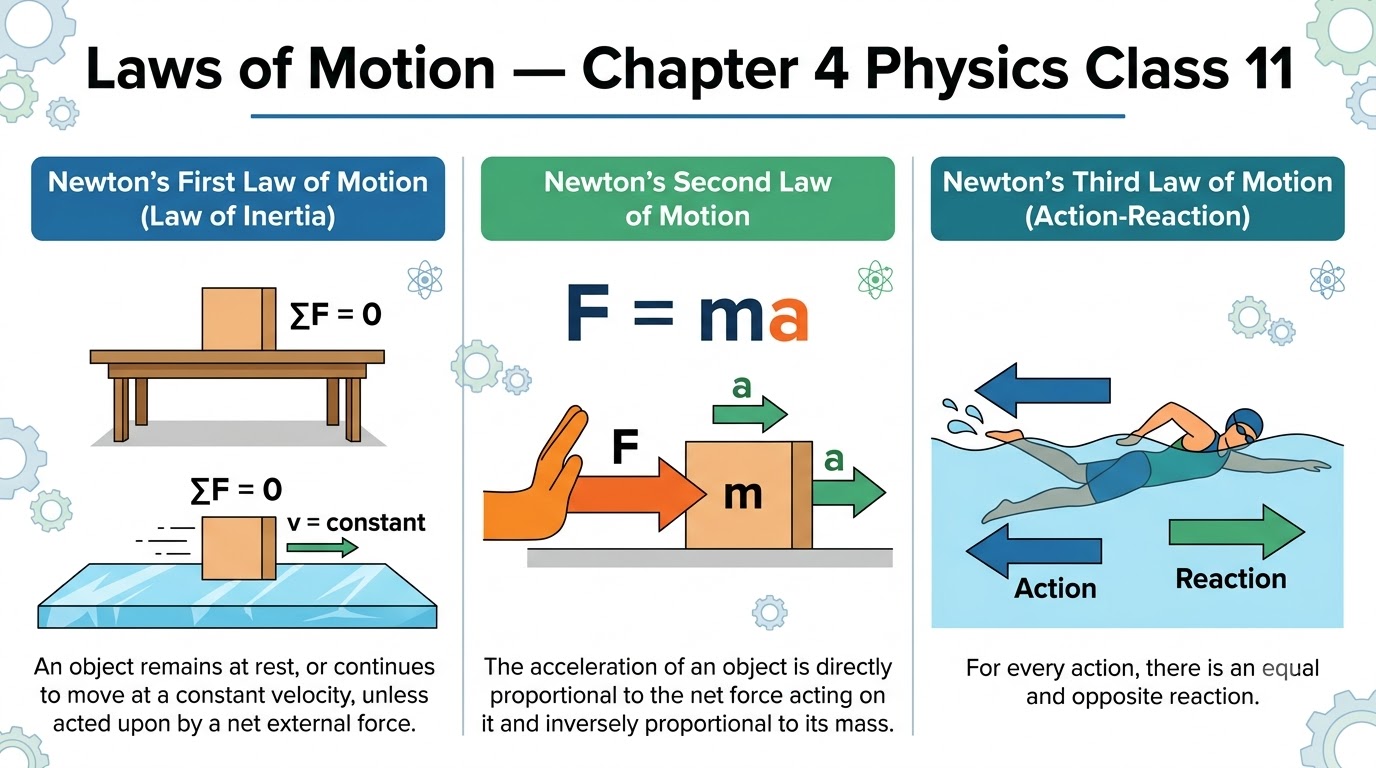
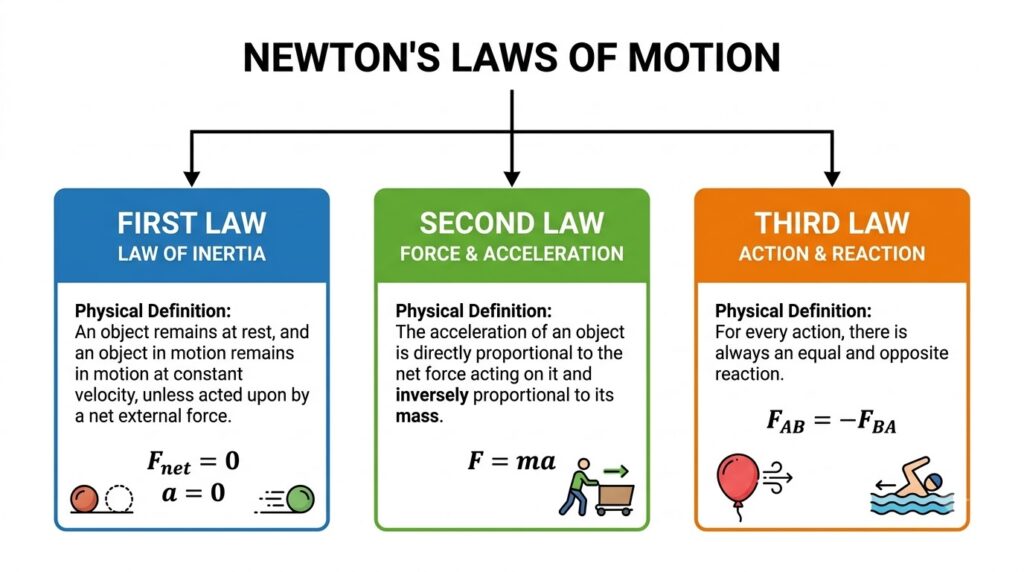
Q1. State Newton’s first law of motion. Every body continues to be in its state of rest or of uniform motion in a straight line unless compelled by some external force to act otherwise.
Q2. What is inertia? Inertia is the property of a body by which it resists any change in its state of rest or uniform motion. It is the tendency of a body to remain in its current state unless acted upon by an external force.
Q3. What are the three types of inertia?
- Inertia of rest — resistance to change from rest.
- Inertia of motion — resistance to change from uniform motion.
- Inertia of direction — resistance to change in direction of motion.
Q4. State Newton’s second law of motion. The rate of change of momentum of a body is directly proportional to the applied external force and takes place in the direction in which the force acts. Mathematically: F = dp/dt = ma
Q5. What is the SI unit of force? The SI unit of force is the Newton (N). 1 N = 1 kg m s⁻²
Q6. Define 1 Newton. One Newton is the force that causes an acceleration of 1 m/s² in a body of mass 1 kg.
Q7. State Newton’s third law of motion. To every action, there is always an equal and opposite reaction. Or: Forces always occur in pairs. Force on body A by B is equal and opposite to force on body B by A: F_AB = −F_BA
Q8. What is momentum? Momentum is the product of mass and velocity of an object. p = mv It is a vector quantity. SI unit: kg m s⁻¹ or N s.
Q9. What is the relationship between force and momentum (Newton’s second law)? F = dp/dt Force equals the rate of change of momentum with respect to time.
Q10. What is impulse? Impulse is the product of force and the time duration for which it acts. It equals the change in momentum. Impulse = F × Δt = Δp SI unit: N s or kg m s⁻¹
Q11. State the law of conservation of momentum. The total momentum of an isolated system (no external force) remains constant, regardless of any internal interactions. If F_ext = 0, then p_total = constant
Q12. What is static friction? Static friction is the frictional force that acts on a body at rest when an external force is applied, opposing impending (about to begin) motion. It adjusts itself to balance the applied force up to a maximum limit.
Q13. What is kinetic (sliding) friction? Kinetic friction is the frictional force that opposes relative motion between two surfaces that are already sliding against each other. fₖ = μₖN
Q14. Write the law of static friction. fs ≤ μₛN where μₛ is the coefficient of static friction and N is the normal reaction.
Q15. What is the coefficient of friction (μ)? The coefficient of friction is a dimensionless constant that depends on the nature of the two surfaces in contact. It is the ratio of the frictional force to the normal reaction: μ = f/N
Q16. Which is greater — static friction or kinetic friction? Static friction (μₛ) > Kinetic friction (μₖ) for the same pair of surfaces. It is harder to start sliding than to keep sliding.
Q17. What is rolling friction? Rolling friction is the frictional force that opposes the rolling of a circular body (wheel, sphere) over a surface. It is much smaller than static or kinetic friction, which is why wheels revolutionised transport.
Q18. What is Aristotle’s fallacy regarding motion? Aristotle incorrectly believed that an external force is required to keep a body in uniform motion. He thought force was needed to sustain motion. Galileo corrected this — force is needed only to overcome friction, not to maintain uniform motion itself.
Q19. What is the normal reaction force? Normal reaction (N) is the contact force exerted by a surface on a body in contact with it, acting perpendicular (normal) to the surface. For a body resting on a horizontal floor: N = mg.
Q20. What is tension in a string? Tension is the restoring force in a string or rope when it is stretched. For a massless, inextensible string, the tension is the same throughout its length.
Q21. What is the angle of friction? The angle of friction (λ) is the angle that the resultant of normal reaction N and maximum static friction fs makes with the normal: tan λ = μₛ
Q22. What is the angle of repose? The angle of repose (θ) is the minimum angle of inclination of a surface at which a body placed on it just begins to slide. tan θ = μₛ So angle of repose = angle of friction.
Q23. Give two examples of Newton’s third law in daily life.
- Recoil of a gun: When a bullet is fired forward, the gun recoils backward.
- Walking: When we push the ground backward with our foot, the ground pushes us forward (reaction).
Q24. What is the centripetal force for a body moving in a circle? Centripetal force is the force directed toward the centre of the circular path, required to maintain circular motion. Fᶜ = mv²/R = mω²R
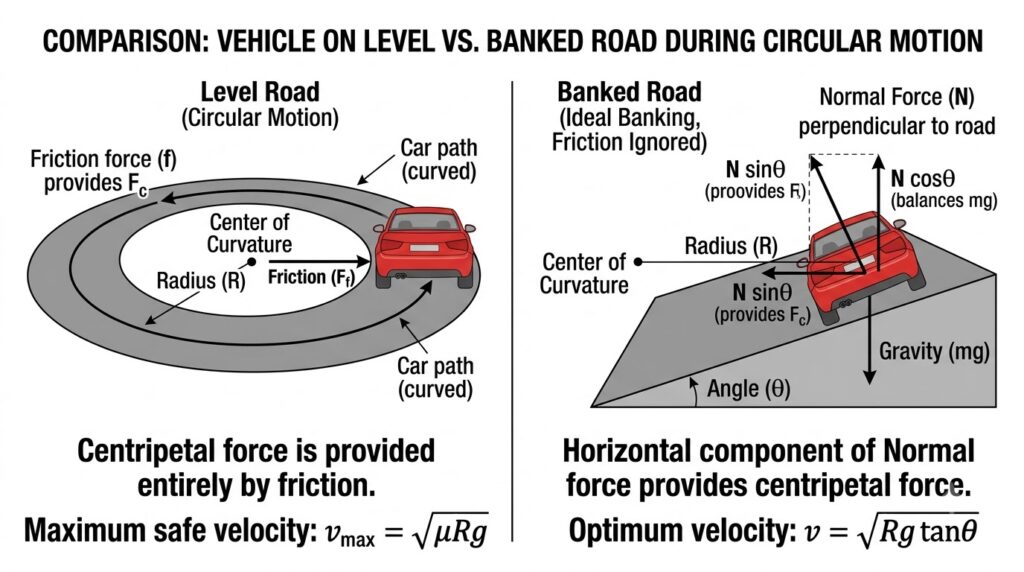
Q25. What provides centripetal force for a car taking a circular turn on a level road? The static friction between the tyres and the road provides the centripetal force.
Q26. What is the maximum speed for a car on a level road circular turn? vₘₐₓ = √(μₛRg) where μₛ = coefficient of static friction, R = radius, g = acceleration due to gravity.
Q27. What provides centripetal force for a stone whirled in a circle by a string? The tension in the string provides the centripetal force.
Q28. What provides centripetal force for a planet moving around the Sun? The gravitational force of the Sun provides the centripetal force for the planet’s orbital motion.
Q29. Why does a gun recoil when a bullet is fired? By Newton’s third law, when the gun exerts a forward force on the bullet, the bullet exerts an equal and opposite backward force on the gun, causing it to recoil (kick backward).
Q30. A body is in equilibrium. What can you say about the net force on it? If a body is in equilibrium, the net external force on it is zero. By Newton’s first law, it is either at rest or moving with uniform velocity.
Q31. What is a free body diagram? A free body diagram (FBD) is a diagram showing a body in isolation with all external forces acting on it drawn as arrows from the point of application. It helps in applying Newton’s laws.
Q32. Does friction depend on the area of contact? No. Experimentally, kinetic and static friction are found to be independent of the area of contact. They depend only on the normal force and the nature of surfaces.
Q33. What is the formula for the maximum acceleration a train can have without a box on its floor sliding? aₘₐₓ = μₛg where μₛ is the coefficient of static friction between the box and floor.
Q34. What is an impulsive force? An impulsive force is a large force acting for a very short time that produces a finite change in momentum. Example: the force between a bat and a cricket ball during a hit.
Q35. Define inertial mass. Inertial mass is the measure of the resistance of a body to change in its state of motion. It is defined by Newton’s second law: m = F/a.
Q36. What is the third law pair for the gravitational pull of the Earth on a stone? The reaction is the gravitational pull of the stone on the Earth (equal in magnitude, opposite in direction). We don’t notice the Earth’s acceleration because of its enormous mass.
Q37. Is action-reaction pair a balanced force pair? No. Though equal and opposite, action-reaction forces act on different bodies, so they do not cancel each other. Balanced forces act on the same body.
Q38. If the net external force on a system is zero, what happens to its momentum? If the net external force is zero, the total momentum of the system remains constant (conserved). This is the law of conservation of momentum.
Q39. A batsman hits a ball of mass 0.15 kg at 12 m/s back in the same direction. Find the impulse. Change in momentum = 0.15 × 12 − (−0.15 × 12) = 0.15 × 24 = 3.6 N s
Q40. What is the condition for static equilibrium of a particle? For static equilibrium: ΣF = 0 (vector sum of all external forces is zero), i.e., F₁ + F₂ + F₃ + … = 0.
Q41. What is the formula for force on a banked road without friction? For a perfectly banked road (no friction): tan θ = v²/(Rg) where θ = banking angle, v = speed, R = radius.
Q42. What does the first law of motion define? Newton’s first law defines force — a force is what causes a change in the state of rest or uniform motion of a body. It also defines inertia — the inherent tendency to resist change.
Q43. A bullet of mass 0.04 kg enters a wooden block at 90 m/s and stops in 60 cm. Find the resistive force. a = −v²/(2s) = −(90)²/(2 × 0.6) = −6750 m/s² F = ma = 0.04 × 6750 = 270 N
Q44. State the relation between coefficient of static friction and angle of repose. μₛ = tan θ where θ is the angle of repose (minimum angle at which an object just begins to slide on an inclined plane).
Q45. A force of 10 N acts on a body of mass 2 kg. What is the acceleration? F = ma → a = F/m = 10/2 = 5 m/s²
Q46. What is the principle of Galileo’s experiment with the double inclined plane? Galileo showed that on a frictionless surface, a rolling ball rises to the same height on both inclines regardless of the angle. When the second incline is made horizontal (0°), the ball rolls forever — establishing the law of inertia.
Q47. What happens to friction when a lubricant is applied between surfaces? Lubricants reduce kinetic friction by creating a thin fluid layer between surfaces, preventing direct contact. This reduces μₖ and makes sliding easier (e.g., engine oil in cars).
Q48. Can a body have zero velocity but non-zero net force? Yes. Example: A ball thrown vertically upward has zero velocity at the highest point but the net force (gravity = mg) is still acting downward.
Q49. If two forces F₁ and F₂ act on a particle and it is in equilibrium, what is the condition? F₁ = −F₂ (the two forces are equal in magnitude and opposite in direction).
Q50. What is the importance of Newton’s laws of motion? Newton’s laws form the foundation of classical mechanics. They explain the motion of everyday objects, are used in engineering, aerospace, vehicle design, and all of macroscopic physics. They were the basis of the scientific revolution and remain valid for speeds much less than the speed of light.
2 Mark Questions and Answers (രണ്ട് മാർക്ക് ചോദ്യങ്ങൾ) — Laws of Motion
Q51. Explain Aristotle’s fallacy and how Galileo corrected it. Aristotle’s fallacy: He believed that a continuous external force is required to maintain uniform motion. He observed that moving objects come to rest when not pushed and concluded that force sustains motion.
Galileo’s correction: Galileo showed through the double inclined plane experiment that on a frictionless surface, a ball would roll indefinitely. Objects in the real world stop due to friction, not because force is absent. If there were no friction, no force would be needed to keep a body moving uniformly. The flaw in Aristotle’s reasoning was that he did not account for friction.
Q52. State Newton’s second law of motion and derive F = ma. Statement: The rate of change of momentum of a body is directly proportional to the applied force and takes place in the direction of the force.
Derivation: F ∝ dp/dt = d(mv)/dt = m(dv/dt) = ma (for constant mass m)
Choosing the proportionality constant = 1 (which defines the unit of force): F = ma
In SI units, F is in Newton (N), m in kg, a in m/s².
Q53. Explain Newton’s third law with two real-life examples. Newton’s Third Law: To every action, there is an equal and opposite reaction. Forces always occur in pairs acting on different bodies.
Example 1 — Swimming: A swimmer pushes water backward (action); water pushes the swimmer forward (reaction).
Example 2 — Rocket propulsion: Hot gases are expelled backward at high speed (action); the rocket is pushed forward (reaction). This works even in outer space where there is no air.
Key point: Action and reaction are equal in magnitude, opposite in direction, and act on different bodies simultaneously.
Q54. Distinguish between static friction and kinetic friction.
| Property | Static Friction | Kinetic Friction |
|---|---|---|
| Condition | Body at rest | Body in motion |
| Value | Variable (up to max μₛN) | Constant (μₖN) |
| Magnitude | ≤ μₛN | = μₖN |
| Relative value | Greater | Lesser (μₖ < μₛ) |
| Formula | fₛ ≤ μₛN | fₖ = μₖN |
Q55. A bullet of 0.04 kg moving at 90 m/s enters a block and stops in 60 cm. Find (a) retardation (b) resistive force. v₀ = 90 m/s, v = 0, s = 0.6 m
(a) v² = v₀² + 2as → 0 = 8100 + 2a(0.6) → a = −6750 m/s² (retardation)
(b) F = ma = 0.04 × 6750 = 270 N (average resistive force)
Q56. State and explain the law of conservation of linear momentum. Statement: The total linear momentum of an isolated system remains constant if no external force acts on it.
Explanation: If F_ext = 0, then dp/dt = 0, so p = constant.
This follows from Newton’s second and third laws: internal forces (equal and opposite pairs) cancel, leaving total momentum unchanged.
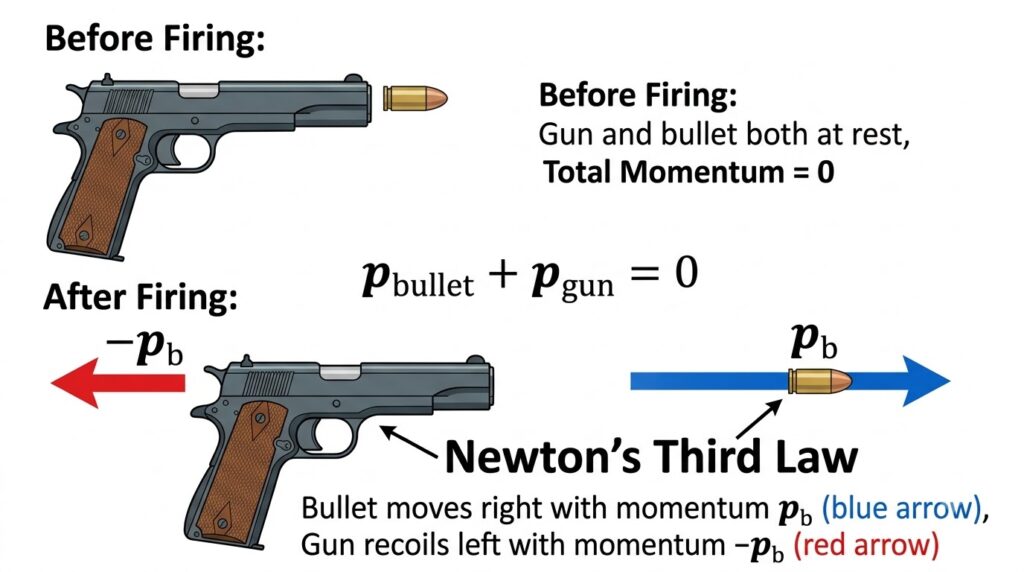
Example: When a gun fires a bullet, the system (gun + bullet) initially has zero momentum. After firing: p_bullet (forward) + p_gun (backward) = 0. The gun recoils to conserve momentum.
Q57. Explain why passengers are thrown forward when a bus stops suddenly. Due to inertia of motion, the passengers’ bodies tend to continue moving forward even when the bus decelerates suddenly. The bus stops but the passengers’ upper bodies keep moving forward (in the absence of sufficient friction between the seat and their body). This is Newton’s First Law in action — a body in motion stays in motion unless acted upon by an external force.
Q58. Derive the condition for the angle of repose on an inclined plane. A body on an incline of angle θ is in equilibrium when:
- Along incline: fₛ = mg sin θ
- Perpendicular to incline: N = mg cos θ
At the point of just sliding: fₛ = μₛN → mg sin θ = μₛ × mg cos θ μₛ = tan θ
So at angle of repose θ: tan θ = μₛ
This shows the angle of repose depends only on the coefficient of static friction, not the mass.
Q59. A mass of 6 kg hangs from the ceiling by a rope. A horizontal force of 50 N is applied at the midpoint of the rope. Find the angle the rope makes with the vertical. (g = 10 m/s²) At the midpoint P, three forces act: T₁ (upper rope, along rope), T₂ = weight below = 60 N (downward), 50 N (horizontal).
For equilibrium at P: T₁ cos θ = T₂ = 60 N T₁ sin θ = 50 N
tan θ = 50/60 = 5/6 θ = tan⁻¹(5/6) ≈ 40°
Q60. Explain three advantages and two disadvantages of friction. Advantages:
- Friction between shoe soles and ground enables walking.
- Friction between tyres and road enables vehicles to move and brake.
- Friction between pen/pencil and paper enables writing.
Disadvantages:
- Friction causes wear and tear of machine parts, reducing efficiency.
- Friction generates heat, wasting energy (in engines, brakes).
Q61. What is the maximum speed of a car on a circular level road of radius R with coefficient of static friction μₛ? Derive it. On a level road, the centripetal force is provided by friction: mv²/R = fₛ ≤ μₛN = μₛmg
v² ≤ μₛRg
vₘₐₓ = √(μₛRg)
This is independent of the mass of the car. Heavier and lighter cars have the same maximum safe speed on the same road.
Q62. Explain the concept of impulse with an example. Impulse = Force × time = F × Δt = Change in momentum (Δp)
Even when the force and time are hard to measure separately, their product (impulse = Δp) can be easily calculated.
Example: A cricket ball of mass 0.15 kg hits a bat at 12 m/s and is returned at 12 m/s. Impulse = Δp = 0.15 × 12 − (−0.15 × 12) = 3.6 N s
This is why catching a fast ball with a stiff hand hurts more than with a yielding hand — a longer time reduces the average force even for the same impulse.
Q63. Determine the maximum acceleration of a train so that a box on its floor does not slide. (μₛ = 0.15, g = 10 m/s²) The static friction provides the acceleration to the box: ma ≤ μₛN = μₛmg aₘₐₓ = μₛg = 0.15 × 10 = 1.5 m/s²
Above this acceleration, the box slides backward relative to the train. This is independent of the mass of the box.
Q64. State Newton’s third law and explain why action and reaction do not cancel each other. Newton’s Third Law: Forces always occur in pairs; force on A by B = −force on B by A.
Action and reaction do not cancel because they act on different bodies:
- Force on the ball by the bat acts on the ball.
- Force on the bat by the ball acts on the bat.
To cancel, both forces must act on the same body. Since they act on different bodies, each force accelerates its own object independently. The net force on each body is calculated separately.
Q65. Two bodies A (3 kg) and B (20 kg) are connected by a string over a pulley. B is on a table (μₖ = 0.04). Find acceleration and tension. (g = 10 m/s²) fₖ = μₖN = 0.04 × 20 × 10 = 8 N
For A: 30 − T = 3a …(1) For B: T − 8 = 20a …(2)
Adding: 22 = 23a → a = 22/23 ≈ 0.96 m/s² T = 30 − 3 × (22/23) = 30 − 2.87 = 27.1 N
Q66. What is a contact force? Give examples. A contact force arises when two bodies are in physical contact. The contact force has two components:
- Normal reaction (N): perpendicular to the surface of contact.
- Friction (f): parallel to the surface, opposing relative motion.
Examples: Normal force of a floor on a book, friction between tyres and road, tension in a rope, buoyant force in a fluid, viscous drag in air.
Q67. Explain inertia with three examples from daily life. Inertia is the tendency of a body to resist any change in its state.
- A passenger lurches backward when a bus starts suddenly — the passenger’s body tends to stay at rest (inertia of rest) while the bus moves forward.
- Clothes become clean when beaten — dust particles remain at rest while the clothes move, separating them.
- A ball placed on a spinning turntable flies off — inertia of motion tends to keep the ball moving in a straight line, opposing the circular path.
Q68. A block on an inclined plane begins to slide at 15°. Find μₛ. At angle of repose: μₛ = tan θ = tan 15° = 0.268 ≈ 0.27
Q69. What are three important points about Newton’s Second Law?
- F = 0 implies a = 0: The second law is consistent with the first law. If no force, no acceleration.
- It is a vector law: F = ma holds for each component: Fₓ = maₓ, Fᵧ = maᵧ, Fz = maz.
- It is a local relation: The acceleration at any instant depends only on the force at that instant, not on the history of motion.
Q70. Explain why it is easier to pull a lawn roller than to push it. When pushing a roller at angle θ below horizontal: the vertical component of push force adds to the weight, increasing normal reaction N and thus friction (f = μN increases).
When pulling at angle θ above horizontal: the vertical component of pull reduces the effective weight, decreasing N and thus friction.
Since friction opposes motion, pulling requires less effort than pushing for the same angle θ. This is a consequence of Newton’s laws applied to the normal reaction and friction.

3 Mark Questions and Answers (മൂന്ന് മാർക്ക് ചോദ്യങ്ങൾ) — Laws of Motion
Q71. State Newton’s three laws of motion and give one example for each. First Law (Law of Inertia): A body continues in its state of rest or uniform motion unless an external force changes it. Example: A book on a table remains at rest until someone applies a force; a ball rolling on a frictionless surface would keep rolling indefinitely.
Second Law (Law of Force): F = dp/dt = ma — force equals rate of change of momentum. Example: The same force produces greater acceleration in a lighter object than a heavier one. A cricket bat hitting a light ball imparts greater acceleration than hitting a heavy ball.
Third Law (Law of Action-Reaction): For every action, there is an equal and opposite reaction, acting on different bodies. Example: A swimmer pushes water backward (action); water pushes swimmer forward (reaction), propelling the swimmer.
Q72. Derive the law of conservation of linear momentum from Newton’s second and third laws. Consider two bodies A and B interacting with each other (isolated system, no external force).
By Newton’s Third Law: F_AB = −F_BA …(i) (Force on A by B = −Force on B by A)
By Newton’s Second Law for each body: F_AB = dp_A/dt …(ii) F_BA = dp_B/dt …(iii)
From (i), (ii), (iii): dp_A/dt = −dp_B/dt dp_A/dt + dp_B/dt = 0 d(p_A + p_B)/dt = 0
Therefore: p_A + p_B = constant
The total momentum of an isolated system is conserved. ✓
Q73. Explain static, kinetic, and rolling friction. State laws of friction. Static Friction (fₛ): Opposes impending (about-to-start) motion. Self-adjusting up to maximum: (fₛ)ₘₐₓ = μₛN Law: fₛ ≤ μₛN Arises when applied force is not sufficient to start motion.
Kinetic Friction (fₖ): Opposes actual relative motion between surfaces. Law: fₖ = μₖN (constant) Since μₖ < μₛ, kinetic friction < max static friction.
Rolling Friction: Opposes rolling of a circular body (wheel, sphere) on a surface. Much smaller than static or kinetic friction — this is why wheels made transportation efficient.
Laws of friction (common to static and kinetic):
- Friction is proportional to the normal force (f ∝ N).
- Friction is independent of the area of contact.
- Kinetic friction is nearly independent of velocity.
- Both depend on the nature of surfaces in contact.
Q74. A block-and-trolley system: 3 kg block hangs by string, 20 kg trolley on table (μₖ = 0.04). Find acceleration and tension. (g = 10 m/s²) Forces on 3 kg block: weight 30 N down, tension T up. Forces on trolley: Tension T forward, kinetic friction fₖ backward.
fₖ = μₖ × 20 × 10 = 0.04 × 200 = 8 N
For the block: 30 − T = 3a …(1) For the trolley: T − 8 = 20a …(2)
Adding (1) and (2): 22 = 23a a = 22/23 ≈ 0.96 m/s²
From (2): T = 8 + 20 × (22/23) = 8 + 19.13 = 27.1 N
Q75. Explain circular motion on a level road and derive the maximum safe speed. When a vehicle takes a circular turn on a level (flat) road:
Three forces act on the vehicle:
- Weight: mg (downward)
- Normal reaction: N (upward)
- Static friction: fₛ (toward the centre = centripetal direction)
Vertical equilibrium: N = mg
Centripetal requirement: fₛ = mv²/R
Since fₛ ≤ μₛN = μₛmg: mv²/R ≤ μₛmg v² ≤ μₛRg
vₘₐₓ = √(μₛRg)
This shows:
- Maximum speed increases with μₛ (grippier tyres are safer)
- Maximum speed increases with R (wider curves are safer)
- Maximum speed is independent of the mass of the vehicle
Q76. Two billiard balls strike a rigid wall — one perpendicularly (case a) and one at 30° to the normal (case b) — both at speed u and reflected without change in speed. Find the direction of force on the wall and ratio of impulses. Case (a) — Ball hits perpendicular: x-impulse on ball = −2mu (change in momentum in x-direction) Direction of impulse/force on ball: −x (into the wall) By Newton’s Third Law: force on wall = +x direction (normal to wall outward)
Case (b) — Ball hits at 30° to normal: pₓ changes: from +mu cos30° to −mu cos30° → x-impulse = −2mu cos 30° pᵧ unchanged (parallel component reverses sign too… actually pᵧ: mu sin30° → −mu sin30° → y-impulse = 0 if wall is along y) Direction: force on wall is still normal to wall (in +x direction)
Ratio of magnitudes of impulses: |Impulse_a| = 2mu |Impulse_b| = 2mu cos30° = 2mu × (√3/2) = mu√3
Ratio = 2mu / mu√3 = 2/√3 ≈ 1.15 : 1
Q77. Explain how rockets work using conservation of momentum. What is Tsiolkovsky’s rocket equation concept? A rocket in outer space has no external force acting on it (no air, no gravity if far enough). Total initial momentum = 0 (rocket at rest).
When fuel is burned, hot exhaust gases are expelled backward at high speed v_e.
By conservation of momentum:
- If exhaust momentum = p_e (backward)
- Then rocket momentum = p_e (forward)
m_rocket × v_rocket = m_exhaust × v_exhaust
As the rocket expels more fuel, it gains more forward momentum. The rocket keeps accelerating as long as it burns fuel — no need for any medium (air) to push against.
This is why rockets work in space (unlike aircraft which need air for propulsion via Newton’s 3rd law with air molecules).
Q78. A mass of 4 kg rests on a surface. The surface is inclined until at 15° the mass just begins to slide. Find μₛ. Also find the angle of friction. At the angle of repose θ = 15°: μₛ = tan 15° = 0.268 ≈ 0.27
Angle of friction = angle whose tangent = μₛ = tan⁻¹(μₛ) = tan⁻¹(0.27) = 15°
Note: The angle of friction equals the angle of repose. Both depend only on the nature of surfaces, not the mass.
Q79. Explain the concept of equilibrium of a particle. State the conditions for a particle to be in equilibrium under three concurrent forces. Equilibrium of a particle: The net external force on the particle is zero (ΣF = 0). By Newton’s first law, the particle is either at rest or moving with uniform velocity.
Conditions under three concurrent forces F₁, F₂, F₃: F₁ + F₂ + F₃ = 0 (vector sum = zero)
In components: F₁ₓ + F₂ₓ + F₃ₓ = 0 F₁ᵧ + F₂ᵧ + F₃ᵧ = 0 F₁z + F₂z + F₃z = 0
Graphical method: When three forces are in equilibrium, they can be represented by the three sides of a closed triangle (Lami’s theorem condition).
Example: A suspended mass has weight W downward, two string tensions T₁ and T₂. For equilibrium: T₁ + T₂ + W = 0.
Q80. Explain the motion of a car on a banked road. Derive the expression for optimum speed. On a banked road (road tilted at angle θ):
Forces on car: weight mg (down), normal reaction N (perpendicular to road), friction fₛ (may or may not be present).
For optimum speed (no friction needed):
- Vertical: N cos θ = mg …(i)
- Horizontal (centripetal): N sin θ = mv²/R …(ii)
Dividing (ii) by (i): tan θ = v²/(Rg)
v_opt = √(Rg tan θ)
At this speed, no friction is needed. This is the ideal speed for the banked curve. Above this speed, friction acts inward; below it, friction acts outward.
Maximum speed (with friction): vₘₐₓ = √[Rg(tan θ + μₛ)/(1 − μₛ tan θ)]
5 Mark / Essay Questions and Answers (അഞ്ച് മാർക്ക് ചോദ്യങ്ങൾ) — Laws of Motion
Q81. (a) State Newton’s three laws of motion. (b) Derive F = ma from the second law. (c) A bullet (0.04 kg, 90 m/s) enters a wooden block and stops in 60 cm. Find the resistive force. (d) Explain how F = 0 implies a = 0, connecting first and second laws.
(a) Newton’s Three Laws:
- First Law: A body continues in rest or uniform motion unless acted on by external force.
- Second Law: F = dp/dt (Force = rate of change of momentum, in the direction of force).
- Third Law: For every action there is an equal and opposite reaction (on different bodies).
(b) Derivation of F = ma: F ∝ dp/dt; d(mv)/dt = m(dv/dt) = ma Choosing proportionality constant k = 1: F = ma
(c) Resistive force on bullet: v₀ = 90 m/s, v = 0, s = 0.6 m v² = v₀² + 2as → 0 = 8100 + 2a(0.6) → a = −6750 m/s² F = ma = 0.04 × 6750 = 270 N
(d) Connection between 1st and 2nd laws: From F = ma: if F = 0, then a = 0, which means velocity is constant (body at rest stays at rest, body in motion continues in motion). This is exactly the statement of Newton’s First Law. So the First Law is a special case of the Second Law (when F = 0).
Q82. (a) State the law of conservation of linear momentum. (b) Derive it from Newton’s laws. (c) Explain the recoil of a gun. (d) A gun (3 kg) fires a bullet (0.03 kg) at 300 m/s. Find the recoil velocity of the gun.
(a) Law of Conservation of Momentum: The total linear momentum of an isolated system (no external force) remains constant in magnitude and direction.
(b) Derivation (from Newton’s 2nd and 3rd laws): For two bodies A and B: F_AB = dp_A/dt; F_BA = dp_B/dt By 3rd law: F_AB = −F_BA So: dp_A/dt = −dp_B/dt → d(p_A + p_B)/dt = 0 ∴ p_A + p_B = constant ✓
(c) Recoil of a gun: Initially, both gun and bullet are at rest: total momentum = 0. On firing, bullet moves forward (momentum p_b). By conservation: p_bullet + p_gun = 0 ∴ Gun recoils backward with momentum = −p_b. Recoil velocity = −(m_bullet × v_bullet)/m_gun (negative = backward direction)
(d) Numerical: Initial momentum = 0 After firing: m_bullet × v_bullet + m_gun × v_gun = 0 0.03 × 300 + 3 × v_gun = 0 9 + 3 v_gun = 0 v_gun = −3 m/s (3 m/s in the opposite direction to the bullet)
Q83. (a) Explain the laws of friction. (b) Define angle of repose and derive μₛ = tan θ. (c) A body on a 15° incline just begins to slide. Find μₛ. (d) Find the minimum force needed to slide a 10 kg block on a surface with μₛ = 0.3. (g = 10 m/s²)
(a) Laws of Friction:
- Friction ∝ Normal reaction (f ∝ N)
- Friction is independent of the area of contact.
- Static friction is self-adjusting (fₛ ≤ μₛN).
- Kinetic friction is constant (fₖ = μₖN) and nearly independent of velocity.
- μₖ < μₛ for the same surfaces.
(b) Angle of repose (θ) and μₛ = tan θ: On an incline at angle θ, forces on block:
- Along incline: fₛ = mg sin θ
- Perpendicular: N = mg cos θ
At limiting equilibrium (just about to slide): fₛ = (fₛ)ₘₐₓ = μₛN mg sin θ = μₛ × mg cos θ μₛ = sin θ / cos θ = tan θ ✓
(c) θ = 15°: μₛ = tan 15° ≈ 0.27
(d) Minimum force to start sliding (horizontal surface): F = fₛ,ₘₐₓ = μₛN = μₛmg = 0.3 × 10 × 10 = 30 N
Q84. (a) What is inertia? (b) Give examples for all three types of inertia. (c) Explain Newton’s first law as the law of inertia. (d) A passenger feels thrown backward when a bus starts. Explain using Newton’s laws.
(a) Inertia: The inherent tendency of a body to resist any change in its state of rest or uniform motion. The measure of inertia is the mass of the body — greater mass = greater inertia.
(b) Three types of inertia:
Inertia of rest: A body at rest stays at rest. Example: When a bus starts suddenly, passengers feel pushed backward — their bodies tend to stay at rest while the bus moves forward.
Inertia of motion: A moving body continues moving. Example: An athlete runs some distance after crossing the finish line — the body continues forward due to inertia of motion. Also, a ball rolling on a smooth floor keeps rolling.
Inertia of direction: A body moving in a straight line tends to continue in the same direction. Example: When a car takes a sharp turn, passengers feel pushed outward — their bodies tend to continue in the straight-line direction.
(c) First Law as Law of Inertia: Newton’s first law says: “If net force = 0, the body stays in its current state (rest or uniform motion).” This is essentially a statement that every body has inertia — it resists changes in motion. The law gives us the concept of force as the agent that overcomes inertia.
(d) Bus starting suddenly: When a stationary bus suddenly starts forward, the seats (attached to the bus) move forward. The passengers, due to inertia of rest, tend to stay at their original position. Relative to the bus, they appear to be thrown backward. In reality, the bus moves forward and the passengers lag behind momentarily until the seat-friction carries them along.
Q85. (a) Define centripetal force. (b) Explain circular motion of a car on a level road. (c) Derive the maximum speed. (d) Explain circular motion on a banked road and find the optimal speed. (e) Why is banking necessary?
(a) Centripetal Force: The force directed toward the centre of a circular path, required to maintain circular motion. Fᶜ = mv²/R = mω²R It is not a new type of force — it is provided by some existing force (friction, tension, gravity, normal reaction).
(b) Level Road: For a car of mass m taking a circular turn of radius R at speed v on a flat road:
- N = mg (vertical equilibrium)
- Centripetal force = friction = mv²/R
Condition: mv²/R ≤ μₛmg → v ≤ √(μₛRg)
(c) Maximum speed on level road: vₘₐₓ = √(μₛRg) Does not depend on the mass of the car.
(d) Banked Road (no friction): Banking angle θ: Road tilted inward. Now normal reaction N has a horizontal inward component:
- N cos θ = mg
- N sin θ = mv²/R
- tan θ = v²/(Rg)
- v_opt = √(Rg tan θ)
With friction, vₘₐₓ = √[Rg(tan θ + μₛ)/(1 − μₛ tan θ)]
(e) Why banking is necessary: On a level road, friction alone provides centripetal force. For high speeds, the required friction exceeds μₛmg and the car skids. Banking provides an inward component of normal force (N sin θ), reducing (or eliminating) dependence on friction. This allows vehicles to safely take high-speed turns on highways.
Additional Important Questions (Kerala Board Previous Year Style)
Q86. Two forces of 10 N and 6 N act on a body of mass 2 kg in the same direction. Find acceleration. If they act in opposite directions, find acceleration. Same direction: F_net = 10 + 6 = 16 N; a = 16/2 = 8 m/s² Opposite: F_net = 10 − 6 = 4 N; a = 4/2 = 2 m/s²
Q87. Explain why Newton’s first law is also called the “law of inertia”. Newton’s first law defines inertia — the tendency to resist changes in motion state. The law states that in the absence of force, the state of motion doesn’t change. Since this directly expresses the property of inertia, it is called the law of inertia.
Q88. A rocket of mass 20 kg ejects gas at 2 kg/s at 1000 m/s. Find the thrust on the rocket. Thrust = rate of change of momentum = (mass ejected per second) × velocity = 2 × 1000 = 2000 N
Q89. Is there any violation of Newton’s third law in the following: Earth pulls you down (gravity), but the ground also pushes you up (normal reaction). Are these action-reaction pairs? No. These two forces (gravity down and normal force up) are NOT a Newton’s third law pair — they act on the same body (you) and happen to be equal only when you are in equilibrium.
The third law pair of “Earth pulling you down” is “You pulling Earth up” (gravitational reaction). The third law pair of “ground pushing you up” is “You pushing the ground down” (Newton’s 3rd law). These pairs act on different bodies.
Q90. A body at rest explodes into two pieces of masses 4 kg and 6 kg. The 4 kg piece moves at 15 m/s. Find the velocity of the 6 kg piece. Initial momentum = 0 Final: 4 × 15 + 6 × v = 0 → 60 + 6v = 0 → v = −10 m/s The 6 kg piece moves at 10 m/s in the opposite direction.
Q91. Why do passengers in a bus feel pushed outward when the bus takes a sharp turn? When the bus turns, the seat (attached to the bus) changes direction. But the passenger’s body, due to inertia of direction, tends to continue moving in the original straight-line direction. Relative to the bus, the passenger appears to be pushed outward. No outward force actually acts — it is the absence of sufficient inward force (centripetal force) from the seat that causes this effect.
Q92. What is the effect of doubling the mass and halving the force on the acceleration? Original: a = F/m New: a’ = (F/2)/(2m) = F/(4m) = a/4 Acceleration reduces to one-fourth of the original.
Q93. A man of mass 70 kg stands in a lift. Find his apparent weight when the lift (a) accelerates upward at 3 m/s² (b) accelerates downward at 3 m/s² (c) moves with uniform velocity. (g = 10 m/s²) (a) N = m(g + a) = 70(10 + 3) = 910 N (b) N = m(g − a) = 70(10 − 3) = 490 N (c) N = mg = 70 × 10 = 700 N (uniform velocity → a = 0)
Q94. A man pushes a wall with force 10 N. Does the wall move? Explain using Newton’s laws. By Newton’s third law, the wall pushes back on the man with 10 N in the opposite direction. The wall does not move because the large mass of the wall (and the building/ground it is attached to) means the net force on the entire Earth-wall system is negligible. The man, however, may be pushed back. The forces are equal and opposite but act on different objects.
Q95. A 2 kg block is pushed on a surface with a force of 20 N. The kinetic friction is 8 N. Find (a) acceleration (b) distance covered in 5 s (c) velocity after 5 s. F_net = 20 − 8 = 12 N; a = 12/2 = 6 m/s² Distance = ½ × 6 × 25 = 75 m v = 0 + 6 × 5 = 30 m/s
Frequently Asked Questions (FAQ) — Kerala Plus One Physics Chapter 4
- State Newton’s three laws of motion. (Kerala Board FAQ)
- First Law: A body continues at rest or in uniform motion unless a net external force acts on it.
- Second Law: F = ma (Force = mass × acceleration). Rate of change of momentum equals applied force.
- Third Law: Every action has an equal and opposite reaction (on different bodies).
- ഇനേർഷ്യ (Inertia) എന്നാൽ എന്ത്? (What is inertia in Malayalam?) ഇനേർഷ്യ അഥവാ ജഡത്വം — ഒരു വസ്തുവിന്റെ തന്നിൽ ഇളകാതിരിക്കാനുള്ള, അഥവാ ഒരേ ഗതിയിൽ ചലിക്കാനുള്ള സ്വഭാവം ആണ്. ഇത് ദ്രവ്യമാനത്തിന്റെ ഒരു ഗുണം ആണ്.
- What is the difference between action-reaction pair and balanced forces? Action-reaction forces (Newton’s 3rd law) act on different bodies and cannot cancel. Balanced forces act on the same body and cancel to give zero net force (equilibrium).
- Why is μₛ > μₖ? (Kerala Board) It is harder to initiate motion than to maintain it. The surface irregularities interlock more strongly at rest (static) than when sliding (kinetic). Hence the coefficient of static friction (μₛ) is always greater than kinetic friction (μₖ).
- What is the law of conservation of momentum? When does it apply? Total momentum of a system is conserved when no net external force acts (isolated system). It follows from Newton’s 2nd and 3rd laws. Examples: gun recoil, rocket propulsion, collision of billiard balls.
- Why does a rocket work in outer space? Rockets work on the principle of conservation of momentum. Exhaust gases are expelled backward (action); the rocket moves forward (reaction) — Newton’s 3rd law. No surrounding medium (air) is needed.
- What is the maximum safe speed on a circular road? (Plus One Physics Kerala) On a level road: vₘₐₓ = √(μₛRg). On a banked road: v_opt = √(Rg tan θ). Exceeding this speed causes the vehicle to skid outward.
This article covers Kerala Plus One Physics Chapter 4 — Laws of Motion (ചലന നിയമങ്ങൾ) — with 150+ questions covering Newton’s Laws, Momentum, Friction, Equilibrium, and Circular Motion, following the Kerala Board (SCERT) exam pattern. Visit hsslives.com for chapter-wise solutions for all Plus One and Plus Two subjects.