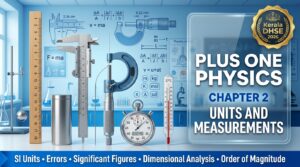

Units and Measurements Class 11 Questions and Answers | Kerala Plus One Physics Chapter 1 (ഒരു മാർക്ക് മുതൽ അഞ്ച് മാർക്ക് വരെ)
Kerala Plus One Physics Chapter 1 — Units and Measurements — is
one of the most scoring and frequently tested chapters in the Kerala Board (SCERT) Class 11 exam. This article provides 150+ Questions and Answers strictly following the Kerala Higher Secondary exam pattern, covering all mark categories: 1 Mark, 2 Mark, 3 Mark, and 5 Mark. Units and Measurements Class 11 Questions and Answers | Kerala Plus One Physics Chapter 1
Whether you are searching for Plus One Physics Chapter 1 questions Kerala, Units and Measurements solutions Class 11, or ഒന്നാം അധ്യായം ചോദ്യങ്ങൾ, you have come to the right place. Units and Measurements Chapter 1 Questions and Answers for Kerala Plus One Physics (Class 11). 150+ questions covering 1 Mark, 2 Mark, 3 Mark, and 5 Mark as per Kerala Board (SCERT) exam pattern. ഒരു മാർക്ക്, രണ്ട് മാർക്ക്, മൂന്ന് മാർക്ക്, അഞ്ച് മാർക്ക് ചോദ്യങ്ങൾ ഉത്തരങ്ങൾ സഹിതം. FOCUS KEYWORD: Units and Measurements Class 11 Kerala Questions and Answers SECONDARY KEYWORDS: Plus One Physics Chapter 1 Questions, Kerala SCERT Class 11 Physics, Units and Measurements Malayalam, Plus One Physics Solutions Kerala, യൂണിറ്റുകളും അളവുകളും ചോദ്യങ്ങൾ

1 Mark Questions and Answers (ഒരു മാർക്ക് ചോദ്യങ്ങൾ) — Units and Measurements
Plus One Physics Chapter 1: Physical World Revision Notes (HSSLiVE / Kerala Syllabus)
Kerala Higher Secondary Plus One Physics-ലെ ആദ്യ ചാപ്റ്ററായ Chapter 1: Physical World വളരെ ലളിതവും പ്രധാനപ്പെട്ട അടിസ്ഥാന ആശയങ്ങൾ ഉൾക്കൊള്ളുന്നതുമായ ഒന്നാണ്. പരീക്ഷകളിൽ ചോദിക്കാറുള്ള പ്രധാനപ്പെട്ട നിർവചനങ്ങളും (definitions) ആശയങ്ങളും മലയാളം വിശദീകരണത്തോടെ എളുപ്പത്തിൽ പഠിക്കാം.
Q1. What is a unit? A unit is a certain basic, arbitrarily chosen, internationally accepted reference standard used for measurement of a physical quantity.
Q2. What is the full form of SI? SI stands for Système Internationale d’ Unites, which means International System of Units (French).
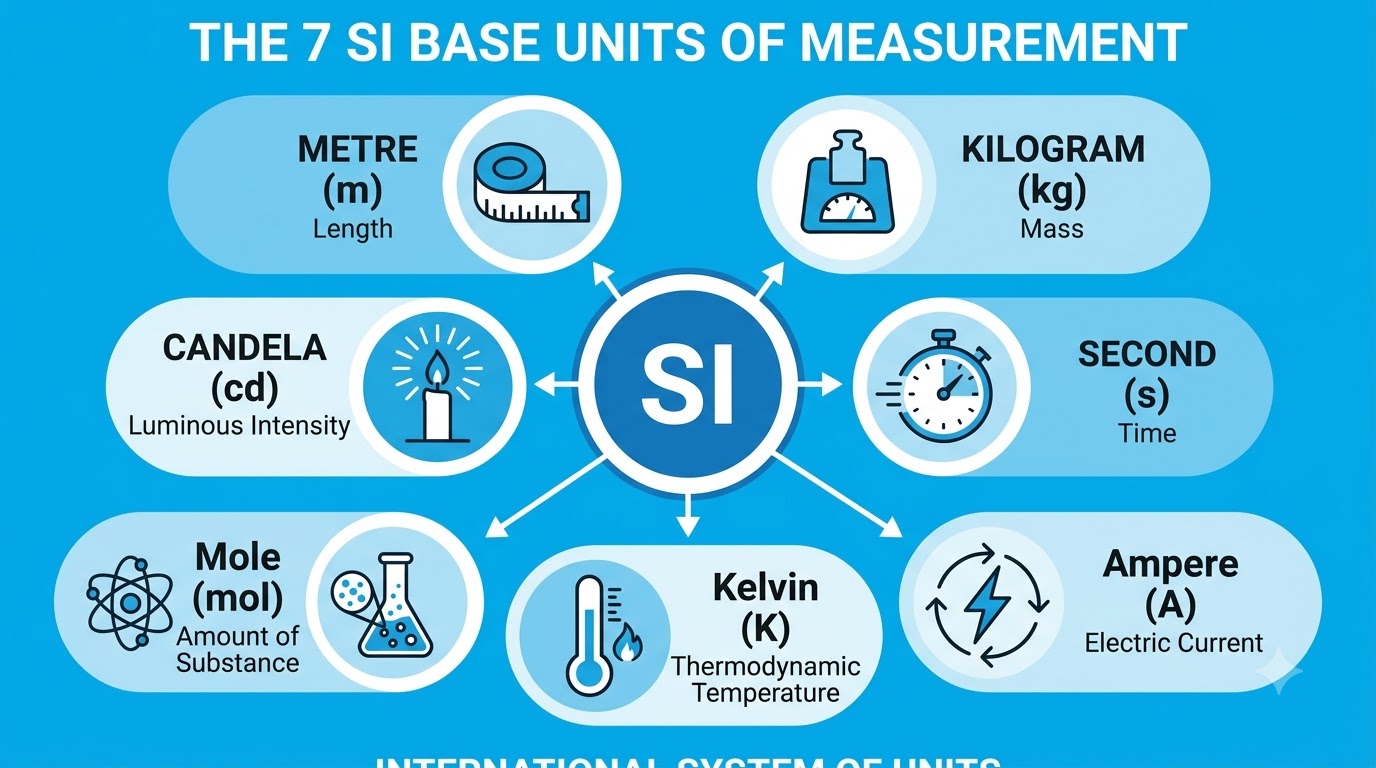
Q3. How many base units are there in the SI system? There are seven (7) base units in the SI system.
Q4. What is the SI unit of length? The SI unit of length is the metre (m).
Q5. What is the SI unit of mass? The SI unit of mass is the kilogram (kg).
Q6. What is the SI unit of time? The SI unit of time is the second (s).
Q7. What is the SI unit of electric current? The SI unit of electric current is the ampere (A).
Q8. What is the SI unit of thermodynamic temperature? The SI unit of thermodynamic temperature is the kelvin (K).
Q9. What is the SI unit of amount of substance? The SI unit of amount of substance is the mole (mol).
Q10. What is the SI unit of luminous intensity? The SI unit of luminous intensity is the candela (cd).
Q11. Define fundamental units. Fundamental (or base) units are those units that cannot be expressed in terms of any other units. They are the units for the fundamental quantities like length, mass, time, etc.
Q12. What are derived units? Units that can be expressed as combinations of base units are called derived units. Example: m/s (unit of velocity), kg·m/s² (unit of force).
Q13. What is the unit for plane angle in SI? The unit for plane angle is radian (rad).
Q14. What is the unit for solid angle in SI? The unit for solid angle is steradian (sr).
Q15. What is a light year? A light year is the distance travelled by light in vacuum in one year. 1 light year = 9.46 × 10¹⁵ m.
Q16. What is 1 Angstrom (Å)? 1 Angstrom = 10⁻¹⁰ m. It is used to measure atomic sizes.
Q17. What is 1 fermi (fm)? 1 fermi = 10⁻¹⁵ m. It is used to measure nuclear sizes.
Q18. What is 1 astronomical unit (AU)? 1 AU = 1.496 × 10¹¹ m. It is the average distance between the Earth and the Sun.
Q19. What is 1 parsec? 1 parsec = 3.08 × 10¹⁶ m = 3.26 light years. It is used to measure stellar distances.
Q20. What is significant figures? The digits that carry meaningful information about the precision of a measured value are called significant figures.
Q21. What is the number of significant figures in 0.007 m²? Only 1 significant figure (the digit 7).
Q22. What is the number of significant figures in 2.64 × 10²⁴ kg? 3 significant figures (2, 6, and 4).
Q23. What is the number of significant figures in 0.2370 g cm⁻³? 4 significant figures (2, 3, 7, and 0).
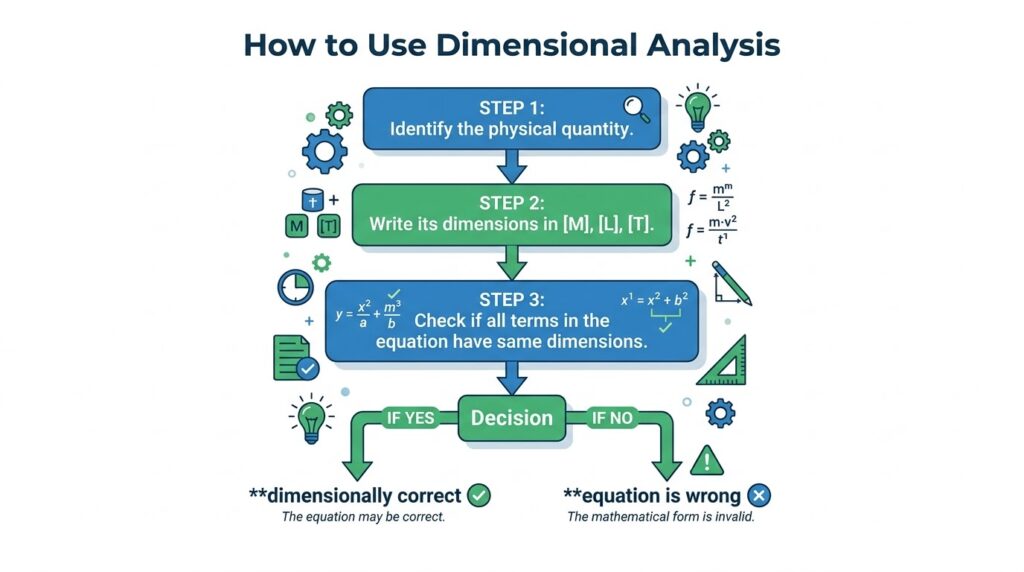
Q24. What is dimensional analysis? Dimensional analysis is a method of checking, deriving, or deducing the relationship among physical quantities using their dimensions.
Q25. What is the dimension of velocity? Dimension of velocity = [L T⁻¹] (Length per Time).
Q26. What is the dimension of force? Dimension of force = [M L T⁻²].
Q27. What is the dimension of work or energy? Dimension of work/energy = [M L² T⁻²].
Q28. What is the dimension of power? Dimension of power = [M L² T⁻³].
Q29. What is the dimension of pressure? Dimension of pressure = [M L⁻¹ T⁻²].
Q30. What is a dimensionless quantity? Give one example. A dimensionless quantity has no units and its dimensional formula has all zero exponents. Example: refractive index, strain.
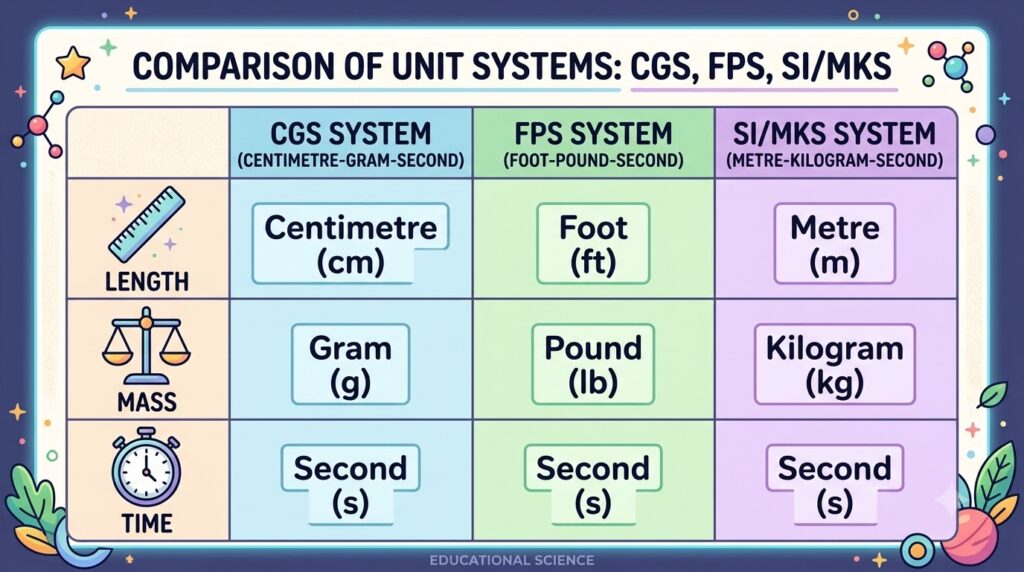
Q31. What is CGS system? In CGS system, the base units for length, mass, and time are centimetre, gram, and second respectively.
Q32. What is FPS system? In FPS (British) system, the base units for length, mass, and time are foot, pound, and second respectively.
Q33. What is MKS system? In MKS system, the base units for length, mass, and time are metre, kilogram, and second respectively.
Q34. What is the SI prefix for 10⁻⁹? The SI prefix for 10⁻⁹ is nano (n).
Q35. What is the SI prefix for 10⁶? The SI prefix for 10⁶ is mega (M).
Q36. What is the SI prefix for 10⁻³? The SI prefix for 10⁻³ is milli (m).
Q37. What is the SI prefix for 10¹²? The SI prefix for 10¹² is tera (T).
Q38. Name the most accurate device for measuring length among — vernier callipers, screw gauge, and optical instrument. An optical instrument that can measure length to within a wavelength of light is the most precise.
Q39. What is 1 unified atomic mass unit (u)? 1 u = 1.66 × 10⁻²⁷ kg. It is used to express masses of atoms and molecules.
Q40. What does the principle of homogeneity of dimensions state? It states that only quantities with the same dimensions can be added or subtracted. In a correct physical equation, dimensions on both sides must be equal.
Q41. What is the order of magnitude of a number? The order of magnitude is the power of 10 closest to the number when it is expressed in scientific notation.
Q42. What are supplementary units in SI? Radian (rad) for plane angle and steradian (sr) for solid angle are the two supplementary units in SI.
Q43. Give the dimensional formula of gravitational constant G. Dimensional formula of G = [M⁻¹ L³ T⁻²].
Q44. What is the SI unit of frequency? The SI unit of frequency is hertz (Hz), where 1 Hz = 1 s⁻¹.
Q45. What is absolute error? Absolute error is the magnitude of the difference between the measured value and the true (mean) value of a physical quantity.
Q46. What is relative error? Relative error = Absolute error / Mean value of the quantity.
Q47. What is percentage error? Percentage error = Relative error × 100%.
Q48. What is the dimension of Planck’s constant (h)? Dimension of Planck’s constant = [M L² T⁻¹].
Q49. What is the dimension of angular momentum? Dimension of angular momentum = [M L² T⁻¹].
Q50. What is the dimension of surface tension? Dimension of surface tension = [M T⁻²].
2 Mark Questions and Answers (രണ്ട് മാർക്ക് ചോദ്യങ്ങൾ) — Units and Measurements
Q51. Distinguish between fundamental units and derived units with examples.
- Fundamental units: Units of base physical quantities that are independent of each other. Examples: metre (length), kilogram (mass), second (time).
- Derived units: Units obtained from combinations of base units. Examples: m/s (velocity), kg·m/s² (force/Newton), m² (area).
Q52. What are significant figures? State any two rules for determining significant figures. Significant figures are the meaningful digits in a measured value that indicate the precision of the measurement.
Rules:
- All non-zero digits are significant. Example: 324 has 3 significant figures.
- Zeros between non-zero digits are significant. Example: 3007 has 4 significant figures.
Q53. A student measures the diameter of a wire using a screw gauge of pitch 1 mm and 100 divisions on the circular scale. Find the least count of the screw gauge. Least count = Pitch / Number of divisions on circular scale = 1 mm / 100 = 0.01 mm = 10⁻⁵ m
Q54. Distinguish between systematic errors and random errors.
- Systematic errors: Errors that tend to be in one direction (either always positive or always negative). They arise from faulty instruments or biased technique. Example: zero error in a screw gauge.
- Random errors: Errors that vary in an unpredictable manner for each measurement. They arise due to unpredictable fluctuations. Example: fluctuations in room temperature while measuring resistance.
Q55. State and explain the principle of homogeneity of dimensions. According to the principle of homogeneity of dimensions, for a physical equation to be valid, the dimensions of every term on both sides of the equation must be the same. This principle allows us to check whether an equation is dimensionally consistent or not. For example, in the equation s = ut + ½at², all three terms (s, ut, ½at²) have the dimension [L], confirming it is dimensionally correct.
Q56. What is scientific notation? Why is it used? Scientific notation is a way of expressing numbers as a number between 1 and 10 multiplied by a power of 10. Example: 300,000,000 m/s = 3 × 10⁸ m/s.
It is used because:
- It makes very large or very small numbers easy to write and compare.
- It clearly indicates the number of significant figures.
Q57. Write the SI base units and their symbols for all seven base quantities.
| Base Quantity | SI Unit | Symbol |
|---|---|---|
| Length | Metre | m |
| Mass | Kilogram | kg |
| Time | Second | s |
| Electric Current | Ampere | A |
| Temperature | Kelvin | K |
| Amount of Substance | Mole | mol |
| Luminous Intensity | Candela | cd |
Q58. The mass of a body is 2.30 kg and two pieces of gold of mass 20.15 g and 20.17 g are placed on it. Find (a) total mass, (b) difference in masses of gold pieces. (a) Total mass = 2300 g + 20.15 g + 20.17 g = 2340.32 g → correct to decimal places of 2300 g → 2340 g = 2.34 kg (b) Difference = 20.17 − 20.15 = 0.02 g
Q59. What is the difference between accuracy and precision?
- Accuracy refers to how close a measured value is to the true value.
- Precision refers to how reproducible or consistent multiple measurements are to each other, regardless of the true value.
A measurement can be precise without being accurate (systematic error), but an accurate measurement will generally also be precise.
Q60. Convert: 1 kg m² s⁻² to g cm² s⁻². 1 kg = 10³ g; 1 m = 10² cm; so 1 m² = 10⁴ cm² ∴ 1 kg m² s⁻² = 10³ × 10⁴ g cm² s⁻² = 10⁷ g cm² s⁻²
Q61. What are the limitations of dimensional analysis?
- The value of dimensionless constants cannot be determined using dimensional analysis.
- It cannot distinguish between physical quantities having the same dimensional formula (e.g., work and torque both have [M L² T⁻²]).
- It is not applicable to equations involving trigonometric, logarithmic, or exponential functions.
Q62. Find the number of significant figures in: (a) 6.320 J (b) 6.032 N m⁻² (c) 0.0006032 m² (a) 6.320 J → 4 significant figures (trailing zero after decimal is significant) (b) 6.032 N m⁻² → 4 significant figures (zero between digits is significant) (c) 0.0006032 m² → 4 significant figures (leading zeros are not significant)
Q63. What is error of measurement? Write its types. Error of measurement is the difference between the measured value and the true value of a physical quantity.
Types:
- Systematic errors — arise from instruments, method, or personal bias
- Random errors — arise from unpredictable, uncontrollable variations
- Gross errors (mistakes) — arise from careless readings or blunders
Q64. Express 1 AU in metres and state its significance. 1 Astronomical Unit (AU) = 1.496 × 10¹¹ m
It is the average distance between the Earth and the Sun and is commonly used to measure distances within the solar system.
Q65. A cube has each side measuring 1 cm. What is its volume in m³? 1 cm = 10⁻² m Volume = (10⁻²)³ m³ = 10⁻⁶ m³
Q66. Write the dimensional formula for: (a) momentum (b) impulse (c) torque (a) Momentum = mass × velocity → [M L T⁻¹] (b) Impulse = force × time → [M L T⁻¹] (c) Torque = force × distance → [M L² T⁻²]
Q67. Why is it important to use SI units internationally? SI units are important because:
- They provide a universal, standardised system accepted worldwide.
- They use a decimal system, making conversions simple.
- They ensure consistency in scientific, commercial, and industrial work globally.
Q68. What is least count? What is the least count of a Vernier callipers with 10 divisions on the sliding scale equal to 9 mm? Least count is the smallest value that can be measured by a measuring instrument.
Least count of Vernier callipers = 1 MSD − 1 VSD Here, 1 MSD = 1 mm; 1 VSD = 9/10 = 0.9 mm Least count = 1 − 0.9 = 0.1 mm
Q69. The length, breadth and thickness of a rectangular metal sheet are 4.234 m, 1.005 m, and 2.01 cm respectively. Calculate the area of the sheet to correct significant figures. Area = length × breadth = 4.234 × 1.005 = 4.255 m² Rounded to minimum significant figures (4) → Area = 4.255 m²
Q70. What is meant by dimensional formula? Give the dimensional formula of (a) density (b) velocity gradient. Dimensional formula is an expression showing which base quantities and with what powers are involved in a physical quantity.
(a) Density = mass/volume → [M L⁻³] (b) Velocity gradient = velocity/distance → [T⁻¹]
3 Mark Questions and Answers (മൂന്ന് മാർക്ക് ചോദ്യങ്ങൾ) — Units and Measurements
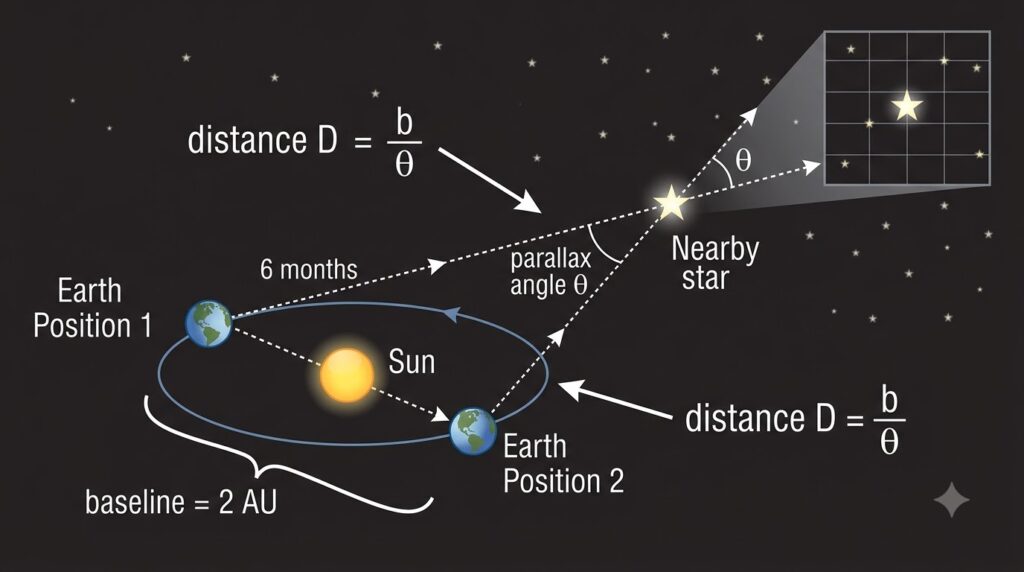
Q71. Describe the method of measuring large distances using parallax method. The parallax method is used to measure very large distances such as the distance of a planet or star.
When we observe a nearby object against a distant background from two different positions, the object appears to shift. This shift is called parallax.
Steps:
- Let the diameter of Earth’s orbit (baseline) be b.
- Observe the planet from two positions A and B of Earth’s orbit, six months apart.
- Measure the angle θ (called parallax angle or parallactic angle) subtended by the baseline at the planet.
- Then the distance D = b / (2 sin θ/2) ≈ b/θ (for small θ in radians).
This method gives accurate distances to stars and planets within a few hundred light years.
Q72. State and explain any three rules for writing significant figures in arithmetic operations. Rule 1 — Addition and Subtraction: The result should have no more decimal places than the number with the fewest decimal places. Example: 1.2 + 3.45 + 0.356 = 5.006 → rounded to 5.0 (least decimal places = 1)
Rule 2 — Multiplication and Division: The result should have no more significant figures than the number with the fewest significant figures. Example: 2.5 × 3.14 = 7.85 → 7.9 (2 significant figures, as 2.5 has only 2)
Rule 3 — Rounding off: If the digit to be dropped is greater than 5, increase the last retained digit by 1. If it is less than 5, leave the last retained digit unchanged. If exactly 5, round to the nearest even number. Example: 2.745 → 2.74; 2.735 → 2.74
Q73. What is dimensional analysis? Explain how it is used to check the correctness of a physical equation. Give an example. Dimensional analysis is a technique used to verify physical equations by checking whether the dimensions of quantities on both sides of the equation are the same (Principle of Homogeneity).
Example: Check the equation v² = u² + 2as
LHS: v² → [L T⁻¹]² = [L² T⁻²]
RHS: u² → [L² T⁻²]; 2as → [L T⁻²][L] = [L² T⁻²]
Since all three terms have dimensions [L² T⁻²], the equation is dimensionally correct.
Limitation: This method cannot verify the correctness of constants or equations with functions like sin, cos, or log.
Q74. Derive the SI unit of force using dimensional analysis. Force = mass × acceleration
Dimensions: Force = [M] × [L T⁻²] = [M L T⁻²]
In SI units:
- [M] → kilogram (kg)
- [L] → metre (m)
- [T] → second (s)
∴ SI unit of force = kg · m · s⁻² = Newton (N)
Verification: 1 N is the force required to give a mass of 1 kg an acceleration of 1 m s⁻².

Q75. Explain with an example how dimensional analysis is used to derive the formula for the time period of a simple pendulum. Assume time period T depends on length l, mass m, and acceleration due to gravity g.
Let T = k · lˣ · mʸ · gᶻ
Dimensions: [T] = [L]ˣ [M]ʸ [L T⁻²]ᶻ = [Mʸ Lˣ⁺ᶻ T⁻²ᶻ]
Comparing both sides:
- For M: y = 0
- For T: −2z = 1 → z = −½
- For L: x + z = 0 → x = ½
Therefore: T = k · l^(½) · g^(−½) = k √(l/g)
The actual formula is T = 2π√(l/g), where k = 2π is determined experimentally.
Q76. What are systematic errors? Explain any three types of systematic errors with examples. Systematic errors are those that tend to be consistently in one direction for every measurement.
Types:
- Instrumental errors: Due to faulty design or imperfect calibration of the instrument. Example: A beam balance with unequal arms gives wrong mass readings.
- Imperfection in experimental technique: Due to limitations in the experimental procedure. Example: Measuring body temperature of a patient by placing thermometer under armpit instead of in the mouth gives a lower reading.
- Personal errors (Personal bias): Due to individual habits of the observer. Example: An observer who always looks at a measuring scale at an angle from one side will record systematically wrong readings (parallax error).
Q77. Explain the concept of errors in measurement. How can we minimise random errors? Measurement always involves some uncertainty. The difference between the measured value and the true value is called the error of measurement.
Types of errors: systematic, random, and gross errors.
Minimising Random Errors:
- Take multiple readings: Performing a large number of measurements and calculating the arithmetic mean reduces random error significantly.
- Use precise instruments: High-precision instruments like optical instruments reduce the spread of readings.
- Statistical methods: Standard deviation and standard error of mean can quantify and help reduce random errors.
The mean of n measurements is: x_mean = (x₁ + x₂ + … + xₙ) / n Mean absolute error = Σ|Δxᵢ| / n
Q78. A student finds that the period of oscillation of a simple pendulum is 1.62 s. The digits 1 and 6 are reliable, while the digit 2 is uncertain. What is the absolute error and relative error if actual value is 1.60 s? Measured value = 1.62 s; True value = 1.60 s
Absolute error = |1.62 − 1.60| = 0.02 s
Relative error = 0.02 / 1.60 = 0.0125
Percentage error = 0.0125 × 100 = 1.25%
Q79. Explain the CGS, FPS, and MKS systems of units. Which system is now internationally accepted? CGS System: Base units are Centimetre (length), Gram (mass), Second (time). Used in older scientific work, particularly in electromagnetism.
FPS (British) System: Base units are Foot (length), Pound (mass), Second (time). Used in some engineering fields in the US and UK.
MKS System: Base units are Metre (length), Kilogram (mass), Second (time). Formed the basis for the modern SI system.
International Standard: The SI (International System of Units) is now internationally accepted for scientific, technical, industrial, and commercial use worldwide. It is based on 7 base units and uses the decimal system.
Q80. Derive dimensional formula for: (a) gravitational constant G (b) coefficient of viscosity η.
(a) Gravitational constant G: From Newton’s law of gravitation: F = Gm₁m₂/r² ∴ G = Fr²/(m₁m₂) Dimensions of G = [MLT⁻²][L²] / [M²] = [M⁻¹ L³ T⁻²]
(b) Coefficient of viscosity η: From Newton’s viscosity law: F = η A (dv/dx) ∴ η = F·dx / (A·dv) Dimensions = [MLT⁻²][L] / ([L²][LT⁻¹]) = [MLT⁻²L] / [L³T⁻¹] = [M L⁻¹ T⁻¹]
Q81. What is the difference between the distance of measurement by parallax method and that by echo method? Explain echo method. Echo method is used to measure shorter distances (like depth of a sea or width of a building) using sound.
Principle: A sound pulse is emitted, and the time t for the echo to return is measured. If v is the speed of sound:
Distance = v × t / 2
For example, if an ultrasonic pulse takes 0.4 s to return from the ocean floor and v = 1500 m/s: Depth = 1500 × 0.4 / 2 = 300 m
The parallax method is used for distances of the order of parsecs (astronomical distances), while the echo method is for terrestrial distances.
Q82. Express the dimensions of the following physical quantities and find if they have the same dimensions: (a) Work (b) Torque (c) Energy. (a) Work = Force × displacement = [MLT⁻²][L] = [ML²T⁻²]
(b) Torque = Force × perpendicular distance = [MLT⁻²][L] = [ML²T⁻²]
(c) Energy = capacity to do work = [ML²T⁻²]
All three have the same dimensional formula [ML²T⁻²]. However, they are physically different quantities — work and energy are scalar, while torque is a vector. This shows the limitation of dimensional analysis: it cannot distinguish quantities with the same dimensions.
Q83. A photograph of a house occupies 1.75 cm² on a 35 mm slide. The slide is projected and the area on the screen is 1.55 m². Find the linear magnification. Area on screen = 1.55 m² = 1.55 × 10⁴ cm² Area on slide = 1.75 cm²
Area magnification = 1.55 × 10⁴ / 1.75 = 8857.14
Linear magnification = √(8857.14) = 94.1 ≈ 94
Q84. Explain how to estimate the size of a molecule using the oil film method. Oil film method (Avogadro’s method):
- Take a known volume V of oleic acid (dissolved in alcohol — the solvent evaporates).
- Spread it on a clean water surface. It forms a monomolecular layer.
- Measure the area A of the film formed.
- The thickness of the film (≈ size of molecule): t = V/A
Example: If V = 10⁻⁶ cm³ and A = 500 cm²: t = 10⁻⁶ / 500 = 2 × 10⁻⁹ m = 2 nm
This gives an estimate of the diameter of a molecule.
Q85. Explain any 3 uses of dimensional analysis. 1. Checking dimensional consistency of equations: Verify whether a physical equation is correct by confirming dimensions match on both sides. Example: checking s = ut + ½at².
2. Deriving relations between physical quantities: By knowing the factors on which a quantity depends, we can derive the formula. Example: deriving T = k√(l/g) for a simple pendulum.
3. Converting units from one system to another: If [Q] = Mᵃ Lᵇ Tᶜ, then: n₁u₁ = n₂u₂ → n₂ = n₁ (M₁/M₂)ᵃ (L₁/L₂)ᵇ (T₁/T₂)ᶜ This allows conversion of values from CGS to SI or vice versa.
5 Mark / Essay Questions and Answers (അഞ്ച് മാർക്ക് ചോദ്യങ്ങൾ) — Units and Measurements
Q86. (a) What is dimensional analysis? (b) State the principle of homogeneity of dimensions. (c) Using dimensional analysis, check whether the equation v² = u² + 2as is dimensionally correct. (d) Mention two limitations of dimensional analysis.
(a) Dimensional Analysis: Dimensional analysis is a technique that uses the dimensions of physical quantities to establish relationships between them, verify equations, or convert units. The dimensions of any physical quantity are expressed in terms of base quantities: Mass [M], Length [L], Time [T], Current [A], Temperature [K], Amount [mol], Luminous intensity [cd].
(b) Principle of Homogeneity: Only quantities with identical dimensions can be added, subtracted, or equated. In any physically valid equation, every term must have the same dimensions.
(c) Checking v² = u² + 2as:
- LHS: [v²] = [LT⁻¹]² = [L²T⁻²]
- RHS term 1: [u²] = [LT⁻¹]² = [L²T⁻²]
- RHS term 2: [2as] = [LT⁻²][L] = [L²T⁻²]
Since all terms = [L²T⁻²], the equation is dimensionally correct.
(d) Limitations:
- Dimensionless constants (like 2 in 2as or π in T = 2π√(l/g)) cannot be determined by dimensional analysis.
- It cannot be applied to equations involving trigonometric, exponential, or logarithmic functions (e.g., x = a sin(ωt)).
Q87. (a) What is meant by significant figures? (b) State the rules for finding significant figures. (c) State the rules for arithmetic operations with significant figures. (d) Round off 2.745 and 2.735 to three significant figures.
(a) Significant Figures: The digits that carry meaningful information about a measurement and indicate its precision are called significant figures. They include all certain digits plus one uncertain (estimated) digit.
(b) Rules for Counting Significant Figures:
- All non-zero digits are significant. (e.g., 234 → 3 s.f.)
- Zeros between non-zero digits are significant. (e.g., 3007 → 4 s.f.)
- Trailing zeros after the decimal point are significant. (e.g., 3.60 → 3 s.f.)
- Leading zeros (zeros before the first non-zero digit) are NOT significant. (e.g., 0.007 → 1 s.f.)
- Trailing zeros in a whole number without a decimal point are ambiguous.
(c) Arithmetic Operations:
- Addition/Subtraction: Result has decimal places equal to the least number of decimal places in any operand. Example: 2.1 + 3.45 + 0.006 = 5.556 → 5.6
- Multiplication/Division: Result has significant figures equal to the least number of significant figures in any operand. Example: 2.5 × 1.34 = 3.35 → 3.4 (2 s.f.)
(d) Rounding off:
- 2.745 rounded to 3 s.f.: digit after 4 is 5, and preceding digit 4 is even → 2.74
- 2.735 rounded to 3 s.f.: digit after 3 is 5, and preceding digit 3 is odd → round up → 2.74
Q88. (a) What are different types of errors in measurement? (b) Explain each with an example. (c) How is the mean value and mean absolute error of a quantity calculated?
(a) Types of Errors:
- Systematic errors
- Random errors
- Gross errors (mistakes)
(b) Explanation with Examples:
Systematic Errors — errors that consistently occur in the same direction:
- Instrumental errors: Faulty zero calibration of a meter. Example: A weighing scale showing 5 g when nothing is placed on it.
- Technique errors: Wrong positioning of a thermometer.
- Personal bias: An observer always reading the scale from an angle.
Random Errors — unpredictable fluctuations:
- Multiple readings of the same voltage show values like 5.2, 5.3, 5.1, 5.25 V due to electrical fluctuations.
- These can be reduced by taking many readings and averaging them.
Gross Errors (Mistakes):
- Recording a reading wrongly (e.g., writing 21.5 instead of 12.5).
- These can only be avoided by care and repetition.
(c) Calculating Mean Value and Mean Absolute Error:
If n measurements give values x₁, x₂, …, xₙ:
Mean value (x̄) = (x₁ + x₂ + … + xₙ) / n
Absolute errors: Δx₁ = |x̄ − x₁|, Δx₂ = |x̄ − x₂|, …, Δxₙ = |x̄ − xₙ|
Mean absolute error (Δx̄) = (Δx₁ + Δx₂ + … + Δxₙ) / n
The result is expressed as: x = x̄ ± Δx̄
Q89. (a) What is the SI system of units? (b) Name all seven base quantities, their SI units, and symbols. (c) Why is SI preferred over other unit systems?
(a) SI System: SI (Système Internationale d’ Unites) is the modern, internationally accepted system of measurement based on seven base units. It was developed by the Bureau International des Poids et Measures (BIPM) in 1971 and revised in 2018.
(b) Seven Base Quantities:
| Base Quantity | SI Unit | Symbol |
|---|---|---|
| Length | Metre | m |
| Mass | Kilogram | kg |
| Time | Second | s |
| Electric Current | Ampere | A |
| Thermodynamic Temperature | Kelvin | K |
| Amount of Substance | Mole | mol |
| Luminous Intensity | Candela | cd |
(c) Advantages of SI over other systems:
- Universally accepted: Used in all countries for scientific, industrial, and commercial purposes.
- Decimal system: Conversions are easy (multiples of 10).
- Coherent system: All derived units follow naturally from base units with no conversion factors.
- Reproducible: Units are defined based on fundamental constants of nature (e.g., speed of light, Planck’s constant), making them reproducible anywhere.
- Single unit per quantity: Only one unit for each physical quantity, avoiding confusion (e.g., only joule for energy, not cal, erg, BTU separately).
Q90. Using the method of dimensions, derive the expression for the time period T of a simple pendulum. The time period is assumed to depend on mass m of the bob, length l of the pendulum, and acceleration due to gravity g.
Let T = k · mˣ · lʸ · gᶻ (where k is a dimensionless constant)
Writing dimensions on both sides:
[M⁰ L⁰ T¹] = [M]ˣ · [L]ʸ · [L T⁻²]ᶻ
[M⁰ L⁰ T¹] = [Mˣ · Lʸ⁺ᶻ · T⁻²ᶻ]
Comparing powers of M, L, and T:
- Power of M: x = 0
- Power of T: −2z = 1 → z = −1/2
- Power of L: y + z = 0 → y = 1/2
Therefore: T = k · m⁰ · l^(1/2) · g^(−1/2)
T = k √(l/g)
Experimentally, k = 2π, so the actual formula is:
T = 2π √(l/g)
This shows that the time period is:
- Independent of the mass of the bob (m⁰)
- Proportional to the square root of the length (l^(½))
- Inversely proportional to the square root of g (g^(−½))
Additional Important Questions (Kerala Board Previous Year Style)
Q91. Check the dimensional correctness of the equation: P = hρg, where P is pressure, h is height, ρ is density, g is acceleration due to gravity. LHS: [P] = [M L⁻¹ T⁻²] RHS: [hρg] = [L][ML⁻³][LT⁻²] = [ML⁻¹T⁻²] LHS = RHS → equation is dimensionally correct.
Q92. The frequency of a vibrating string depends on length L, tension F, and linear mass density μ (mass per unit length). Using dimensional analysis, derive the formula for frequency. Let ν = k · Lˣ · Fʸ · μᶻ
[T⁻¹] = [L]ˣ [MLT⁻²]ʸ [ML⁻¹]ᶻ = [M^(y+z) L^(x+y−z) T^(−2y)]
Comparing: y + z = 0, x + y − z = 0, −2y = −1 → y = 1/2, z = −1/2, x = −1
∴ ν = k/L · √(F/μ) = (1/2L)√(F/μ) with k = 1/2
Q93. What is the order of magnitude of the following: (a) mass of Sun = 2 × 10³⁰ kg (b) size of atom = 10⁻¹⁰ m? (a) Order of magnitude of mass of Sun = 10³⁰ (b) Order of magnitude of atomic size = 10⁻¹⁰
Q94. Convert the value of G = 6.67 × 10⁻¹¹ N m² kg⁻² into CGS units. G in SI = 6.67 × 10⁻¹¹ N m² kg⁻² Dimensional formula of G = [M⁻¹ L³ T⁻²]
n₂ = n₁ × (M₁/M₂)⁻¹ × (L₁/L₂)³ × (T₁/T₂)⁻² = 6.67 × 10⁻¹¹ × (1 kg/1 g)⁻¹ × (1 m/1 cm)³ × (1 s/1 s)⁻² = 6.67 × 10⁻¹¹ × (10³)⁻¹ × (10²)³ = 6.67 × 10⁻¹¹ × 10⁻³ × 10⁶ = 6.67 × 10⁻⁸ dyne cm² g⁻²
Q95. What are the rules for rounding off numbers? Round off 3.155 and 3.145 to three significant figures. Rules:
- If digit to be dropped < 5: leave preceding digit unchanged.
- If digit to be dropped > 5: increase preceding digit by 1.
- If digit = 5, and preceding digit is odd: increase by 1. If even: leave unchanged.
- 3.155 → preceding digit 5 is odd → round up → 3.16
- 3.145 → preceding digit 4 is even → leave unchanged → 3.14
Frequently Asked Questions (FAQ) — Kerala Plus One Physics Chapter 1
- What are the 7 SI base units? The seven SI base units are: metre (length), kilogram (mass), second (time), ampere (electric current), kelvin (temperature), mole (amount of substance), and candela (luminous intensity).
- What is the principle of homogeneity in dimensional analysis? It states that all terms in a physical equation must have the same dimensions for the equation to be valid. This principle is used to verify or derive physical formulas.
- What is 1 light year in metres? 1 light year = 9.46 × 10¹⁵ m. It is the distance travelled by light in vacuum in one year.
- What is the difference between accuracy and precision? (Plus One Physics Kerala) Accuracy refers to how close a measurement is to the true value. Precision refers to the reproducibility of measurements. A measurement can be precise but not accurate if there is a systematic error.
- How many significant figures are in 0.006032? 4 significant figures: 6, 0, 3, 2. Leading zeros are not significant.
- What are the limitations of dimensional analysis? (Kerala Board) (1) Cannot determine dimensionless constants. (2) Cannot be applied to equations with trig/log/exponential functions. (3) Cannot distinguish quantities with same dimensions (e.g., work and torque).
- ഡൈമൻഷണൽ അനാലിസിസ് ഉപയോഗിച്ച് ഒരു ലളിതമായ ഫോർമുല ഉദ്ഭവിക്കുന്നത് എങ്ങനെ? (How to derive a formula using dimensional analysis in Malayalam medium?) ഡൈമൻഷണൽ അനാലിസിസ് ഉപയോഗിച്ച് ഫോർമുല ഉദ്ഭവിക്കാൻ: ആദ്യം ഏതൊക്കെ physical quantities ഉൾപ്പെടുന്നുവെന്ന് കണ്ടെത്തുക, ശേഷം ഡൈമൻഷൻ ഇക്വേഷൻ ഉണ്ടാക്കുക, ഘാതങ്ങൾ (powers) തുലനം ചെയ്ത് കണ്ടുപിടിക്കുക, ഒടുവിൽ ഫോർമുല എഴുതുക.
- What is dimensional formula of velocity, acceleration, and momentum?
- Velocity: [LT⁻¹]
- Acceleration: [LT⁻²]
- Momentum: [MLT⁻¹]
1. What is Physics? (എന്താണ് ഫിസിക്സ്?)
പ്രകൃതിയെയും പ്രകൃതിയിലെ പ്രതിഭാസങ്ങളെയും (natural phenomena) വ്യവസ്ഥാപിതമായി മനസ്സിലാക്കാനുള്ള പഠന ശാഖയാണ് സയൻസ്. ഫിസിക്സിൽ പ്രധാനമായും രണ്ട് സമീപനങ്ങളാണ് (two core approaches) ഉള്ളത്:
-
Unification (ഏകീകരണം): വ്യത്യസ്തങ്ങളായ ഭൗതിക പ്രതിഭാസങ്ങളെ വളരെ കുറച്ചു നിയമങ്ങൾ ഉപയോഗിച്ച് വിശദീകരിക്കുന്ന രീതിയാണിത്.
ഉദാഹരണം: വൈദ്യുത, കാന്തിക പ്രതിഭാസങ്ങളെ മാക്സ്വെൽ സമവാക്യങ്ങൾ (Maxwell’s equations) വഴി ഒരൊറ്റ ഫ്രെയിംവർക്കിൽ കൊണ്ടുവന്നത്.
-
Reductionism (റിഡക്ഷനിസം): ഒരു സങ്കീർണ്ണമായ സിസ്റ്റത്തിന്റെ ഗുണങ്ങൾ (properties) അതിലെ ചെറിയ ഘടകങ്ങളുടെ സ്വഭാവത്തെ അടിസ്ഥാനമാക്കി പഠിക്കുന്ന രീതി.
ഉദാഹരണം: ഒരു വാതകത്തിന്റെ താപനില (temperature) എന്നത് അതിലെ തന്മാത്രകളുടെ ശരാശരി ഗതികോർജ്ജവുമായി (average kinetic energy of molecules) ബന്ധപ്പെട്ടിരിക്കുന്നു എന്ന് കണ്ടെത്തിയത്.
2. Scope and Excitement of Physics
ഫിസിക്സിന്റെ പരിധി പ്രധാനമായും രണ്ട് ഡൊമെയ്നുകളായി തിരിച്ചിരിക്കുന്നു:
-
Macroscopic Domain (സ്ഥൂല മണ്ഡലം): ലബോറട്ടറി പരീക്ഷണങ്ങൾ, ഭൂമിയിലെ പ്രതിഭാസങ്ങൾ (terrestrial), അസ്ട്രോണമിക്കൽ സ്കെയിലിലുള്ള ആകാശഗോളങ്ങൾ എന്നിവ ഇതിൽ ഉൾപ്പെടുന്നു.
-
Microscopic Domain (സൂക്ഷ്മ മണ്ഡലം): ദ്രവ്യത്തിന്റെ ഘടന, ഇലക്ട്രോൺ, പ്രോട്ടോൺ, ന്യൂട്രോൺ, ഫോട്ടോൺ തുടങ്ങിയ സൂക്ഷ്മ കണികകൾ തമ്മിലുള്ള പ്രവർത്തനങ്ങൾ എന്നിവ ഇതിൽ കൈകാര്യം ചെയ്യുന്നു.
Range of Physics (ഭൗതിക അളവുകളുടെ വ്യാപ്തി):
-
Length (നീളം): $10^{-14}\text{ m}$ (ന്യൂക്ലിയർ സ്കെയിൽ) മുതൽ $10^{26}\text{ m}$ (പ്രപഞ്ചത്തിന്റെ വ്യാപ്തി) വരെ.
-
Time (സമയം): $10^{-22}\text{ s}$ മുതൽ $10^{18}\text{ s}$ വരെ.
-
Mass (പിണ്ഡം): $10^{-30}\text{ kg}$ (ഇലക്ട്രോണിന്റെ ഭാരം) മുതൽ $10^{55}\text{ kg}$ (പ്രപഞ്ചത്തിന്റെ ആകെ ഭാരം) വരെ.
3. Fundamental Forces in Nature (പ്രകൃതിയിലെ 4 അടിസ്ഥാന ബലങ്ങൾ)
പരീക്ഷകളിൽ സ്ഥിരമായി 2 അല്ലെങ്കിൽ 3 മാർക്കിന് ചോദിക്കുന്ന പ്രധാനപ്പെട്ട ഭാഗമാണിത്.
| Force (ബലം) | Relative Strength (ആപേക്ഷിക ശക്തി) | Range (പരിധി) | Key Characteristics (പ്രധാന പ്രത്യേകതകൾ) |
| Gravitational Force | $10^{-39}$ (ഏറ്റവും ദുർബലമായത്) | Infinite (അനന്തം) | പിണ്ഡമുള്ള (mass) ഏത് രണ്ട് വസ്തുക്കൾ തമ്മിലും ആകർഷണബലം മാത്രമായി നിലനിൽക്കുന്നു. |
| Weak Nuclear Force | $10^{-13}$ | Very short (~$10^{-16}\text{ m}$) | $\beta$-decay പോലുള്ള ചില ന്യൂക്ലിയർ പ്രക്രിയകളിൽ മാത്രം കാണപ്പെടുന്നു. |
| Electromagnetic Force | $10^{-2}$ | Infinite (അനന്തം) | ചാർജുള്ള വസ്തുക്കൾ തമ്മിൽ പ്രവർത്തിക്കുന്നു; ആകർഷണവും വികർഷണവുമുണ്ട്. |
| Strong Nuclear Force | $1$ (ഏറ്റവും ശക്തമായത്) | Short (~$10^{-15}\text{ m}$) | ന്യൂക്ലിയസിനുള്ളിൽ പ്രോട്ടോണുകളെയും ന്യൂട്രോണുകളെയും ഒരുമിച്ച് നിർത്തുന്നു; charge-independent ആണ്. |
4. Unification of Forces (ശക്തികളുടെ ഏകീകരണം)
ശാസ്ത്രജ്ഞർ വിവിധ കാലഘട്ടങ്ങളിലായി പല ബലങ്ങളെ ഒന്നിച്ചു ചേർത്ത പ്രധാനപ്പെട്ട ഘട്ടങ്ങൾ:
-
ഐസക് ന്യൂട്ടൺ (Isaac Newton): ഭൂമിയിലെ വസ്തുക്കളുടെ ചലനത്തെയും (terrestrial) ആകാശഗോളങ്ങളുടെ ചലനത്തെയും (celestial) ഒരൊറ്റ ഗ്രാവിറ്റേഷണൽ നിയമത്തിന് കീഴിൽ കൊണ്ടുവന്നു.
-
ഓർസ്റ്റെഡും ഫാരഡേയും (Oersted & Faraday): വൈദ്യുതിയും കാന്തികതയും പരസ്പരം വേർതിരിക്കാനാവാത്തതാണെന്ന് തെളിയിച്ചു.
-
മാക്സ്വെൽ (James Clerk Maxwell): ഇലക്ട്രോമാഗ്നെറ്റിസവും പ്രകാശവും (optics) ഒന്നുതന്നെയാണെന്ന് തെളിയിച്ചു (Light is an electromagnetic wave).
5. Nature of Physical Laws (ഭൗതിക നിയമങ്ങളുടെ സ്വഭാവം)
ഒരു ഭൗതിക പ്രക്രിയയിൽ മാറ്റമില്ലാതെ നിലനിൽക്കുന്ന അളവുകളെ Conserved Quantities എന്ന് വിളിക്കുന്നു.
പ്രധാന സംരക്ഷണ നിയമങ്ങൾ (Conservation Laws):
-
Law of Conservation of Energy (ഊർജ്ജ സംരക്ഷണ നിയമം)
-
Law of Conservation of Linear Momentum (രേഖീയ സംവേഗ സംരക്ഷണ നിയമം)
-
Law of Conservation of Angular Momentum (കോണീയ സംവേഗ സംരക്ഷണ നിയമം)
-
Law of Conservation of Electric Charge (വൈദ്യുത ചാർജ്ജ് സംരക്ഷണ നിയമം)
പ്രത്യേകം ശ്രദ്ധിക്കുക: പ്രകൃതിയിലെ സമമിതിയും (Symmetry) സംരക്ഷണ നിയമങ്ങളും തമ്മിൽ നേരിട്ട് ബന്ധമുണ്ട്.
Symmetry in time translation $\rightarrow$ Law of conservation of energy.
Symmetry in space translation $\rightarrow$ Law of conservation of linear momentum.
Quick Exam Revision Tips
-
Fundamental forces-ന്റെ ശക്തിയുടെ ക്രമം (Order of strength) കാണാതെ പഠിക്കുക:
$$\text{Strong Nuclear} > \text{Electromagnetic} > \text{Weak Nuclear} > \text{Gravitational}$$ -
Unification vs Reductionism തമ്മിലുള്ള വ്യത്യാസം ചോദിക്കാൻ സാധ്യത കൂടുതലാണ്.
-
ഈ ചാപ്റ്ററിൽ നിന്ന് സാധാരണയായി വലിയ പ്രോബ്ലംസ് ചോദിക്കാറില്ല; മുകളിൽ നൽകിയ കൺസെപ്റ്റുകളും ടേബിളും മാത്രം ശ്രദ്ധിച്ചു പഠിച്ചാൽ മുഴുവൻ മാർക്കും നേടാം.
This article covers Kerala Plus One Physics Chapter 1 — Units and Measurements — with 150+ questions for 1 mark, 2 mark, 3 mark, and 5 mark categories following the Kerala Board (SCERT) exam pattern. Bookmark hsslives.com for complete chapter-wise solutions for all Plus One and Plus Two subjects.
Tags: Plus One Physics Questions Answers Kerala | Class 11 Physics Chapter 1 | ഒന്നാം അധ്യായം ചോദ്യോത്തരങ്ങൾ | Units Measurements Kerala Board | SCERT Class 11 Physics Solutions | Plus One Physics Notes Malayalam