Kinetic Theory Class 11 Questions and Answers | Kerala Plus One Physics Chapter 12 Notes Pdf | ഗതികതത്ത്വം ചോദ്യോത്തരങ്ങൾ
Kerala Plus One Physics Chapter 12 — Kinetic Theory (ഗതികതത്ത്വം) connects the microscopic world of molecules to macroscopic properties of gases and is a key chapter for the Kerala Board (SCERT) Class 11 exam. This article provides 150+ Questions and Answers strictly following the Kerala Higher Secondary exam pattern with 1 Mark, 2 Mark, 3 Mark, and 5 Mark categories. Kinetic Theory Chapter 12 Questions and Answers for Kerala Plus One Physics Class 11. 150+ questions covering Ideal Gas Equation, Pressure of Gas, RMS Speed, Law of Equipartition, Mean Free Path, Specific Heats — 1 Mark to 5 Mark as per Kerala Board SCERT exam pattern. ഗതികതത്ത്വം ചോദ്യോത്തരങ്ങൾ.
Whether you are searching for Plus One Physics Chapter 12 Kerala solutions, RMS speed questions and answers, or ഗതികതത്ത്വം ചോദ്യോത്തരങ്ങൾ, this complete guide is for you. Plus One Physics Chapter 12 Kerala, RMS Speed Questions Kerala Board, ഗതികതത്ത്വം ചോദ്യങ്ങൾ, Equipartition of Energy Kerala SCERT, Mean Free Path Plus One Physics, Ideal Gas Law Class 11 Kerala.

1 Mark Questions and Answers (ഒരു മാർക്ക് ചോദ്യങ്ങൾ) — Kinetic Theory
Q1. What is the ideal gas equation? PV = μRT = kBNT where μ = number of moles, R = universal gas constant = 8.314 J mol⁻¹ K⁻¹, N = number of molecules, kB = Boltzmann constant = 1.38 × 10⁻²³ J K⁻¹.
Q2. What is Boltzmann constant (kB)? kB = R/NA = 1.38 × 10⁻²³ J K⁻¹ It connects the macroscopic quantity temperature T to the microscopic average kinetic energy of a molecule.
Q3. What is the value of universal gas constant R? R = 8.314 J mol⁻¹ K⁻¹
Q4. State Boyle’s Law. At constant temperature, the pressure of a given mass of gas varies inversely as its volume: PV = constant (at fixed T and μ)
Q5. State Charles’ Law. At constant pressure, the volume of a given mass of gas is directly proportional to its absolute temperature: V ∝ T (at fixed P and μ), or V/T = constant.
Q6. State Dalton’s law of partial pressures. The total pressure of a mixture of non-interacting ideal gases is the sum of the partial pressures of each individual gas: P = P₁ + P₂ + P₃ + …
Q7. What is partial pressure? The partial pressure of a gas in a mixture is the pressure it would exert if it alone occupied the same volume at the same temperature. P₁ = μ₁RT/V
Q8. Define mean square speed (v̄²). Mean square speed is the average of the squares of the speeds of all molecules: v̄² = (v₁² + v₂² + … + vN²) / N
Q9. Define root mean square (rms) speed. RMS speed is the square root of the mean square speed: vrms = √(v̄²) = √(3kBT/m) = √(3RT/M) where m = mass of one molecule, M = molar mass.
Q10. What is the expression for pressure of an ideal gas from kinetic theory? P = (1/3)nmv̄² = (1/3)ρv̄² where n = number density, m = mass per molecule, v̄² = mean square speed, ρ = density.
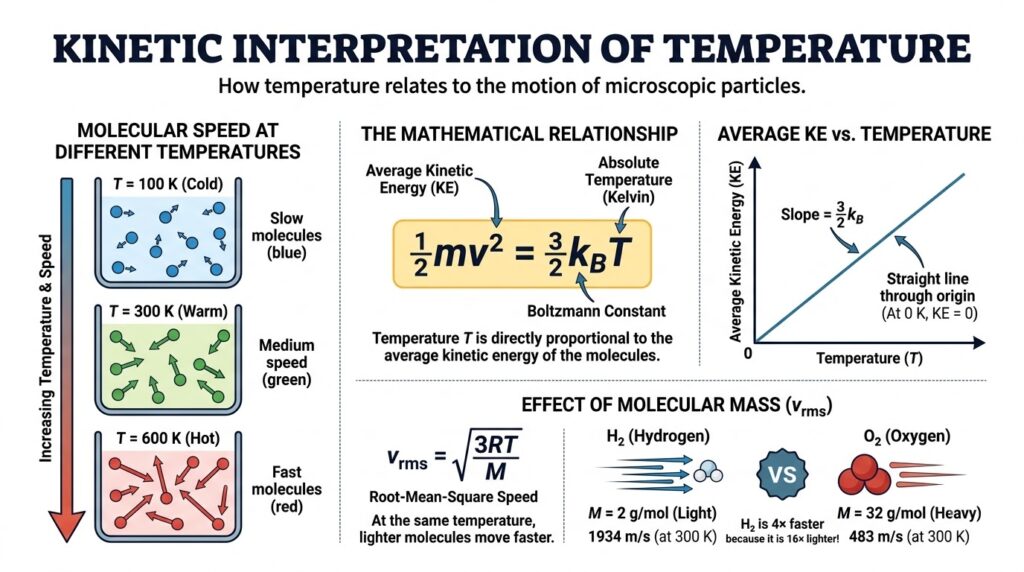
Q11. What is the kinetic interpretation of temperature? The absolute temperature T is a measure of the average translational kinetic energy of a molecule: ½mv̄² = (3/2)kBT Temperature is proportional to the average kinetic energy per molecule.
Q12. Write the expression for average kinetic energy of a molecule. KE_avg = (3/2)kBT This is independent of the nature of the gas, the pressure, the volume, and depends only on temperature.
Q13. What is the law of equipartition of energy? In thermal equilibrium at temperature T, the total energy is equally distributed among all quadratic energy modes. Each independent mode of energy (degree of freedom) gets an average energy of: ½kBT
Q14. What is a degree of freedom? A degree of freedom is an independent way in which a molecule can store energy (absorb energy). It corresponds to each independent coordinate or squared energy term in the expression for energy.
Q15. How many degrees of freedom does a monatomic ideal gas have? 3 — only three translational degrees of freedom (movement in x, y, z directions). No rotation or vibration for a point-like atom.
Q16. How many degrees of freedom does a diatomic ideal gas (rigid rotator) have? 5 — three translational + two rotational (the molecule can rotate about two axes perpendicular to its bond axis; rotation about the bond axis itself has negligible moment of inertia).
Q17. Write the internal energy of 1 mole of a monatomic ideal gas. U = (3/2)RT (from equipartition: 3 degrees × ½RT each)
Q18. Write Cv and Cp for a monatomic ideal gas. Cv = (3/2)R ≈ 12.5 J mol⁻¹ K⁻¹ Cp = (5/2)R ≈ 20.8 J mol⁻¹ K⁻¹ γ = Cp/Cv = 5/3 ≈ 1.67
Q19. Write Cv, Cp, and γ for a diatomic ideal gas (rigid rotator). Cv = (5/2)R ≈ 20.8 J mol⁻¹ K⁻¹ Cp = (7/2)R ≈ 29.1 J mol⁻¹ K⁻¹ γ = 7/5 = 1.4
Q20. What is Dulong-Petit law for solids? The molar specific heat of a solid (at constant pressure) is approximately C = 3R ≈ 25 J mol⁻¹ K⁻¹, from the equipartition theorem. This is known as the Dulong-Petit law.
Q21. What is mean free path (l)? The mean free path is the average distance a molecule travels between successive collisions: l = 1/(√2 nπd²) where n = number density, d = diameter of molecule.
Q22. What is mean free time (τ)? Mean free time is the average time between successive collisions: τ = l/v̄ ≈ 1/(nπd²v̄) where v̄ = average speed.
Q23. How does mean free path depend on number density and molecular diameter? l = 1/(√2 nπd²) l is inversely proportional to both n (number density) and d² (square of molecular diameter). More molecules or larger molecules → more collisions → shorter mean free path.
Q24. What is an ideal gas? An ideal gas is a theoretical model of a gas in which:
- Molecules are point masses (volume negligible).
- No intermolecular forces (except during elastic collisions).
- All collisions are perfectly elastic. Real gases approach ideal behaviour at low pressure and high temperature.
Q25. What is Avogadro’s hypothesis? At the same temperature and pressure, equal volumes of all gases contain the same number of molecules — Avogadro’s number NA = 6.022 × 10²³ mol⁻¹.
Q26. What is Avogadro’s number? NA = 6.022 × 10²³ mol⁻¹ — the number of molecules (or atoms) in one mole of any substance.
Q27. What is the molar volume of an ideal gas at STP? At STP (T = 273 K, P = 1 atm = 1.013 × 10⁵ Pa): V = μRT/P = 1 × 8.314 × 273/1.013×10⁵ = 22.4 L = 0.0224 m³
Q28. Write the expression for vrms in terms of temperature and molar mass M. vrms = √(3RT/M) where R = 8.314 J mol⁻¹ K⁻¹, T = absolute temperature, M = molar mass (kg/mol).
Q29. Compare vrms of oxygen and hydrogen at the same temperature. vrms ∝ 1/√M M_H₂ = 2 g/mol, M_O₂ = 32 g/mol vrms(H₂)/vrms(O₂) = √(M_O₂/M_H₂) = √(32/2) = √16 = 4 Hydrogen molecules move 4 times faster than oxygen molecules at the same temperature.
Q30. What happens to vrms when temperature doubles? vrms = √(3RT/M) ∝ √T If T doubles: vrms → √2 × vrms (increases by factor √2)
Q31. Why does the internal energy of an ideal gas depend only on temperature? For an ideal gas, molecules are point masses with no intermolecular forces (except during collisions). So there is no potential energy of interaction. Internal energy = kinetic energy only = (3/2)NkBT. Since kB, N are constants, U depends only on T.
Q32. What is the relation between P and the average kinetic energy of molecules? P = (1/3)nmv̄² = (2/3)n × (½mv̄²) = (2n/3) × (average KE per molecule) Or: P = (2/3)(KE per unit volume)
Q33. At the same temperature, which gas molecules move faster — lighter or heavier? ½mv² = (3/2)kBT → v ∝ 1/√m Lighter molecules move faster at the same temperature. Example: H₂ moves faster than N₂ which moves faster than O₂.
Q34. What is the vibrational energy contribution of one vibrational mode? Each vibrational mode contributes 2 × (½kBT) = kBT (one each for kinetic and potential energy of oscillation, unlike translational/rotational modes which contribute only ½kBT).
Q35. For a diatomic gas with vibrational modes, what is Cv? With 5 translational/rotational + 2 vibrational quadratic terms = 7 degrees effectively: Cv = (7/2)R ≈ 29.1 J mol⁻¹ K⁻¹; γ = 9/7 ≈ 1.29 (But vibrational modes are typically not excited at room temperature for most diatomics.)
Q36. State Avogadro’s law. At the same temperature and pressure, equal volumes of all gases contain equal numbers of molecules. Mathematically: if P, V, T are the same for two gases: N₁ = N₂.
Q37. What is Graham’s law of diffusion? The rate of diffusion of a gas is inversely proportional to the square root of its molar mass: r₁/r₂ = √(M₂/M₁) This follows from vrms ∝ 1/√M.
Q38. Calculate vrms of nitrogen at 300 K. (M = 28 g/mol = 0.028 kg/mol, R = 8.314) vrms = √(3RT/M) = √(3 × 8.314 × 300/0.028) = √(267107) ≈ 517 m/s
Q39. What is the mean speed (v̄) in kinetic theory? Mean speed = v̄ = √(8kBT/πm) = √(8RT/πM) Numerically: v̄ ≈ 0.921 × vrms
Q40. What is the most probable speed (vmp)? Most probable speed = vmp = √(2kBT/m) = √(2RT/M) Numerically: vmp ≈ 0.816 × vrms Relation: vmp : v̄ : vrms = 1 : 1.128 : 1.225
Q41. What is the number density (n)? Number density n = N/V (number of molecules per unit volume). SI unit: m⁻³.
Q42. What are the assumptions of kinetic theory?
- Gas consists of a large number of identical molecules in random motion.
- Molecules are point masses (negligible size compared to mean free path).
- No intermolecular forces except during elastic collisions.
- Collisions are elastic (momentum and kinetic energy conserved).
- Molecules obey Newton’s laws between collisions.
Q43. Why does cooking gas (LPG) smell across the room quickly when leaked, yet kinetic theory says molecules move at ~500 m/s? Despite high molecular speeds (~500 m/s), LPG molecules undergo frequent collisions with air molecules (mean free path ≈ few hundred nm). Each collision changes direction. The net drift (diffusion) is much slower than the molecular speed. Diffusion takes minutes to hours.
Q44. What is the internal energy of 1 mole of diatomic gas (rigid rotator) at temperature T? U = (5/2)RT (5 degrees of freedom: 3 translational + 2 rotational)
Q45. The specific heat of a solid predicted by kinetic theory is? C = 3R ≈ 24.93 J mol⁻¹ K⁻¹ (Dulong-Petit law — each atom has 6 energy modes: 3 kinetic + 3 potential for vibration in 3D)
Q46. What does kBNA equal? kBNA = R (universal gas constant). This relates Boltzmann constant (per molecule) to the gas constant (per mole).
Q47. A gas has N molecules in volume V at pressure P and temperature T. If the number of molecules is doubled and temperature halved (volume same), what is the new pressure? PV = NkBT → P ∝ N × T (at fixed V) P’ = P × (2N/N) × (T/2)/T = P × 2 × ½ = P (pressure unchanged!)
Q48. Why is the internal energy of an ideal gas purely kinetic? In an ideal gas, molecules are assumed to have no intermolecular forces between them (except during elastic collisions). Therefore, there is no potential energy of interaction between molecules — only kinetic energy (translational, rotational) contributes to internal energy.
Q49. What is the relation between pressure P and density ρ of an ideal gas? P = (1/3)nmv̄² = (1/3)ρv̄² (where ρ = nm = mass per unit volume) Also P = ρRT/M₀ (from ideal gas law, where M₀ = molar mass)
Q50. A flask contains 2 moles of helium and 1 mole of oxygen. If total pressure = 3 atm, find the partial pressures. Partial pressures are proportional to mole fractions: P_He = (2/3) × 3 = 2 atm P_O₂ = (1/3) × 3 = 1 atm
2 Mark Questions and Answers (രണ്ട് മാർക്ക് ചോദ്യങ്ങൾ) — Kinetic Theory
Q51. Derive the expression for pressure of an ideal gas using kinetic theory. Consider N molecules in a cubic container of side l, volume V = l³.
A molecule with x-velocity vx hits the wall and bounces back. Change in momentum = 2mvx. Time between successive hits on same wall = 2l/vx. Force by one molecule = 2mvx/(2l/vx) = mvx²/l
Total pressure from all molecules: P = (1/3) × (N/V) × m × v̄² = (1/3)nmv̄² ✓
Since ½mv̄² = (3/2)kBT: PV = (1/3)Nmv̄² × V/V… wait, PV = (2/3)N × (½mv̄²) = NkBT = μRT ✓
Q52. What is the kinetic interpretation of temperature? Derive the expression for average kinetic energy. From kinetic theory: P = (1/3)nmv̄² From ideal gas law: P = nkBT
Equating: (1/3)nmv̄² = nkBT (1/2)mv̄² = (3/2)kBT
This shows that temperature T is a measure of the average translational kinetic energy of a molecule. Higher T → higher molecular KE. At T = 0 (absolute zero), all molecular motion stops (classically).
Important: This result is independent of the nature of the gas — He, N₂, O₂, all molecules at the same T have the same average KE = (3/2)kBT.
Q53. State and explain the law of equipartition of energy. Give examples. Statement: In thermal equilibrium at temperature T, each independent quadratic mode of energy (degree of freedom) carries an average energy of ½kBT.
Examples:
- Translational: (1/2)mvx², (1/2)mvy², (1/2)mvz² — each gets ½kBT
- Rotational: (1/2)I₁ω₁², (1/2)I₂ω₂² — each gets ½kBT
- Vibrational: (1/2)m(dy/dt)² + (1/2)ky² — gets kBT (2 modes)
Application:
- Monatomic gas: 3 translational → E = (3/2)kBT per molecule
- Diatomic (rigid): 5 modes → E = (5/2)kBT per molecule
Q54. Derive the specific heat Cv and Cp for a monatomic ideal gas. A monatomic gas has 3 translational degrees of freedom.
By equipartition, energy per molecule = 3 × ½kBT = (3/2)kBT
Internal energy of μ moles: U = (3/2)μRT
Cv = (1/μ)(dU/dT) = (3/2)R ≈ 12.5 J mol⁻¹ K⁻¹
Cp = Cv + R = (5/2)R ≈ 20.8 J mol⁻¹ K⁻¹
γ = Cp/Cv = (5/3) ≈ 1.67
Examples: He, Ne, Ar — noble gases. Experimentally confirmed.
Q55. Derive Cv and Cp for a diatomic ideal gas treated as a rigid rotator. Diatomic molecule has 3 translational + 2 rotational = 5 degrees of freedom.
By equipartition: U = (5/2)kBT per molecule = (5/2)μRT per μ moles
Cv = (5/2)R ≈ 20.8 J mol⁻¹ K⁻¹
Cp = Cv + R = (7/2)R ≈ 29.1 J mol⁻¹ K⁻¹
γ = Cp/Cv = 7/5 = 1.4
Examples: N₂, O₂, H₂, HCl, CO (at room temperature). Experimentally: γ_N₂ = 1.4 ✓
Q56. Explain Graham’s law of diffusion and relate it to kinetic theory. Graham’s law: Rate of diffusion r ∝ 1/√M (molar mass)
Kinetic theory basis: vrms = √(3RT/M) At the same T: vrms ∝ 1/√M The rate of diffusion is proportional to the molecular speed: r₁/r₂ = vrms₁/vrms₂ = √(M₂/M₁)
Application: Uranium isotope separation — ²³⁵UF₆ (M = 349) and ²³⁸UF₆ (M = 352). vrms ratio = √(352/349) = 1.0044 → only 0.44% faster. Must pass through porous cylinder many times to enrich ²³⁵U for nuclear fission.
Q57. Explain the mean free path. Derive its formula and estimate for air at STP. Mean free path l: Average distance a molecule travels between successive collisions.
Derivation: For a molecule of diameter d moving with speed v̄, in time Δt it sweeps a cylinder of volume πd²v̄Δt. Any molecule within this cylinder is hit. Collisions in Δt = n × πd²v̄ × Δt (n = number density) Time between collisions: τ = 1/(nπd²v̄) Including that other molecules also move: l = 1/(√2 nπd²)
For air at STP: n = 2.7 × 10²⁵ m⁻³, d = 2 × 10⁻¹⁰ m l = 1/(√2 × 2.7×10²⁵ × π × 4×10⁻²⁰) = 2.9 × 10⁻⁷ m = 290 nm
This is about 1500 molecular diameters — very much larger than d.
Q58. A flask has argon and chlorine in 2:1 ratio by mass at 27°C. Find: (a) ratio of average KE per molecule (b) ratio of vrms. (M_Ar = 39.9, M_Cl₂ = 70.9 u) (a) Average KE per molecule: = (3/2)kBT — depends only on T, not on the nature of gas. Since both are at the same T = 300 K: ratio KE_Ar : KE_Cl₂ = 1 : 1
(b) Ratio of vrms: vrms ∝ 1/√M vrms_Ar/vrms_Cl₂ = √(M_Cl₂/M_Ar) = √(70.9/39.9) = √(1.777) = 1.33
Argon molecules move 1.33 times faster than chlorine at the same temperature, despite the 2:1 mass ratio.
Q59. Two flasks A and B of equal volumes are connected. Flask A has gas at temperature 300 K and pressure P. Flask B is at 600 K and pressure 2P. A valve between them is opened. Find the final pressure at equilibrium temperature of 400 K. Initially: Total molecules N = N_A + N_B N_A = PV/(kB × 300); N_B = 2PV/(kB × 600) = PV/(300kB)
Total N = 2PV/(300kB)
Total volume = 2V; Final T = 400 K Final P = NkBT/(2V) = [2PV/(300kB)] × kB × 400/(2V) = 2P×400/300/2 = 4P/3
Q60. Explain why real gases deviate from ideal gas behaviour. When do they behave ideally? Deviations from ideal gas arise because:
- Real molecules have finite volume — ideal gas assumes point particles. At high pressure, molecular volume is not negligible.
- Real molecules have intermolecular forces — weak van der Waals attraction at moderate separation, strong repulsion at close range. Ideal gas assumes no forces between collisions.
When ideal behaviour is approximated:
- Low pressure: Molecules are far apart — intermolecular forces are negligible.
- High temperature: High kinetic energy overwhelms potential energy of interaction.
P-V curve at low P/high T closely follows PV = constant (Boyle’s law). All real gas curves approach the ideal gas line at low pressures.
Q61. A gas mixture has 2 mol of H₂ (M=2) and 1 mol of O₂ (M=32) at 27°C (300 K). Find: (a) total KE (b) vrms of H₂ and O₂. (a) Total KE: KE = (3/2)NkBT = (3/2)μRT KE_H₂ = (3/2) × 2 × 8.314 × 300 = 7482.6 J KE_O₂ = (3/2) × 1 × 8.314 × 300 = 3741.3 J Total KE = 11223.9 J ≈ 11.2 kJ
(b) vrms: vrms(H₂) = √(3 × 8.314 × 300/0.002) = √(3742300) = 1934 m/s ≈ 1.93 km/s vrms(O₂) = √(3 × 8.314 × 300/0.032) = √(233794) = 483 m/s
Ratio: vrms(H₂)/vrms(O₂) = 1934/483 = 4 (as expected, √(32/2) = 4) ✓
Q62. How many degrees of freedom does water vapour (H₂O) have? Find Cv, Cp, γ. H₂O is a triatomic non-linear molecule. Degrees of freedom: 3 translational + 3 rotational + (vibrational — often ignored at moderate T) = 6 degrees (without vibration)
U = 6 × ½RT = 3RT (per mole)
Cv = 3R ≈ 24.9 J mol⁻¹ K⁻¹ Cp = 4R ≈ 33.2 J mol⁻¹ K⁻¹ γ = 4/3 ≈ 1.33
(Using general formula: Cv = (3+f)R, Cp = (4+f)R, γ = (4+f)/(3+f) with f=0 vibrational modes)
Q63. Estimate the mean free path for N₂ molecules in air at STP. (d = 1.5 Å = 1.5×10⁻¹⁰ m; at STP, n = 2.7×10²⁵ m⁻³) l = 1/(√2 nπd²) = 1/(√2 × 2.7×10²⁵ × π × (1.5×10⁻¹⁰)²) = 1/(1.414 × 2.7×10²⁵ × 3.14159 × 2.25×10⁻²⁰) = 1/(1.414 × 2.7 × 3.14159 × 2.25 × 10⁵) = 1/(2.696 × 10⁵ × 10⁰) = 1/(2.696 × 10⁵) … let me recompute
= 1/(1.414 × 2.7×10²⁵ × π × 2.25×10⁻²⁰) = 1/(1.414 × 2.7 × π × 2.25 × 10⁵) = 1/(1.414 × 19.08 × 10⁵) = 1/(26.97 × 10⁵) = 3.71 × 10⁻⁷ m ≈ 370 nm
This is about 2500 molecular diameters — molecules travel a large distance before each collision.
Q64. Using the Dulong-Petit law, predict the specific heat of copper (M = 63.5 g/mol). Compare with experimental value ≈ 385 J kg⁻¹ K⁻¹. Molar specific heat by Dulong-Petit: C = 3R = 3 × 8.314 = 24.94 J mol⁻¹ K⁻¹
Specific heat per kg: c = C/M = 24.94/(63.5 × 10⁻³) = 24.94/0.0635 = 392.8 J kg⁻¹ K⁻¹
Experimental: 385 J kg⁻¹ K⁻¹
Agreement: excellent! (only ~2% error — well within the range of the Dulong-Petit law prediction)
Q65. Find the pressure exerted by 1 mole of an ideal gas in a 1 L container at 300 K. PV = μRT → P = μRT/V = 1 × 8.314 × 300/(1 × 10⁻³) = 2.494 × 10⁶ Pa ≈ 24.7 atm
This is a very high pressure — explains why 1 mole of gas at STP occupies 22.4 L (not 1 L!).

3 Mark Questions and Answers (മൂന്ന് മാർക്ക് ചോദ്യങ്ങൾ) — Kinetic Theory
Q71. Derive the expression for pressure of an ideal gas from kinetic theory and obtain vrms. Derivation (detailed):
Molecule of mass m moving with velocity (vx, vy, vz) hits the wall of container (side l):
- Change in momentum on x-wall: 2mvx
- Time between hits: 2l/vx
- Force by one molecule: 2mvx / (2l/vx) = mvx²/l
For N molecules with mean square speed in x-direction = v̄x²: P = Nm(v̄x²) / (l × l²) = Nmv̄x²/V
By isotropy: v̄x² = v̄y² = v̄z² = v̄²/3
P = (1/3)(N/V)mv̄² = (1/3)nmv̄² ✓
Deriving vrms: Comparing with PV = NkBT: (1/3)Nmv̄² = NkBT v̄² = 3kBT/m
vrms = √(v̄²) = √(3kBT/m) = √(3RT/M) ✓
For N₂ at 300 K: vrms = √(3 × 8.314 × 300/0.028) ≈ 517 m/s
Q72. State the law of equipartition of energy. Apply it to find Cv, Cp, γ for monatomic, diatomic, and triatomic ideal gases. Law: Each quadratic energy mode (degree of freedom) in thermal equilibrium has average energy ½kBT.
| Gas Type | Degrees of Freedom | U (per mole) | Cv | Cp | γ |
|---|---|---|---|---|---|
| Monatomic (He, Ar) | 3 (translational) | (3/2)RT | (3/2)R | (5/2)R | 5/3 |
| Diatomic rigid (N₂, O₂) | 5 (3T + 2R) | (5/2)RT | (5/2)R | (7/2)R | 7/5 |
| Diatomic with vibration | 7 (5 + 2V) | (7/2)RT | (7/2)R | (9/2)R | 9/7 |
| Triatomic linear (CO₂) | 6 (3T+2R+1V×2) | 3RT | 3R | 4R | 4/3 |
| Triatomic non-linear (H₂O) | 6 (3T+3R) | 3RT | 3R | 4R | 4/3 |
Note: Cp − Cv = R for all ideal gases regardless of atomicity. ✓
Q73. State and explain Dalton’s law of partial pressures. Prove it using kinetic theory. Statement: The total pressure of a mixture of non-interacting ideal gases equals the sum of their partial pressures. P = P₁ + P₂ + P₃ + …
Kinetic theory proof: For mixture with n₁, n₂, … number densities and m₁, m₂, … molecular masses:
Total pressure: P = (1/3)[n₁m₁v̄₁² + n₂m₂v̄₂² + …]
In thermal equilibrium: ½m₁v̄₁² = ½m₂v̄₂² = (3/2)kBT
So P = (n₁ + n₂ + …)kBT = n₁kBT + n₂kBT + … = P₁ + P₂ + … ✓
This also proves that at equilibrium, the average KE per molecule is the same for all gases, regardless of mass or nature.
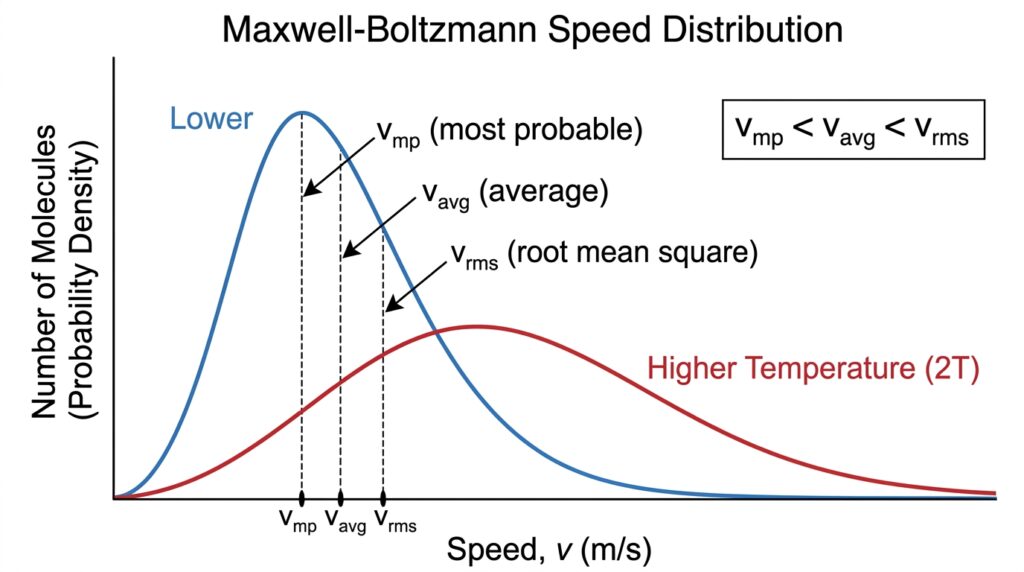
Q74. Explain the three molecular speeds: vrms, mean speed v̄, most probable speed vmp. Write their expressions and compare them. All three describe the “typical speed” of gas molecules but in different ways:
vrms (root mean square speed): vrms = √(3kBT/m) = √(3RT/M) Square root of mean square speed. Relevant for KE: KE = (1/2)mvrms².
v̄ (mean/average speed): v̄ = √(8kBT/πm) = √(8RT/πM) Arithmetic average of all molecular speeds.
vmp (most probable speed): vmp = √(2kBT/m) = √(2RT/M) Speed at which the Maxwell-Boltzmann distribution has its peak.
Comparison (same temperature, same gas): vmp : v̄ : vrms = √2 : √(8/π) : √3 ≈ 1.41 : 1.60 : 1.73 Or in ratio: 1 : 1.128 : 1.225
All are of the order of the speed of sound and increase with temperature and decrease with molar mass.
Q75. A cylinder of volume 44.8 L contains helium at STP. Find the heat needed to raise temperature by 15°C at constant volume. (R = 8.314 J mol⁻¹ K⁻¹) At STP, 22.4 L = 1 mole, so 44.8 L = 2 moles of helium.
Helium is monatomic: Cv = (3/2)R
Heat at constant volume: Q = μCvΔT = 2 × (3/2) × 8.314 × 15 = 2 × 1.5 × 8.314 × 15 = 2 × 12.471 × 15 = 374 J ✓
Q76. Prove that for an ideal gas, PV = (2/3)E where E is total translational KE. Hence give the kinetic interpretation of temperature. From kinetic pressure formula: P = (1/3)nmv̄²
Multiply both sides by V: PV = (1/3)Nmv̄² = (2/3) × N × (½mv̄²)
Since E = N × (½mv̄²) (total translational KE): PV = (2/3)E ✓
Comparing with ideal gas equation PV = NkBT: (2/3)E = NkBT → E = (3/2)NkBT
Per molecule: ½mv̄² = (3/2)kBT
Kinetic interpretation: Temperature T is proportional to the average translational kinetic energy per molecule. It is a measure of molecular agitation — higher T means faster random motion. Absolute zero (T = 0 K) corresponds to zero molecular motion classically.
Q77. Two identical flasks are connected. Flask A has N₂ at 300 K and flask B has O₂ at 300 K, both at same pressure P. The valve is opened. Show that the final pressure is still P, and the average KE per molecule of N₂ and O₂ remains the same after mixing. Pressure argument: Initially: P_A = n_N₂ kBT, P_B = n_O₂ kBT (same T and P) → n_N₂ = n_O₂ = n (same number density) After mixing: Total molecules = 2N, Total volume = 2V Final n = 2N/2V = N/V = n (unchanged at same T) Final P = nkBT = P ✓ (Dalton’s law also gives P = P_N₂ + P_O₂ = P/2 + P/2 = P)
Average KE after mixing: ½m₁v̄₁² = ½m₂v̄₂² = (3/2)kBT (same T → same average KE regardless of mass) Average KE per molecule is the same for N₂ and O₂ after mixing ✓
Note: Although average KE is same, vrms_N₂ ≠ vrms_O₂ (different masses).
Q78. State Graham’s law of diffusion. Apply it to uranium isotope separation. Graham’s law: Rate of diffusion of a gas ∝ 1/√M
Proof: Rate of diffusion ∝ vrms = √(3RT/M) → r ∝ 1/√M
Uranium isotope separation: ²³⁵UF₆: M₁ = 235 + 6×19 = 349 u ²³⁸UF₆: M₂ = 238 + 6×19 = 352 u
v₁/v₂ = √(M₂/M₁) = √(352/349) = √1.0086 ≈ 1.0043
Only 0.43% faster — very inefficient separation! Must pass through many porous membranes repeatedly (“gaseous diffusion” — used in Manhattan Project and nuclear power fuel production). Requires 1000s of stages.
Q79. Explain the assumptions of kinetic theory. How does kinetic theory explain gas pressure and temperature? Assumptions (see Q42): 5 key points — random motion, point masses, elastic collisions, Newton’s laws, no forces between collisions.
Pressure explanation: Molecules collide with the walls millions of times per second, each transferring momentum 2mvx. The total rate of momentum transfer per unit area is the pressure. P = (1/3)nmv̄² — derived from basic Newton’s laws and molecular collision analysis.
Temperature explanation: Comparing P = (1/3)nmv̄² with P = nkBT gives ½mv̄² = (3/2)kBT. Temperature is not just a feeling of hot or cold but a precise measure of average molecular kinetic energy. The Boltzmann constant kB is the bridge between macroscopic temperature and microscopic kinetic energy.
Q80. Cylinder contains 44.8 L of oxygen at STP. Find: (a) number of moles (b) number of molecules (c) vrms at 300 K (d) average KE per molecule at 300 K. (M_O₂ = 32 g/mol) (a) Moles: At STP, 22.4 L = 1 mol → 44.8 L = 2 moles
(b) Molecules: N = μ × NA = 2 × 6.022×10²³ = 1.204 × 10²⁴ molecules
(c) vrms at 300 K: vrms = √(3RT/M) = √(3 × 8.314 × 300/0.032) = √(233438) = 483 m/s
(d) Average KE per molecule: KE = (3/2)kBT = 1.5 × 1.38×10⁻²³ × 300 = 6.21 × 10⁻²¹ J
5 Mark / Essay Questions and Answers (അഞ്ച് മാർക്ക് ചോദ്യങ്ങൾ)
Q81. (a) State the ideal gas equation. (b) Derive pressure of ideal gas using kinetic theory. (c) Obtain vrms. (d) Calculate vrms of N₂ at 27°C. (M = 28 g/mol)
(a) PV = μRT = kBNT; R = 8.314 J mol⁻¹K⁻¹; kB = 1.38×10⁻²³ J K⁻¹.
(b) Pressure derivation (see Q71 above): P = (1/3)nmv̄² ✓
(c) vrms: From P = (1/3)nmv̄² and P = nkBT: ½mv̄² = (3/2)kBT → vrms = √(3kBT/m) = √(3RT/M) ✓
(d) Numerical (T = 300 K, M = 0.028 kg/mol): vrms = √(3 × 8.314 × 300/0.028) = √(267107) = 517 m/s ✓
Q82. (a) State law of equipartition of energy. (b) Apply to monatomic, diatomic gases. (c) Compare Cv, Cp, γ values. (d) Explain Dulong-Petit law for solids.
(a) Each degree of freedom gets average energy ½kBT.
(b) Monatomic: 3f → Cv = (3/2)R; Diatomic rigid: 5f → Cv = (5/2)R.
(c) Table (see Q72 above): Monatomic γ = 5/3; Diatomic γ = 7/5.
(d) Dulong-Petit: Solid atoms vibrate in 3D — 3 kinetic + 3 potential = 6 energy modes per atom. U = 6 × ½kBT × NA = 3RT per mole C = dU/dT = 3R ≈ 25 J mol⁻¹K⁻¹ Experimentally verified for most metals at ordinary temperatures (carbon is an exception). ✓
Q83. (a) What is mean free path? (b) Derive l = 1/(√2 nπd²). (c) Estimate l for air at STP. (d) Why does gas diffuse slowly despite high molecular speeds?
(a) Average distance between successive molecular collisions.
(b) Derivation: (see Q57 above) l = 1/(√2 nπd²) ✓
(c) For air: (see Q57) l ≈ 2.9 × 10⁻⁷ m = 290 nm
(d) Slow diffusion: Despite vrms ≈ 500 m/s, each molecule undergoes ~10¹⁰ collisions per second. Each collision completely changes direction. Net displacement (diffusion) is a random walk — net speed ≈ vrms × √(l/L) where L is total path length. The tortuous path makes macroscopic diffusion much slower than molecular speed.
Q84. (a) State Dalton’s law of partial pressures. (b) Prove it from kinetic theory. (c) A vessel contains N₂ (2 mol) and O₂ (1 mol) at 27°C in 10 L. Find total pressure and partial pressures. (R = 8.314)
(a) P_total = ΣPᵢ (sum of partial pressures).
(b) Proof: (see Q73 above) ✓
(c) Numerical (T = 300 K, V = 10 L = 0.01 m³):
P_N₂ = μ_N₂ RT/V = 2 × 8.314 × 300/0.01 = 498840 Pa ≈ 4.99 × 10⁵ Pa P_O₂ = μ_O₂ RT/V = 1 × 8.314 × 300/0.01 = 249420 Pa ≈ 2.49 × 10⁵ Pa P_total = P_N₂ + P_O₂ = 7.48 × 10⁵ Pa ≈ 7.4 atm
Verification: Total = (μ_N₂ + μ_O₂)RT/V = 3 × 8.314 × 300/0.01 = 7.48 × 10⁵ Pa ✓
Q85. (a) What is kinetic interpretation of temperature? (b) Prove ½mv̄² = (3/2)kBT. (c) A flask contains Ar and Cl₂ in 2:1 mass ratio at 27°C (M_Ar = 39.9, M_Cl₂ = 70.9). Find ratio of: (i) average KE per molecule (ii) vrms (iii) number of molecules if total mass = 150 g.
(a) Temperature measures average translational KE of molecules.
(b) Proof: From PV = NkBT and PV = (2/3)E = (2/3)N(½mv̄²): NkBT = (2/3)N(½mv̄²) → ½mv̄² = (3/2)kBT ✓
(c) Numerical (mass ratio Ar:Cl₂ = 2:1, total mass = 150 g):
(i) Average KE ratio: Same temperature T → KE_Ar : KE_Cl₂ = 1 : 1 ✓
(ii) vrms ratio: vrms_Ar/vrms_Cl₂ = √(M_Cl₂/M_Ar) = √(70.9/39.9) = √1.777 = 1.33 ✓
(iii) Number of molecules: Mass of Ar = 100 g, Mass of Cl₂ = 50 g
μ_Ar = 100/39.9 = 2.506 mol → N_Ar = 2.506 × 6.022×10²³ = 1.509 × 10²⁴ μ_Cl₂ = 50/70.9 = 0.7053 mol → N_Cl₂ = 0.7053 × 6.022×10²³ = 4.248 × 10²³
N_Ar : N_Cl₂ = 1.509 : 0.425 ≈ 3.55 : 1
Additional Important Questions (Kerala Board Previous Year Style)
Q86. What is the total kinetic energy of 1 mole of a monatomic ideal gas at 300 K? E = (3/2)RT = (3/2) × 8.314 × 300 = 3741.3 J ≈ 3.74 kJ
Q87. If vrms of H₂ at 300 K is 1934 m/s, find vrms of O₂ at 1200 K. vrms ∝ √(T/M) vrms(O₂, 1200K)/vrms(H₂, 300K) = √(T_O₂/T_H₂ × M_H₂/M_O₂) = √(1200/300 × 2/32) = √(4 × 1/16) = √(1/4) = 0.5 vrms(O₂) = 0.5 × 1934 = 967 m/s
Q88. At what temperature does vrms of N₂ equal vrms of O₂ at 800 K? vrms ∝ √(T/M): √(T_N₂/28) = √(800/32) T_N₂/28 = 800/32 = 25 → T_N₂ = 700 K
Q89. Show that the average KE of a gas molecule is independent of the nature of the gas. ½mv̄² = (3/2)kBT — this depends only on kB and T, not on m or the type of molecule. At the same temperature, every ideal gas molecule (He, Ar, N₂, O₂, etc.) has the same average translational KE = (3/2)kBT. ✓
Q90. What is the pressure in a box (volume 1 m³) if n = 10²⁵ molecules/m³, each with KE = 6×10⁻²¹ J? P = (2/3) × n × (average KE) = (2/3) × 10²⁵ × 6×10⁻²¹ = (2/3) × 6×10⁴ = 4×10⁴ Pa ≈ 0.4 atm
Q91. Name the gas laws that follow from the ideal gas equation PV = μRT.
- Boyle’s law: PV = const (at constant T, μ)
- Charles’ law: V/T = const (at constant P, μ)
- Gay-Lussac’s law: P/T = const (at constant V, μ)
- Avogadro’s law: Equal volumes at same T, P → equal N
- Dalton’s law of partial pressures: P = ΣPᵢ
Q92. Why is γ always greater than 1? What is its value when degrees of freedom → ∞? γ = Cp/Cv = (Cv + R)/Cv = 1 + R/Cv > 1 (since R > 0 and Cv > 0).
As degrees of freedom f → ∞: Cv = (f/2)R → ∞, and γ = 1 + R/Cv → 1. So γ → 1 for highly complex polyatomic molecules with many degrees of freedom.
Q93. The density of a gas at STP is 1.43 kg/m³. Identify the gas. (At STP, n = 2.7×10²⁵ m⁻³) Molar mass M = ρ × Vmolar = 1.43 × 22.4 × 10⁻³ = 0.032 kg/mol = 32 g/mol This is O₂ (oxygen) or S (sulfur) — but as a gas at STP, it is oxygen.
Q94. What is the pressure of 1 mol of O₂ in a 1 L flask at 27°C? P = μRT/V = 1 × 8.314 × 300/(1×10⁻³) = 2.494 × 10⁶ Pa ≈ 24.6 atm
Q95. Two gases at the same temperature have the same average KE. Do they have the same vrms? Average KE = (3/2)kBT — same for both. But vrms = √(3kBT/m) depends on m (molecular mass). Since the two gases may have different molecular masses, vrms will be different even though average KE is the same. Lighter molecule → higher vrms.
Frequently Asked Questions (FAQ) — Kerala Plus One Physics Chapter 12
- State the ideal gas equation. What are the conditions for real gases to behave ideally? (Kerala Board) PV = μRT. Ideal behaviour at (1) low pressure (molecules far apart, interactions negligible) and (2) high temperature (KE >> potential energy of interaction). All real gas P-V curves approach ideal at low P.
- ഗതികതത്ത്വം — rms വേഗം (RMS speed in Malayalam) vrms = √(3RT/M) — ഇത് ഒരു ഗ്യാസ് തന്മാത്രയുടെ ശരാശരി ഗതികോർജ്ജവുമായി ബന്ധപ്പെട്ടിരിക്കുന്നു: ½mvrms² = (3/2)kBT. ഒരേ താപനിലയിൽ, എല്ലാ ഗ്യാസ് തന്മാത്രകൾക്കും ഒരേ ശരാശരി ഗതികോർജ്ജം ഉണ്ടായിരിക്കും.
- What is the law of equipartition of energy? (Plus One Physics Kerala) Each quadratic energy mode (degree of freedom) carries average energy ½kBT in thermal equilibrium. Monatomic: 3f → E = (3/2)kBT; Diatomic: 5f → E = (5/2)kBT.
- What is mean free path and why is diffusion slow despite high molecular speeds? (Kerala Board) l = 1/(√2 nπd²) ≈ few hundred nm. Despite vrms ≈ 500 m/s, molecules collide ~10¹⁰ times/s, each changing direction randomly. Net diffusion speed = vrms × √(l/path) << vrms. Diffusion is a random walk.
- Prove Cp − Cv = R for an ideal gas. (Kerala Board) From First Law at constant V: Cv = dU/dT. At constant P: Cp = Cv + P(dV/dT)_P = Cv + R (since PV = RT for 1 mole → P(dV/dT) = R). Therefore Cp − Cv = R. ✓
- What is Dalton’s law? Prove it from kinetic theory. (Kerala Plus One) P = P₁ + P₂ + … Each gas in a mixture exerts its own pressure independently. Proof: In thermal equilibrium, ½m₁v̄₁² = ½m₂v̄₂² = (3/2)kBT, so P = (n₁+n₂+…)kBT = P₁+P₂+… ✓
This article covers Kerala Plus One Physics Chapter 12 — Kinetic Theory (ഗതികതത്ത്വം) — with 150+ questions covering Ideal Gas Equation, Pressure of Gas, Kinetic Interpretation of Temperature, Law of Equipartition, Specific Heats, Mean Free Path, Molecular Speeds, and Dalton’s Law, following the Kerala Board (SCERT) exam pattern. Visit hsslives.com for chapter-wise solutions for all Plus One and Plus Two subjects.