System of Particles and Rotational Motion Class 11 Questions and Answers | Kerala Plus One Physics Chapter 6 Notes (കണികാ വ്യൂഹങ്ങളും ഭ്രമണ ചലനവും)
Kerala Plus One Physics Chapter 6 — System of Particles and Rotational Motion (കണികാ വ്യൂഹങ്ങളും ഭ്രമണ ചലനവും) is a crucial and conceptually rich chapter for the Kerala Board (SCERT) Class 11 exam. This article provides 150+ Questions and Answers strictly following the Kerala Higher Secondary exam pattern with 1 Mark, 2 Mark, 3 Mark, and 5 Mark categories. System of Particles and Rotational Motion Class 11 Kerala Questions and Answers, Plus One Physics Chapter 6 Kerala, Moment of Inertia Questions Kerala Board, കണികാ വ്യൂഹം ചോദ്യങ്ങൾ, Torque Angular Momentum Kerala SCERT, Rotational Kinematics Plus One, Centre of Mass Class 11 Kerala
Whether you are searching for Plus One Physics Chapter 6 Kerala solutions, Moment of Inertia questions and answers, or കണികാ വ്യൂഹം ഭ്രമണ ചലനം ചോദ്യോത്തരങ്ങൾ, this is your complete guide. System of Particles and Rotational Motion Chapter 6 Questions and Answers for Kerala Plus One Physics Class 11. 150+ questions covering Centre of Mass, Torque, Angular Momentum, Moment of Inertia, Rotational Kinematics — 1 Mark to 5 Mark as per Kerala Board SCERT exam pattern. കണികാ വ്യൂഹങ്ങളും ഭ്രമണ ചലനവും ചോദ്യോത്തരങ്ങൾ.

1 Mark Questions and Answers (ഒരു മാർക്ക് ചോദ്യങ്ങൾ) — System of Particles and Rotational Motion
Q1. What is a rigid body? A rigid body is a body in which the distances between all pairs of particles remain constant, regardless of the forces acting on it. It does not deform under applied forces.
Q2. What are the types of motion a rigid body can have?
- Pure translational motion — every particle has the same velocity at every instant.
- Pure rotational motion — every particle moves in a circle about a fixed axis.
- Combined translational and rotational motion (e.g., a rolling wheel).
Q3. Define centre of mass (CM). The centre of mass is a point where the entire mass of a system may be considered to be concentrated for the purpose of describing its translational motion. For n particles: R_CM = Σmᵢrᵢ / M where M = total mass.
Q4. Where is the centre of mass of a uniform rod? The centre of mass of a uniform rod lies at its geometric centre (midpoint).
Q5. Where is the centre of mass of a uniform circular ring? The centre of mass of a uniform circular ring is at its geometric centre — the point at the centre of the ring (which has no mass itself).
Q6. Define torque (moment of force). Torque is the rotational effect of a force about an axis. It is the cross product of the position vector and force: τ = r × F Magnitude: τ = rF sin θ. SI unit: N m
Q7. What is the SI unit of torque? SI unit of torque: Newton metre (N m)
Q8. Define angular momentum. Angular momentum L of a particle about a point is the cross product of its position vector r and linear momentum p: L = r × p = r × mv Magnitude: L = mvr sin θ. SI unit: kg m² s⁻¹
Q9. Write the relation between torque and angular momentum. τ = dL/dt The torque acting on a system equals the rate of change of its angular momentum. (Rotational analogue of F = dp/dt)
Q10. State the law of conservation of angular momentum. If the total external torque on a system is zero, the total angular momentum of the system is conserved (remains constant). L = constant when τ_ext = 0
Q11. Define moment of inertia (I). Moment of inertia of a body about an axis is the sum of the products of the mass of each particle and the square of its perpendicular distance from the axis: I = Σmᵢrᵢ² SI unit: kg m²
Q12. What is the rotational analogue of mass? Moment of inertia (I) is the rotational analogue of mass. Just as mass resists linear acceleration, moment of inertia resists angular acceleration.
Q13. Write the expression for kinetic energy of a rotating body. K = ½Iω² where I = moment of inertia, ω = angular velocity. (Analogous to K = ½mv² for linear motion.)
Q14. Write Newton’s second law for rotational motion. τ = Iα where τ = net torque, I = moment of inertia, α = angular acceleration. (Analogous to F = ma for linear motion.)
Q15. What is angular velocity? Give its SI unit. Angular velocity (ω) is the rate of change of angular displacement: ω = dθ/dt SI unit: rad/s (radians per second).
Q16. What is angular acceleration? Give its SI unit. Angular acceleration (α) is the rate of change of angular velocity: α = dω/dt SI unit: rad/s²
Q17. Write the three kinematic equations for rotational motion.
- ω = ω₀ + αt
- θ = ω₀t + ½αt²
- ω² = ω₀² + 2αθ (Analogous to linear kinematic equations with θ↔x, ω↔v, α↔a)
Q18. What is the relation between linear velocity and angular velocity? v = ω × r (vector form) or v = ωr (magnitude) where r is the perpendicular distance from the axis of rotation.
Q19. What is the relation between angular momentum and moment of inertia for rotation about a fixed axis? L = Iω (Analogous to p = mv in linear motion)
Q20. Write the rotational analogue of F = ma. τ = Iα (Torque = moment of inertia × angular acceleration)
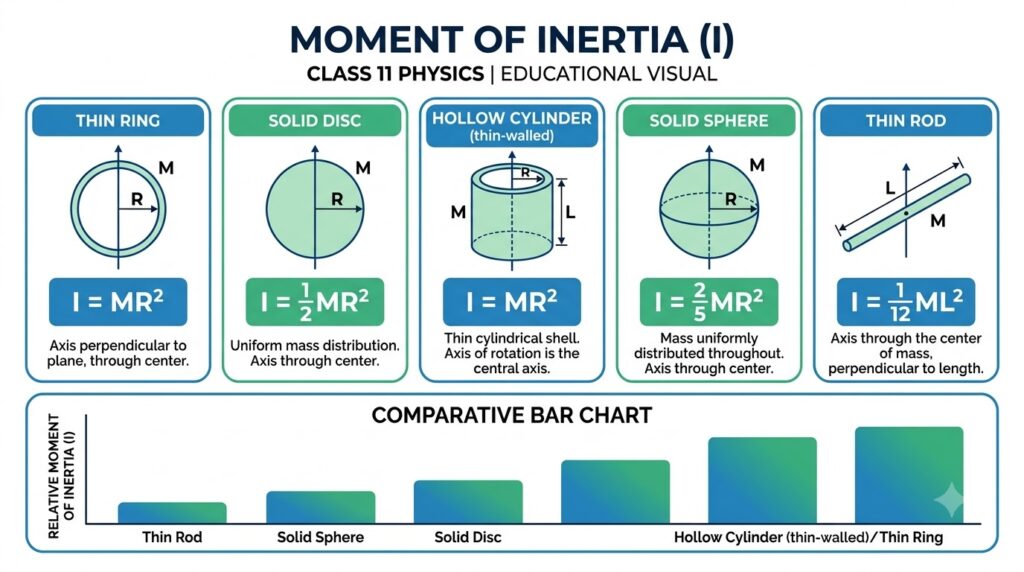
Q21. What is the moment of inertia of a thin circular ring of mass M and radius R about an axis through its centre perpendicular to its plane? I = MR²
Q22. What is the moment of inertia of a solid cylinder of mass M and radius R about its axis? I = MR²/2
Q23. What is the moment of inertia of a thin rod of mass M and length L about an axis through its midpoint perpendicular to the rod? I = ML²/12
Q24. What is the moment of inertia of a solid sphere of mass M and radius R about its diameter? I = 2MR²/5
Q25. What is the moment of inertia of a circular disc of mass M and radius R about an axis through its centre perpendicular to its plane? I = MR²/2
System of Particles and Rotational Motion Class 11 Questions and Answers | Kerala Plus One Physics Chapter 6 Solutions
Q26. What is a couple? A couple is a pair of forces of equal magnitude but opposite directions with different lines of action. A couple produces rotation without translation (net force = 0, net torque ≠ 0). Examples: opening a bottle cap, using a steering wheel.
Q27. What is the torque of a couple? Torque of a couple = F × d (perpendicular distance between the two forces). The torque is the same about any point — it is independent of the choice of origin.
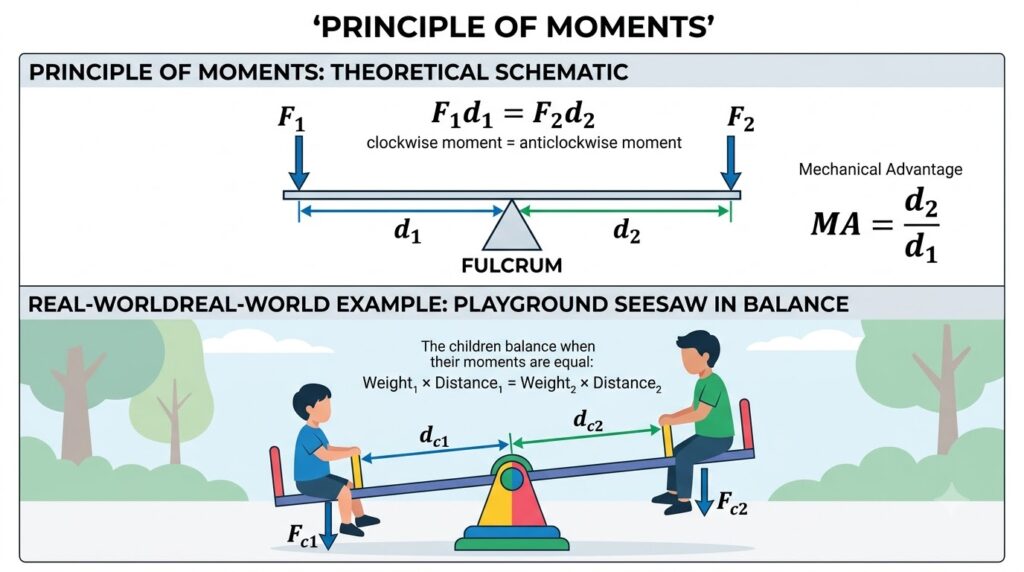
Q28. What is the principle of moments? For a body in rotational equilibrium (lever): F₁d₁ = F₂d₂ (sum of clockwise moments = sum of anticlockwise moments) Load × load arm = Effort × effort arm
Q29. What is mechanical advantage (MA) of a lever? MA = Load/Effort = F₁/F₂ = d₂/d₁ where d₂ = effort arm, d₁ = load arm. MA > 1 when effort arm > load arm.
Q30. What is the centre of gravity? The centre of gravity (CG) is the point where the entire weight (gravitational force) of a body can be considered to act. For a body in a uniform gravitational field, CG coincides with the centre of mass.
Q31. What are the conditions for mechanical equilibrium of a rigid body?
- Translational equilibrium: ΣF = 0 (vector sum of all forces = zero)
- Rotational equilibrium: Στ = 0 (vector sum of all torques = zero)
Q32. What is the cross product (vector product) of two parallel vectors? a × b = 0 (null vector) since sin 0° = 0. Also: î × î = ĵ × ĵ = k̂ × k̂ = 0
Q33. What are the cross products of unit vectors î × ĵ, ĵ × k̂, k̂ × î? î × ĵ = k̂; ĵ × k̂ = î; k̂ × î = ĵ (cyclic rule) And: ĵ × î = −k̂; k̂ × ĵ = −î; î × k̂ = −ĵ (anti-cyclic)
Q34. What is the angular momentum of a particle moving with constant velocity? Constant — as long as the particle moves with constant velocity (no force, no torque), its angular momentum about any point remains constant. (Angular momentum = mvr sin θ = mv × perpendicular distance from the point)
Q35. What is radius of gyration (k)? Radius of gyration is the distance from the axis at which the entire mass could be concentrated to give the same moment of inertia: I = Mk² → k = √(I/M) SI unit: metre (m).
Q36. A flywheel — what is its purpose? A flywheel is a disc with large moment of inertia used in engines. Due to its large I, it resists sudden changes in angular speed, ensuring smooth rotation and preventing jerky motion.
Q37. What is work done by a torque? W = τ × θ (τ = constant torque, θ = angular displacement) Or in differential form: dW = τ dθ
Q38. What is power in rotational motion? P = τω (Analogous to P = Fv in linear motion)
Q39. A girl sitting on a swivel chair stretches her arms. What happens to her angular speed? Stretching arms increases moment of inertia I. By conservation of angular momentum (L = Iω = constant), angular speed ω decreases.
Q40. A ballet dancer pulls her arms in while spinning. What happens? Pulling arms in decreases I, so by conservation of angular momentum (Iω = constant), angular speed ω increases — she spins faster.
Q41. Is the vector product commutative? No. a × b = −(b × a). The vector product is anti-commutative (not commutative). Reversing the order reverses the direction.
Q42. What is the magnitude of a × b? |a × b| = ab sin θ where θ is the angle between vectors a and b.
Q43. What is the direction of a × b? The direction of a × b is perpendicular to the plane containing a and b, determined by the right-hand rule (right-hand screw rule).
Q44. Angular momentum of the Earth around the Sun — is it conserved? Yes. The gravitational force on Earth is directed toward the Sun (along r), so its torque about the Sun (τ = r × F) is zero. Therefore, Earth’s angular momentum about the Sun is conserved (Kepler’s second law).
Q45. What is the dimensional formula of moment of inertia? [ML²] — same as angular momentum per unit angular velocity or torque per unit angular acceleration.
Q46. A motor wheel increases from 1200 rpm to 3120 rpm in 16 s. Find angular acceleration. ω₀ = 2π×1200/60 = 40π rad/s; ω = 2π×3120/60 = 104π rad/s α = (ω − ω₀)/t = (104π − 40π)/16 = 64π/16 = 4π ≈ 12.57 rad/s²
Q47. How many revolutions does the wheel in Q46 make? θ = ω₀t + ½αt² = 40π×16 + ½×4π×256 = 640π + 512π = 1152π rad Revolutions = 1152π / (2π) = 576 revolutions
Q48. What is the expression for torque in terms of perpendicular distance? τ = r⊥ × F where r⊥ is the perpendicular distance from the axis to the line of action of force. Equivalently: τ = Fd (d = moment arm or lever arm).
Q49. What is the angular momentum L for a rigid body rotating about a fixed axis? L = Iω (for symmetric bodies rotating about the symmetry axis, where L is along the axis of rotation)
Q50. What is the relation between torque and angular acceleration (Newton’s second law for rotation)? τ = Iα where τ = net external torque, I = moment of inertia, α = angular acceleration.

2 Mark Questions and Answers (രണ്ട് മാർക്ക് ചോദ്യങ്ങൾ) — System of Particles and Rotational Motion
Q51. Distinguish between translational and rotational motion.
| Property | Translational Motion | Rotational Motion |
|---|---|---|
| Description | All particles have same velocity | Particles move in circles about axis |
| Key quantity | Linear velocity v | Angular velocity ω |
| Inertia | Mass m | Moment of inertia I |
| Newton’s law | F = ma | τ = Iα |
| Momentum | p = mv | L = Iω |
| KE | ½mv² | ½Iω² |
Q52. Explain the concept of centre of mass with an example. Show how it moves under external force. The centre of mass (CM) is a point that moves as if the entire mass of the system is concentrated there and all external forces act on it.
Example: Two balls of mass 1 kg and 3 kg connected by a rod. CM is at 3m × 1/(1+3) = 0.75 m from the 1 kg ball.
Motion of CM: F_ext = M × a_CM (where M = total mass) The CM moves like a point particle of mass M under the net external force, regardless of internal interactions.
Q53. Define and explain torque with examples from daily life. Torque (τ = r × F) is the rotational effect of a force. It depends on the magnitude of force, the perpendicular distance from the axis (moment arm), and their angle.
Examples:
- Opening a door: Push near the edge (large r) requires less force than pushing near the hinge (small r) for the same torque.
- Bicycle pedalling: The force on the pedal at maximum distance from the axle produces maximum torque.
- Spanners: Longer spanner handle → greater torque with same force.
Q54. State the law of conservation of angular momentum and explain a practical example. Law: If the total external torque on a system is zero, total angular momentum L = Iω remains constant.
Example — Figure Skater (or ballet dancer): A skater spinning with arms outstretched has large I and smaller ω. When she pulls her arms in, I decreases. By conservation (Iω = constant), ω increases, and she spins much faster. She can control her spin speed by adjusting her moment of inertia — a perfect demonstration of angular momentum conservation.
Q55. Write all the analogies between linear and rotational motion quantities.
| Linear | Rotational |
|---|---|
| Displacement x | Angular displacement θ |
| Velocity v | Angular velocity ω |
| Acceleration a | Angular acceleration α |
| Mass m | Moment of inertia I |
| Force F | Torque τ |
| Momentum p = mv | Angular momentum L = Iω |
| KE = ½mv² | KE = ½Iω² |
| Work W = Fs | Work W = τθ |
| Power P = Fv | Power P = τω |
| F = ma | τ = Iα |
Q56. A cord is wound on a flywheel (mass 20 kg, radius 0.2 m). A force of 25 N is applied. Find (a) torque (b) angular acceleration. I = MR²/2 = 20 × (0.2)²/2 = 0.4 kg m²
(a) τ = F × R = 25 × 0.2 = 5.0 N m
(b) α = τ/I = 5.0/0.4 = 12.5 rad/s²
Q57. Define moment of inertia. Why does it depend on the axis of rotation? Moment of inertia I = Σmᵢrᵢ² is the sum of mass × (perpendicular distance from axis)² for each particle.
It depends on the axis of rotation because when the axis changes, the perpendicular distances rᵢ of each particle from the axis change. The same body has different I for different axes. Example: A thin rod has I = ML²/12 about its midpoint but I = ML²/3 about one end.
Q58. Derive the expression for kinetic energy of a rotating body (K = ½Iω²). For a rigid body rotating about a fixed axis, each particle (mass mᵢ, at distance rᵢ from axis) has linear speed vᵢ = ωrᵢ.
Total KE = Σ(½mᵢvᵢ²) = Σ(½mᵢω²rᵢ²) = ½ω² × Σ(mᵢrᵢ²) = ½ω² × I
∴ K = ½Iω² ✓
Q59. Explain the conditions for mechanical equilibrium of a rigid body with a relevant example. Two conditions:
- ΣF = 0 (translational equilibrium — no linear acceleration)
- Στ = 0 (rotational equilibrium — no angular acceleration)
Example (seesaw/lever): A seesaw of length 2 m is balanced at its midpoint. Child A (30 kg) sits at one end and child B sits at 1 m from the other end. For equilibrium:
- Στ = 0: 30g × 1 = m_B × g × 1 → m_B = 30 kg
Both conditions ensure the seesaw neither translates nor rotates.
Q60. Explain the principle of moments for a lever. Define load, effort, load arm, effort arm. For an ideal lever in equilibrium: F₁ × d₁ = F₂ × d₂ (Load × load arm = Effort × effort arm)
- Load (F₁): force to be overcome (usually weight of object being lifted)
- Effort (F₂): force applied by the user
- Load arm (d₁): distance of load from fulcrum
- Effort arm (d₂): distance of effort from fulcrum
Mechanical Advantage = F₁/F₂ = d₂/d₁ When d₂ > d₁: MA > 1 → small effort lifts large load (as in a crowbar, bottle opener, etc.).
Q61. Find the centre of mass of a system of two particles: m₁ = 2 kg at x₁ = 0 and m₂ = 3 kg at x₂ = 10 m. x_CM = (m₁x₁ + m₂x₂)/(m₁ + m₂) = (2×0 + 3×10)/(2+3) = 30/5 = 6 m from m₁
The CM is at 6 m from the 2 kg mass, or 4 m from the 3 kg mass.
Q62. Explain rolling motion of a cylinder. Is it purely translational or purely rotational? Rolling motion is a combination of translational motion of the CM and rotational motion about the CM.
For a cylinder rolling without slipping:
- CM translates with velocity v_CM
- Body rotates with angular velocity ω
- Condition for rolling without slipping: v_CM = Rω
- Total KE = ½Mv_CM² + ½Iω² (translational + rotational)
For a solid cylinder: Total KE = ½Mv² + ½(MR²/2)(v/R)² = ½Mv² + ¼Mv² = ¾Mv²
Q63. Two forces of equal magnitude act on a rigid body in opposite directions. Explain whether it is in equilibrium. This is a couple — two equal and opposite forces with different lines of action.
- Translational equilibrium: ΣF = F − F = 0 ✓ (in translational equilibrium)
- Rotational equilibrium: Στ ≠ 0 (both torques act in the same sense, not cancelling)
Therefore, the body is in translational equilibrium but NOT in rotational equilibrium — it undergoes pure rotation.
Q64. Define radius of gyration. Write its expression and give an example. The radius of gyration (k) is the distance from the axis at which the total mass could be concentrated to give the same moment of inertia.
I = Mk² → k = √(I/M)
Example: For a solid disc I = MR²/2: k = √(MR²/2M) = R/√2 ≈ 0.707 R
For a thin ring I = MR²: k = √(MR²/M) = R
The radius of gyration describes how mass is distributed relative to the axis.
Q65. Explain why a diver tucks into a ball when diving from a height. A diver tucking reduces the radius of mass distribution, decreasing moment of inertia I. By conservation of angular momentum (L = Iω = constant), angular velocity ω increases — the diver spins faster, completing more rotations before entering the water.
When the diver straightens out before entering the water, I increases and ω decreases, allowing a clean vertical entry.
Q66. Give a physical explanation of why long handles are used on doors near the edge (away from hinges). Torque = Force × perpendicular distance from axis (hinge).
By placing the handle far from the hinge, the moment arm (lever arm) is maximum. This means for the same torque (needed to rotate the door), a smaller force is required. This is why pushing near the hinge requires much more force than pushing near the edge.
Q67. State and explain the principle of conservation of angular momentum. Give two examples. Statement: When the total external torque on a system is zero, the total angular momentum remains constant: L = Iω = constant.
Example 1 — Figure Skater: A spinning skater extends arms (I increases → ω decreases) or pulls in arms (I decreases → ω increases).
Example 2 — Diver: A diver tucks (I decreases → ω increases) to spin faster; then extends (I increases → ω decreases) for a clean water entry.
Q68. Two forces 7î + 3ĵ − 5k̂ act at position î − ĵ + k̂. Find torque about origin. τ = r × F, where r = î − ĵ + k̂, F = 7î + 3ĵ − 5k̂
Using determinant: | î ĵ k̂ | | 1 −1 1 | | 7 3 −5 |
τ = î[(−1)(−5)−(1)(3)] − ĵ[(1)(−5)−(1)(7)] + k̂[(1)(3)−(−1)(7)] = î[5−3] − ĵ[−5−7] + k̂[3+7] = 2î + 12ĵ + 10k̂ N m
Q69. A rigid body is in mechanical equilibrium. What does this imply about forces and torques? For mechanical equilibrium:
- ΣF = 0 → No net force → No change in linear momentum → No linear acceleration.
- Στ = 0 → No net torque → No change in angular momentum → No angular acceleration.
The body is either at rest or moving with constant velocity (translational) and rotating with constant angular velocity (rotational) — or both at rest.
Q70. Explain why rotation of a rigid body is different from translation in terms of degrees of freedom. Translation: Every particle has the same velocity at every instant → described by 3 components of v_CM → 3 degrees of freedom.
Rotation: About a fixed axis → only 1 degree of freedom (angle θ). About a point → 3 degrees of freedom (Euler angles). For general rotation of a rigid body not fixed at a point → up to 6 degrees of freedom (3 translational + 3 rotational).
3 Mark Questions and Answers (മൂന്ന് മാർക്ക് ചോദ്യങ്ങൾ) — System of Particles and Rotational Motion
Q71. Define angular momentum. Prove that the time rate of change of angular momentum equals the torque acting on the body. Angular momentum: L = r × p = r × mv
Proof: dL/dt = d(r × p)/dt = (dr/dt) × p + r × (dp/dt) = v × mv + r × F (since dr/dt = v and dp/dt = F) = m(v × v) + r × F = 0 + τ (since v × v = 0 for parallel vectors)
∴ dL/dt = τ ✓
This is the rotational analogue of Newton’s second law (F = dp/dt).
Q72. State and prove the law of conservation of angular momentum. Give two practical examples. Statement: If τ_ext = 0, then L = Iω = constant.
Proof: From dL/dt = τ_ext, if τ_ext = 0: dL/dt = 0 → L = constant ✓
Examples:
- Spinning skater: When she pulls her arms in, I decreases. Since Iω = constant, ω increases. She spins faster without any external torque.
- Planetary motion: The gravitational force on a planet is radial (along r), so torque τ = r × F = 0. Hence angular momentum of each planet is conserved → Kepler’s second law (equal areas in equal times).
Q73. Derive the rotational kinematic equations from first principles. For uniform angular acceleration α (constant):
First equation: α = dω/dt → dω = α dt Integrating: ω − ω₀ = αt → ω = ω₀ + αt ✓
Second equation: ω = dθ/dt → dθ = ω dt = (ω₀ + αt) dt Integrating: θ − θ₀ = ω₀t + ½αt² θ = θ₀ + ω₀t + ½αt² ✓
Third equation: Eliminate t using eq. 1: t = (ω − ω₀)/α Substituting into eq. 2: θ = ω₀(ω−ω₀)/α + ½α(ω−ω₀)²/α² 2α(θ − θ₀) = 2ω₀(ω−ω₀) + (ω−ω₀)² = ω² − ω₀² ω² = ω₀² + 2αθ ✓ (taking θ₀ = 0)
Q74. Explain the moment of inertia of different bodies. Write the moments of inertia for ring, disc, rod, and sphere. Moment of inertia I = Σmᵢrᵢ² is the rotational analogue of mass — it measures resistance to angular acceleration.
| Body | Axis | Moment of Inertia |
|---|---|---|
| Thin ring (R) | Centre, ⊥ to plane | MR² |
| Thin ring (R) | Diameter | MR²/2 |
| Thin rod (L) | Centre, ⊥ to rod | ML²/12 |
| Circular disc (R) | Centre, ⊥ to disc | MR²/2 |
| Circular disc (R) | Diameter | MR²/4 |
| Hollow cylinder (R) | Axis | MR² |
| Solid cylinder (R) | Axis | MR²/2 |
| Solid sphere (R) | Diameter | 2MR²/5 |
Key insight: The more mass is distributed away from the axis, the larger I. A ring has larger I than a disc of equal mass and radius (all mass at maximum distance from axis).
Q75. Derive Newton’s second law for rotational motion (τ = Iα). For a rigid body rotating about a fixed axis, the work done by torque τ in angular displacement dθ is: dW = τ dθ
Rate of work done (power): P = τ dθ/dt = τω
Also, KE = ½Iω² Rate of change of KE = d(½Iω²)/dt = Iω(dω/dt) = Iωα
Equating: τω = Iωα ∴ τ = Iα ✓
This is Newton’s second law for rotation: torque is to angular acceleration as force is to linear acceleration.
Q76. A motor wheel (mass = 20 kg, radius = 0.2 m) has a cord wound on it. A 25 N pull is applied. 2 m of cord unwinds. Find (a) angular acceleration (b) work done (c) KE gained. (Disc: I = MR²/2) I = MR²/2 = 20×0.04/2 = 0.4 kg m²
(a) τ = FR = 25 × 0.2 = 5 N m α = τ/I = 5/0.4 = 12.5 rad/s²
(b) Work done = F × distance = 25 × 2 = 50 J
(c) θ = arc length/R = 2/0.2 = 10 rad ω² = 0 + 2αθ = 2 × 12.5 × 10 = 250 rad²/s² KE = ½Iω² = ½ × 0.4 × 250 = 50 J
(Work done = KE gained ✓ — no friction)
Q77. Explain the concept of couple. Show that the torque of a couple is independent of the point of origin. Couple: Two equal and opposite forces F and −F acting at different points. Net force = F + (−F) = 0 (translational equilibrium) But net torque ≠ 0 (causes rotation).
Independence of origin: Let forces −F at point A (position r₁) and F at point B (position r₂).
Torque about origin O: τ = r₁×(−F) + r₂×F = (r₂ − r₁) × F = AB × F
Since AB is the vector from A to B (fixed distance, regardless of where O is), the torque depends only on AB and F, not on the position of O. ∴ Torque of couple is independent of the point of origin. ✓
Q78. Explain centre of gravity. How is it different from centre of mass? Centre of Gravity (CG): The point about which the total gravitational torque on the body is zero. It is where the resultant weight of the body acts.
Centre of Mass (CM): The point where the entire mass can be considered concentrated for studying translational motion.
Difference:
- For a body in a uniform gravitational field (like near Earth’s surface), CG = CM.
- For a body in a non-uniform gravitational field (very large bodies, or near black holes), CG ≠ CM. The CG depends on g at each point, while CM depends only on mass distribution.
Locating CG experimentally: Suspend the body from different points; the vertical lines from each suspension point intersect at the CG.
Q79. Explain the vector product. Write the expression for a × b in component form. Vector product (cross product): a × b = c where:
- |c| = ab sin θ
- Direction: perpendicular to the plane of a and b (right-hand rule)
- a × b = −(b × a) (anti-commutative)
Component form: If a = aₓî + aᵧĵ + azk̂ and b = bₓî + bᵧĵ + bzk̂:
a × b = (aᵧbz − azbᵧ)î − (aₓbz − azbₓ)ĵ + (aₓbᵧ − aᵧbₓ)k̂
Using determinant: |î ĵ k̂ | |aₓ aᵧ az| |bₓ bᵧ bz|
Q80. A rigid body is rotating about a fixed axis with angular speed ω. Derive expressions for: (a) kinetic energy (b) angular momentum (c) power. For a rigid body rotating about fixed axis, each particle (mass mᵢ, distance rᵢ, speed vᵢ = ωrᵢ):
(a) Kinetic energy: K = Σ½mᵢvᵢ² = Σ½mᵢω²rᵢ² = ½ω²Σmᵢrᵢ² = ½Iω² ✓
(b) Angular momentum (for symmetric body): Lz = Σmᵢrᵢ²ω = (Σmᵢrᵢ²)ω = Iω ✓
(c) Power: P = dW/dt = τ(dθ/dt) = τω ✓
These three — K, L, P — are the fundamental quantities in rotational dynamics, analogous to ½mv², mv, and Fv respectively.

5 Mark / Essay Questions and Answers (അഞ്ച് മാർക്ക് ചോദ്യങ്ങൾ)
Q81. (a) Define moment of inertia. (b) Write the physical significance of moment of inertia. (c) Write the moments of inertia of ring, disc, rod, and solid sphere. (d) A ring and disc of same mass and radius roll down an incline. Which reaches the bottom first and why?
(a) Moment of Inertia: I = Σmᵢrᵢ² — sum of (mass × square of distance from axis) for all particles. SI unit: kg m².
(b) Physical significance:
- I is the rotational analogue of mass; it resists angular acceleration (τ = Iα).
- A body with large I requires more torque to achieve the same angular acceleration.
- The value depends on mass, shape, size, and the position/orientation of the axis.
- Used in flywheel design to smooth rotational motion.
(c) Key values:
- Ring (⊥ axis at centre): I = MR²
- Solid disc (⊥ axis at centre): I = MR²/2
- Thin rod (⊥ at midpoint): I = ML²/12
- Solid sphere (diameter): I = 2MR²/5
(d) Rolling down incline: For rolling without slipping, v = √(2gh/(1 + I/MR²))
- Ring: I = MR² → I/MR² = 1 → v_ring = √(gh)
- Disc: I = MR²/2 → I/MR² = 0.5 → v_disc = √(4gh/3)
Since v_disc > v_ring, the disc reaches the bottom first. The ring has more rotational inertia, so more energy goes into rotation and less into translation — it moves slower.
Q82. (a) State law of conservation of angular momentum. (b) Derive it. (c) Explain how a skater uses this principle. (d) A skater (I = 5 kg m²) spins at 2 rad/s. She pulls in arms (I = 2 kg m²). Find new angular speed and change in KE.
(a) If total external torque = 0, then L = Iω = constant.
(b) Derivation: dL/dt = τ_ext. If τ_ext = 0 → dL/dt = 0 → L = Iω = constant. ✓
(c) Skater example: Outstretched arms: large I, small ω. Pull in arms: I decreases, by conservation (Iω = const), ω increases. She can control spin speed by extending/pulling in arms — with no external torque (ice is frictionless).
(d) Numerical: L_initial = I₁ω₁ = 5 × 2 = 10 kg m²/s L_final = I₂ω₂ = 2 × ω₂ = 10 ω₂ = 5 rad/s (spins 2.5 times faster)
KE_initial = ½ × 5 × 4 = 10 J KE_final = ½ × 2 × 25 = 25 J Change in KE = 25 − 10 = +15 J (KE increases — from internal muscular work pulling arms in)
Q83. (a) State Newton’s second law for rotational motion. (b) Derive τ = Iα. (c) Write the analogy table between translational and rotational quantities. (d) A flywheel (I = 4 kg m²) is at rest. A torque of 8 N m is applied. Find angular acceleration, angular velocity and KE after 5 s.
(a) Newton’s Second Law for Rotation: The net torque acting on a body about an axis equals the moment of inertia times the angular acceleration: τ = Iα
(b) Derivation: See Q75 above. τω = Iωα → τ = Iα ✓
(c) Analogy Table:
| Linear | Rotational |
|---|---|
| x (displacement) | θ (angular displacement) |
| v (velocity) | ω (angular velocity) |
| a (acceleration) | α (angular acceleration) |
| m (mass) | I (moment of inertia) |
| F (force) | τ (torque) |
| p = mv | L = Iω |
| F = ma | τ = Iα |
| K = ½mv² | K = ½Iω² |
| W = Fs | W = τθ |
| P = Fv | P = τω |
(d) Numerical (I = 4 kg m², τ = 8 N m, t = 5 s): α = τ/I = 8/4 = 2 rad/s² ω = ω₀ + αt = 0 + 2×5 = 10 rad/s KE = ½Iω² = ½ × 4 × 100 = 200 J
Q84. (a) Define centre of mass. (b) Derive the expression for position of CM of a system of two particles. (c) State properties of CM. (d) Two masses 2 kg and 6 kg are 8 m apart. Find CM from the 2 kg mass. If both move with velocities 3 m/s and 1 m/s toward each other, find velocity of CM.
(a) Centre of Mass (CM): The point that moves as if the entire mass is concentrated there and all external forces act on it.
(b) Derivation for two particles: Mass m₁ at x₁, mass m₂ at x₂. x_CM = (m₁x₁ + m₂x₂)/(m₁ + m₂)
This is the weighted average of positions with mass as weights.
(c) Properties of CM:
- For a system with no external force, CM moves with constant velocity (or stays at rest).
- Internal forces do not affect the motion of CM.
- F_ext = M × a_CM (CM moves like a point particle of total mass M).
- Total linear momentum P = M × v_CM.
(d) Numerical: x_CM = (2×0 + 6×8)/(2+6) = 48/8 = 6 m from 2 kg mass
Taking 2 kg moving in +x direction at 3 m/s and 6 kg moving in −x direction at 1 m/s: v_CM = (m₁v₁ + m₂v₂)/(m₁+m₂) = (2×3 + 6×(−1))/8 = (6−6)/8 = 0 m/s
The CM is at rest! (Total momentum = 0 — equal and opposite momenta)
Q85. (a) Explain rolling motion. (b) Show that total KE of a rolling body = translational KE + rotational KE. (c) Find the velocity of a solid cylinder rolling down from height h without slipping. (d) Compare with a solid sphere rolling from the same height.
(a) Rolling Motion: Combination of translational motion of CM + rotation about CM axis. For rolling without slipping: v_CM = Rω.
(b) Total KE: KE_trans = ½Mv_CM² KE_rot = ½Iω² = ½I(v_CM/R)²
Total KE = ½Mv_CM² + ½I(v_CM/R)² = ½Mv_CM²(1 + I/MR²)
(c) Solid cylinder (I = MR²/2): Using energy conservation: mgh = ½Mv²(1 + I/MR²) = ½Mv²(1 + ½) = ¾Mv² v = √(4gh/3) = √(4gh/3) ≈ 1.15√(gh)
(d) Solid sphere (I = 2MR²/5): mgh = ½Mv²(1 + 2/5) = ½Mv² × 7/5 = 7Mv²/10 v = √(10gh/7) = √(10gh/7) ≈ 1.195√(gh)
Comparison: v_sphere > v_cylinder (sphere is faster), because I_sphere/MR² = 0.4 < I_cylinder/MR² = 0.5. Sphere has smaller rotational inertia relative to its mass, so more translational KE → higher speed.
Additional Important Questions (Kerala Board Previous Year Style)
Q86. Why does a spanner with a longer handle make it easier to tighten a bolt? Torque = Force × perpendicular distance. A longer handle increases the moment arm (lever arm), so the same applied force produces a larger torque, making it easier to rotate (tighten/loosen) the bolt. This is the principle of moments applied to rotational motion.
Q87. Can the angular momentum of a body be zero even if it is moving? Yes. If a body moves along a straight line passing through the reference point, then r and p are parallel (θ = 0°), so L = r × p = rp sin 0° = 0. A particle moving directly toward or away from the origin has zero angular momentum about the origin.
Q88. The angular speed of a motor wheel increases from 1200 rpm to 3120 rpm in 16 s. Find (a) angular acceleration (b) number of revolutions. ω₀ = 1200×2π/60 = 40π rad/s; ω = 3120×2π/60 = 104π rad/s (a) α = (104π − 40π)/16 = 4π rad/s² ≈ 12.57 rad/s² (b) θ = ω₀t + ½αt² = 40π×16 + ½×4π×256 = 640π + 512π = 1152π rad Revolutions = 1152π/(2π) = 576
Q89. What is the difference between torque and couple? Both are torques, but a couple specifically involves two equal and opposite forces with zero net force. A single force produces both translation and rotation; a couple produces only rotation (no translation). The torque of a couple is the same about any point; the torque of a single force changes with the reference point.
Q90. If a uniform disc and a uniform ring of same mass and radius are released from the top of an incline, which reaches the bottom first? v = √(2gh/(1 + I/MR²)) Disc: I/MR² = ½ → v_disc = √(4gh/3) Ring: I/MR² = 1 → v_ring = √(gh) Disc reaches first as v_disc > v_ring.
Q91. A girl sits on a swivel chair. Her friends push her into rotation. She extends her arms. What happens and why? Extending arms increases her moment of inertia I. By conservation of angular momentum (Iω = constant), angular velocity ω decreases — she slows down. If she pulls arms back in, I decreases and ω increases.
Q92. Show that for a particle moving in uniform circular motion, the angular momentum is constant. For uniform circular motion: speed = constant, r = constant. L = mvr sin 90° = mvr = constant (since m, v, r all constant and angle = 90°) Direction: always perpendicular to the plane of motion (fixed). L is constant in magnitude and direction — angular momentum is conserved. ✓ (External torque = 0 since centripetal force is along r, so τ = r × F_centripetal = 0)
Q93. Derive τ = r × F using the definition of angular momentum. L = r × p = r × mv dL/dt = (dr/dt × mv) + (r × m dv/dt) = (v × mv) + (r × ma) = 0 + r × F = τ ✓ (since v × mv = m(v × v) = 0, and ma = F)
Q94. Why are spokes of a bicycle wheel more effective than a solid disc? A bicycle wheel with spokes has most mass (rim) concentrated far from the axis, giving large I. This large angular momentum makes the wheel resist changes in direction (gyroscopic effect), providing stability. Also, spokes are lighter than a solid disc, reducing overall mass while maintaining high I.
Q95. Two particles, each of mass m, are at opposite ends of a rod of length 2L. Find I about an axis through the centre perpendicular to the rod. Also find radius of gyration. I = m×L² + m×L² = 2mL²
Total mass M = 2m k = √(I/M) = √(2mL²/2m) = L
The radius of gyration equals L (half the rod length), which makes physical sense — the masses are exactly at distance L from the axis.
Frequently Asked Questions (FAQ) — Kerala Plus One Physics Chapter 6
- What is moment of inertia? How is it different from mass? (Kerala Board) Moment of inertia I = Σmᵢrᵢ² is the rotational analogue of mass. While mass resists linear acceleration (F = ma), moment of inertia resists angular acceleration (τ = Iα). Unlike mass (a scalar independent of axis), I depends on the axis of rotation and how mass is distributed.
- കണികാ വ്യൂഹത്തിൻ്റെ ദ്രവ്യമാന കേന്ദ്രം (Centre of Mass) എന്നാൽ എന്ത്? (What is Centre of Mass in Malayalam?) ഒരു കണികാ വ്യൂഹത്തിൻ്റെ ദ്രവ്യമാന കേന്ദ്രം ആ ബിന്ദുവാണ്, അവിടെ സമ്പൂർണ ദ്രവ്യമാനം കേന്ദ്രീകൃതമാണ് എന്ന് കരുതപ്പെടുന്നു. R_CM = Σmᵢrᵢ / M
- State the law of conservation of angular momentum. When is it applicable? L = Iω = constant when total external torque τ_ext = 0. Applicable in: spinning skaters, divers tucking/extending, planetary orbits (gravity provides no torque about Sun), gyroscopes.
- What is the analogy between translational and rotational motion? (Plus One Physics Kerala) Displacement↔θ, velocity↔ω, acceleration↔α, mass↔I, force↔torque, momentum↔angular momentum, F=ma↔τ=Iα, K=½mv²↔K=½Iω², P=Fv↔P=τω.
- How does a diver complete more somersaults by tucking? By tucking (pulling limbs close to body), the diver reduces I. By conservation of angular momentum (L = Iω = constant), ω increases — they rotate faster and complete more somersaults. Before entering water, they extend body (I increases, ω decreases) for a clean vertical entry.
- What provides centripetal force for a car turning on a banked road? The horizontal component of normal reaction provides centripetal force (N sin θ = mv²/R), reducing dependence on friction. This is why highways have banked curves at optimal angle v_opt = √(Rg tan θ).
This article covers Kerala Plus One Physics Chapter 6 — System of Particles and Rotational Motion (കണികാ വ്യൂഹങ്ങളും ഭ്രമണ ചലനവും) — with 150+ questions covering Centre of Mass, Torque, Angular Momentum, Moment of Inertia, Rotational Kinematics, and Rolling Motion, following the Kerala Board (SCERT) exam pattern. Visit hsslives.com for chapter-wise solutions for all Plus One and Plus Two subjects.