Plus Two Study Plan 2026-27 Kerala | How to Score 90+ in Board Exam — Complete Guide
Last Updated: July 2026 | 📚 For: Kerala Plus Two 2026-27 Students | ⏱️ Reading Time: 7 minutes
Starting Plus Two and wondering how to score above 90% in the Kerala board exam? This complete Plus Two study plan 2026-27 gives you a realistic, month-by-month schedule, subject-wise strategy, and practical tips that Kerala board toppers follow.
Plus Two board exam result is one of the most important milestones in a Kerala student’s life — it determines college admission, scholarship eligibility, and the foundation for competitive exams. A smart, consistent study plan from Day 1 makes the difference.
ഓർക്കൂ: Plus Two topper ആകണമെങ്കിൽ July 2026 മുതൽ prepare ചെയ്യണം. Last-minute cramming Kerala board-ൽ rarely work ചെയ്യുന്നു — especially Science subjects.
Plus Two Study Plan 2026-27 Kerala — How to Score 90+ in Board Exam
Complete Plus Two study plan 2026-27 for Kerala HSS students. Month-by-month schedule, subject-wise tips, exam strategy & how to score 90+ in Kerala board exam.
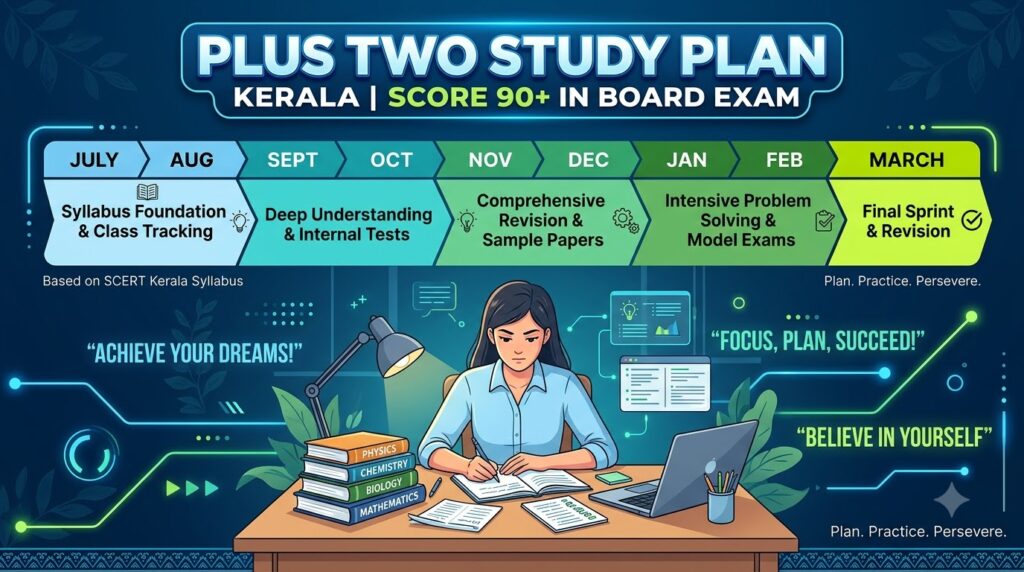
Why Start Preparing Now (July 2026)?
The Kerala Plus Two board exam is in March 2027 — that’s approximately 8 months away. Here’s why starting now matters:
- Science students have 4 subjects with heavy syllabus (Physics, Chemistry, Biology/Maths)
- Kerala board Plus Two has 20-25% derivations/proof-based questions — these take time to master
- NEET/JEE aspirants need to cover Plus One revision too
- Students who start in July consistently outperform those who start in November-December
Subject-wise Study Hours Per Week Recommendation
| Stream | Subject | Hours/Week (Recommended) |
|---|---|---|
| Science | Physics | 5-6 hours |
| Science | Chemistry | 5-6 hours |
| Science | Biology (PCB) | 6-7 hours |
| Science | Mathematics (PCM) | 7-8 hours |
| Commerce | Accountancy | 5-6 hours |
| Commerce | Economics | 4-5 hours |
| Commerce | Business Studies | 3-4 hours |
| Humanities | History | 4-5 hours |
| Humanities | Political Science | 3-4 hours |
| All Streams | Languages (English, Malayalam) | 3-4 hours |
Month-by-Month Study Plan — Science Stream

July 2026 — Foundation Month
Physics: Start from Chapter 1 (Electric Charges). Read SCERT textbook carefully. Make formula notes. Chemistry: Begin with Chapter 1 (Solid State) and Chapter 2 (Solutions). Practice colligative property numericals. Biology/Maths: Start Chapter 1 (Reproduction in Organisms) or Chapter 1 (Relations and Functions). Goal: Complete 2-3 chapters in each subject by end of July.
August 2026 — Building Speed
Physics: Complete Chapters 1-4 (Electrostatics, Current Electricity, Magnetism). Chemistry: Complete Chapters 1-5 (Physical Chemistry section). Biology: Complete Chapters 1-4 (Reproduction, Genetics beginning). Maths: Complete Chapters 1-5 (Relations, ITF, Matrices, Determinants, Continuity). Addition: Start solving chapter-end exercises after finishing each chapter.
September 2026 — Deep Work Month
Physics: Chapters 5-8 (EMI, Alternating Current, EM Waves). Chemistry: Begin Inorganic Chemistry (Chapters 6-9). Biology: Genetics and Molecular Biology (Ch.5, 6) — most important chapters. Maths: Calculus begins — Chapter 5, 6, 7 (Continuity, Derivatives, Integrals). Goal: Complete first half of all subjects by September end.
October 2026 — Second Half Push
Physics: Chapters 9-11 (Ray Optics, Wave Optics, Dual Nature). Chemistry: Start Organic Chemistry (Chapters 10-12) — most important. Biology: Complete Zoology — Human Health, Biotechnology, Ecology. Maths: Complete Integration, Applications, Differential Equations. Addition: Start solving previous year question papers (2020-2024) chapter-wise.
November 2026 — Completion Month
Goal: Complete ALL chapters in all subjects by November 30. Physics: Modern Physics (Atoms, Nuclei, Semiconductors). Chemistry: Amines, Biomolecules, Polymers, Chemistry in Everyday Life. Biology/Maths: Final chapters + catch up on any pending chapters. Focus: No new topics from December — only revision begins.
December 2026 — First Revision
Goal: Complete first full revision of all subjects.
- Read chapter notes (not full textbook) for each chapter
- Revise all formulas and derivations
- Solve 2-3 previous year full papers
- Identify weak areas for second revision focus
January 2027 — Intensive Revision
- Focus on weak chapters from first revision
- Practice all 5-mark questions (derivations, proofs, full accounts)
- Solve 1 full previous year paper every week
- Practice diagrams (Biology) and derivations (Physics) without looking at notes
February 2027 — Mock Tests and Polish
- Solve 2-3 full-length mock tests per week (under exam conditions — 3 hours, closed books)
- Review mistakes after each mock test — don’t just mark the score
- Final revision of formulae, definitions, diagrams
- Start the day with 1-hour revision of any subject
March 2027 — Exam Month
- No new topics
- Light reading of notes each day
- Good sleep (8 hours) — this is non-negotiable
- Eat well — brain function depends on nutrition
- Reach exam centre 30 minutes early
Exam Strategy — How to Write Kerala Board Plus Two Paper
Time Management in 3-Hour Paper:
- Section A (MCQ — 12 marks): 15 minutes
- Section B (2-mark — 16 marks): 25 minutes
- Section C (3-mark — 24 marks): 35 minutes
- Section D (5-mark — 20 marks): 55 minutes
- Revision: 10 minutes
Writing Tips for High Marks:
Section D (5-mark questions):
- Start with a definition/introduction (1-2 lines)
- Use subheadings (H2-style in your answer) — examiners love structure
- Include relevant diagram wherever applicable
- End with a conclusion or significance statement
- Aim for 1 full page per 5-mark answer
Diagrams:
- Use pencil first, then go over with pen
- Label all parts clearly
- Give a proper title below each diagram
- Never draw a rough/messy diagram — examiner deducts marks
Common Mistakes Kerala Plus Two Students Make
❌ Starting preparation in January-February — Too late for Science students ❌ Skipping derivations — “I’ll remember the formula” doesn’t work in Kerala board ❌ Not practicing previous year papers — Kerala board follows patterns; practice reveals them ❌ Ignoring internal assessment — 28 marks in internal can make or break your grade ❌ All-night studying before exam — Sleep deprivation reduces recall significantly
Frequently Asked Questions (FAQ)
Q1: Is 90% possible in Plus Two Kerala board for average students?
Yes. With a consistent study plan starting from July and following the schedule above, students who scored 70-75% in Plus One have achieved 90%+ in Plus Two. Consistency matters more than raw intelligence.
Q2: How many hours per day should Plus Two students study?
A focused 5-6 hours of quality study daily is sufficient. Quality (active recall, problem-solving) beats quantity (passive reading for 10 hours). Take breaks every 45-50 minutes.
Q3: Should I join a coaching centre for Plus Two Kerala board?
For board exams, self-study with good notes is sufficient. Coaching is beneficial if you are also targeting NEET/JEE simultaneously. Choose based on your goals and budget.
Q4: How important is internal assessment (28 marks)?
Very important. Internal assessment (lab work, practicals, viva, activity records) accounts for 28 marks. Scoring 25+ here is very achievable with regular attendance and neat record books — these marks are guaranteed scoring opportunities.
Q5: What time of day is best for studying?
Morning hours (6-9 AM) are generally best for reading new content (fresh brain). Evening hours (5-8 PM) are good for solving problems and revision. Find your peak focus time and stick to it.
Also Read
- ⚛️ Plus Two Physics Notes 2026-27 New Syllabus Kerala
- 🧪 Plus Two Chemistry Notes 2026-27 New Syllabus Kerala
- 🧬 Plus Two Biology Notes 2026-27 New Syllabus Kerala
- 📐 Plus Two Mathematics Notes 2026-27 New Syllabus Kerala
- 🩺 NEET 2027 Preparation Guide for Kerala Students
how to score 90 in Plus Two Kerala board | Plus Two time table Kerala | Plus Two exam preparation tips 2026-27 | Kerala board Plus Two topper tips
Last Updated: July 2026 | Study plan based on Kerala board exam patterns and topper strategies.