
Plus Two Chemistry Notes 2026-27 (New Syllabus) | Kerala SCERT Chapter Wise PDF Download
Last Updated: July 2026 | 📚 Class: Plus Two (Class 12) | 📖 Subject: Chemistry | 🏫 Board: SCERT Kerala
Searching for Plus Two Chemistry Notes 2026-27 based on the latest SCERT Kerala syllabus? This page provides complete chapter-wise Chemistry notes covering Physical, Inorganic, and Organic Chemistry — fully updated for the revised SCERT Plus Two Chemistry textbook 2026-27.
Plus Two Chemistry is one of the most scoring subjects in the Kerala board exam and carries significant weightage in NEET 2027 and KEAM 2027. Students who use well-organized chapter notes consistently score higher than those who rely only on the textbook.
കുറിപ്പ്: Plus Two Chemistry 2026-27-ൽ Organic Chemistry chapters ഏറ്റവും important ആണ്. Board exam-ൽ 40% marks Organic Chemistry-ൽ നിന്ന് വരും. NEET-ൽ ഇത് ഇനിയും കൂടുതൽ ആണ്.
Plus Two Chemistry Notes 2026-27 New Syllabus Kerala PDF
Download Plus Two Chemistry Notes 2026-27 based on new SCERT Kerala syllabus. Chapter-wise Inorganic, Organic & Physical Chemistry PDF notes with NEET tips.
What is Included in These Plus Two Chemistry Notes?
- ✅ All chapters from new SCERT Kerala Plus Two Chemistry textbook 2026-27
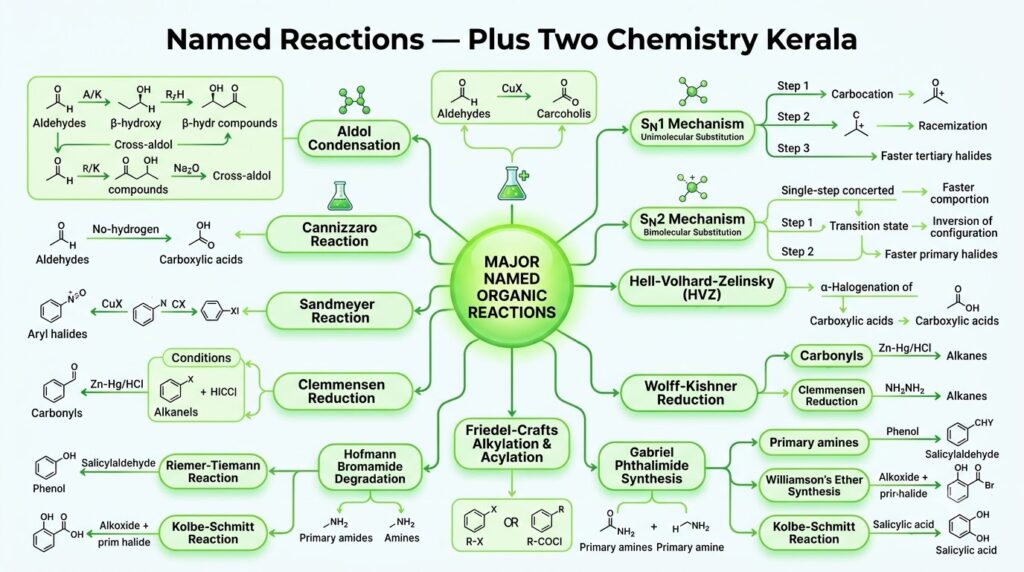
- ✅ All named reactions in Organic Chemistry with mechanisms
- ✅ Important reagents and their uses in each reaction
- ✅ Inorganic Chemistry — preparation, properties, uses for all elements
- ✅ Physical Chemistry numerical problems solved step-by-step
- ✅ NEET-specific concepts highlighted in every chapter
- ✅ PDF format — printable and mobile-friendly
Plus Two Chemistry Chapters 2026-27 — Overview
PHYSICAL CHEMISTRY
Chapter 1: The Solid State
Types of solids, crystal lattice, unit cells, packing efficiency, voids, crystal defects, electrical properties, magnetic properties.
👉 Exam Tip: Packing efficiency calculations for SC (52.4%), BCC (68%), FCC (74%) are must-memorize. Types of defects (Schottky, Frenkel) are regularly asked.
Chapter 2: Solutions
Types of solutions, concentration terms — molality, molarity, mole fraction, Henry’s law, Raoult’s law, colligative properties — vapour pressure lowering, boiling point elevation, freezing point depression, osmotic pressure.
👉 Exam Tip: Colligative property numericals (elevation in BP, depression in FP) are very commonly asked. Van’t Hoff factor for electrolytes must be clear.
Chapter 3: Electrochemistry
Electrochemical cells, Nernst equation, standard electrode potential, EMF, electrolysis, Faraday’s laws, conductance, Kohlrausch’s law, fuel cells, corrosion. 👉 Exam Tip: Nernst equation numerical problems and Faraday’s law calculations are guaranteed in board and NEET. Cell notation and EMF calculation are very important.
Chapter 4: Chemical Kinetics
Rate of reaction, rate law, order of reaction, integrated rate equations (zero order, first order), half-life, Arrhenius equation, activation energy, catalysis.
👉 Exam Tip: First order reaction half-life calculation (t½ = 0.693/k) and Arrhenius equation numericals are very commonly asked. Graph-based questions on order of reaction appear regularly.
Chapter 5: Surface Chemistry
Adsorption — types and isotherms, colloids — types and properties, Tyndall effect, Brownian motion, coagulation, emulsions, catalysis types.
👉 Exam Tip: Difference between adsorption and absorption, types of colloids with examples, and Tyndall effect explanation are important theory questions.
INORGANIC CHEMISTRY
Chapter 6: General Principles and Processes of Isolation of Elements
Occurrence of metals, concentration of ores, extraction methods — roasting, calcination, smelting, refining. Thermodynamic and electrochemical principles. Extraction of Al, Cu, Zn, Fe.
👉 Exam Tip: Ellingham diagram and extraction of specific metals (Al by Hall-Héroult, Fe by blast furnace, Cu by hydrometallurgy) are important. The processes are asked in 5-mark questions.
Chapter 7: The p-Block Elements (Group 15, 16, 17, 18)
Nitrogen family (Group 15) — N₂, NH₃, HNO₃, H₃PO₄. Oxygen family (Group 16) — O₂, O₃, SO₂, H₂SO₄. Halogens (Group 17) — HF, HCl, ClO₂, bleaching powder. Noble gases (Group 18).
👉 Exam Tip: This is one of the longest and most important inorganic chapters. Preparation and properties of NH₃, HNO₃, SO₂, H₂SO₄ are guaranteed questions. Anomalous properties of N and O must be prepared.
Chapter 8: The d and f Block Elements
Electronic configuration of d-block elements, properties — variable oxidation states, colour, magnetic properties, catalytic activity. Preparation and properties of KMnO₄, K₂Cr₂O₇. f-block elements — lanthanoids and actinoids.
👉 Exam Tip: Properties of transition metals, structure and reactions of KMnO₄ and K₂Cr₂O₇ (especially oxidizing power in acidic and basic medium) are frequently asked.
Chapter 9: Coordination Compounds
Terminology, IUPAC nomenclature, Werner’s theory, VBT, CFT (crystal field splitting), isomerism — structural and stereo, stability constants, applications.
👉 Exam Tip: IUPAC naming of coordination compounds is tricky but guaranteed. Crystal field splitting diagram and colour in transition metal complexes explanation are important.
ORGANIC CHEMISTRY
Chapter 10: Haloalkanes and Haloarenes
Nomenclature, methods of preparation, physical and chemical properties, SN1 and SN2 mechanisms, elimination reactions, uses, environmental effects.
👉 Exam Tip: SN1 vs SN2 mechanism comparison is a must-prepare topic. Reactions of haloalkanes with KOH (alcoholic vs aqueous) are very commonly asked.
Chapter 11: Alcohols, Phenols and Ethers
Preparation, properties, reactions of alcohols and phenols. Acidic nature comparison. Williamson synthesis for ethers. Uses.
👉 Exam Tip: Distinction between alcohol and phenol (reaction with FeCl₃), Lucas test, and reactions with Na metal are important. Acid strength order: phenol > alcohol is a common comparison question.
Chapter 12: Aldehydes, Ketones and Carboxylic Acids
Nucleophilic addition reactions (Aldol, Cannizzaro), distinguishing tests (Tollens’, Fehling’s, Benedict’s). Carboxylic acid preparation and reactions.
👉 Exam Tip: Named reactions in this chapter (Aldol condensation, Cannizzaro, Hell-Volhard-Zelinsky) are very frequently asked in board and NEET. Tollens’ and Fehling’s tests for distinguishing aldehyde and ketone are guaranteed.
Chapter 13: Amines
Classification, nomenclature, preparation, properties, reactions, diazonium salts — preparation and reactions, azo dyes.
👉 Exam Tip: Basicity order of amines and Hinsberg’s test for classification are important. Diazonium salt reactions (Sandmeyer, Balz-Schiemann) are must-prepare for NEET.
Chapter 14: Biomolecules
Carbohydrates — classification, monosaccharides, disaccharides, polysaccharides. Proteins — amino acids, structure. Enzymes. Nucleic acids — DNA and RNA. 👉 Exam Tip: Difference between DNA and RNA, peptide bond formation, anomers of glucose (α and β forms), and structures of important biomolecules are very commonly asked.
Chapter 15: Polymers
Classification, addition and condensation polymerization, copolymerization. Important polymers — Nylon, Teflon, Bakelite, natural and synthetic rubber.
👉 Exam Tip: Names, monomers, and uses of important polymers are asked in almost every board and NEET paper. Make a table of polymer → monomer → type → use.
Chapter 16: Chemistry in Everyday Life
Drugs — analgesics, tranquilizers, antiseptics, disinfectants, antacids, antihistamines. Food preservatives, artificial sweeteners, detergents, soaps.
👉 Exam Tip: Classification of drugs with examples and difference between soap and detergent are the most commonly asked topics. Easy marks chapter — don’t skip it.
Download Plus Two Chemistry Notes PDF 2026-27
| Chapter | Topic | Download |
|---|---|---|
| Chapter 1 | The Solid State | Download PDF |
| Chapter 2 | Solutions | Download PDF |
| Chapter 3 | Electrochemistry | Download PDF |
| Chapter 4 | Chemical Kinetics | Download PDF |
| Chapter 5 | Surface Chemistry | Download PDF |
| Chapter 6 | Isolation of Elements | Download PDF |
| Chapter 7 | p-Block Elements | Download PDF |
| Chapter 8 | d and f Block Elements | Download PDF |
| Chapter 9 | Coordination Compounds | Download PDF |
| Chapter 10 | Haloalkanes and Haloarenes | Download PDF |
| Chapter 11 | Alcohols, Phenols and Ethers | Download PDF |
| Chapter 12 | Aldehydes, Ketones and Carboxylic Acids | Download PDF |
| Chapter 13 | Amines | Download PDF |
| Chapter 14 | Biomolecules | Download PDF |
| Chapter 15 | Polymers | Download PDF |
| Chapter 16 | Chemistry in Everyday Life | Download PDF |
Chapter Weightage for Kerala Board + NEET
| High Weightage | Medium Weightage | Easy Scoring |
|---|---|---|
| p-Block (Ch.7) | Electrochemistry (Ch.3) | Surface Chemistry (Ch.5) |
| Aldehydes/Ketones (Ch.12) | Chemical Kinetics (Ch.4) | Polymers (Ch.15) |
| Amines (Ch.13) | Coordination Compounds (Ch.9) | Chemistry in Everyday Life (Ch.16) |
| Haloalkanes (Ch.10) | Solutions (Ch.2) | Biomolecules (Ch.14) |
| d-f Block (Ch.8) | Alcohols/Phenols (Ch.11) |
5 Proven Tips to Score 90+ in Plus Two Chemistry
1. Organic Reactions Notebook:
Create a dedicated notebook for all named reactions in Organic Chemistry (Chapters 10-13). Write the reaction, reagents, conditions, and mechanism. Review this notebook every week.
2. Master Named Reactions:
Aldol, Cannizzaro, Reimer-Tiemann, Sandmeyer, Balz-Schiemann, Hell-Volhard-Zelinsky — these are guaranteed questions in both board and NEET. Know each one perfectly.
3. p-Block in Depth:
Chapter 7 (p-Block) is long but very scoring. Prepare NH₃, HNO₃, SO₂, H₂SO₄ manufacture processes (Contact process, Haber process, Ostwald process) with diagrams.
4. Polymer Table on One Page:
Write all important polymers, their monomers, type (addition/condensation), and uses on one page. This chapter gives guaranteed easy marks.
5. Physical Chemistry — Formula Sheet:
Electrochemistry (Nernst equation), Kinetics (rate laws, half-life), Solutions (colligative properties) — make a formula card and revise daily.
Frequently Asked Questions (FAQ)
Q1: Are these Plus Two Chemistry Notes based on new SCERT Kerala 2026-27 syllabus?
Yes. Fully updated for the revised SCERT Plus Two Chemistry textbook 2026-27.
Q2: How many chapters in Plus Two Chemistry new syllabus Kerala?
There are 16 chapters — 5 Physical Chemistry, 4 Inorganic Chemistry, and 7 Organic Chemistry chapters.
Q3: Which chapters are most important for NEET 2027 from Plus Two Chemistry?
Organic Chemistry (Chapters 10-13), Coordination Compounds, Electrochemistry, and p-Block Elements have the highest NEET weightage from Plus Two.
Q4: Is Plus Two Chemistry easier than Plus One Chemistry?
Plus Two Chemistry has more Organic Chemistry and complex reactions compared to Plus One. However, with a dedicated reactions notebook and daily practice, it becomes very manageable.
Q5: Organic Chemistry-ൽ named reactions എത്ര ഉണ്ട്?
Plus Two has approximately 25-30 named reactions across Chapters 10-13. The most important ones for board exam are Aldol condensation, Cannizzaro, SN1/SN2, and Sandmeyer reaction.
Also Read
- ⚛️ Plus Two Physics Notes 2026-27 New Syllabus Kerala
- 📐 Plus Two Mathematics Notes 2026-27 New Syllabus Kerala
- 🧬 Plus Two Biology Notes 2026-27 New Syllabus Kerala
- 🩺 NEET 2027 Preparation Guide for Kerala Students
-
Plus Two Chemistry Notes New Syllabus Kerala
-
SCERT Plus Two Chemistry Chapter Notes 2026
-
Kerala Plus Two Chemistry PDF Download
-
Plus Two Organic Chemistry Notes Kerala
-
Plus Two Chemistry Notes NEET 2027
Tags: Plus Two Notes, Chemistry Notes, New Syllabus 2026, SCERT Kerala, NEET, Organic Chemistry
Last Updated: July 2026